Issue of the Week: Human Rights, Hunger, Disease, War, Economic Opportunity, Population, Environment, Personal Growth
Published March 1, 2025
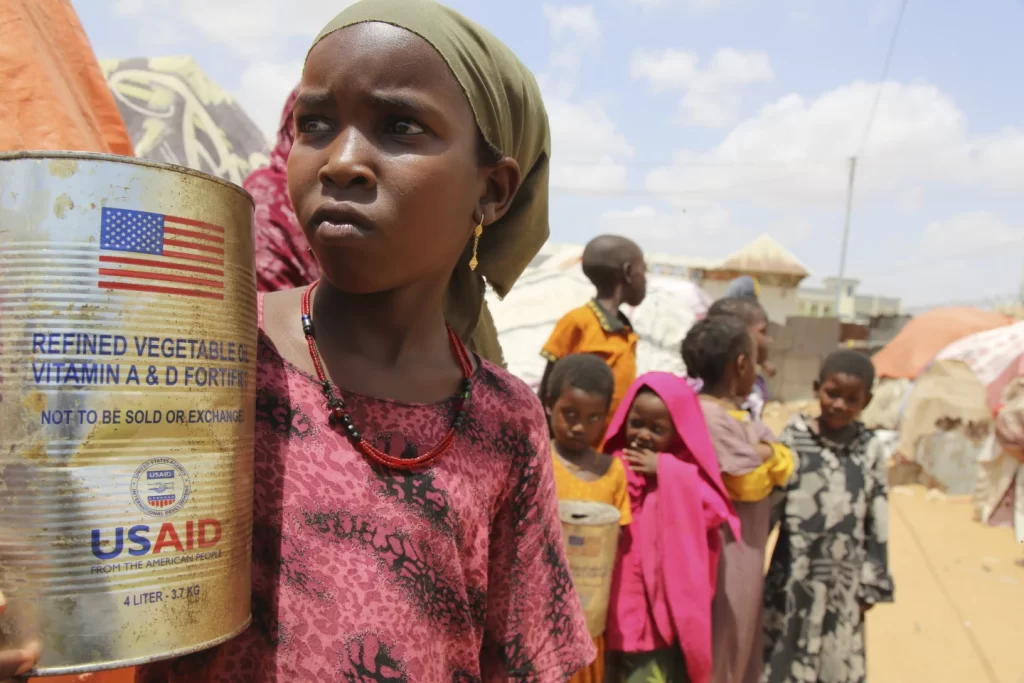
USAID cuts are already hitting countries around the world, AP, March 1, 2025
The End Of Civilization As We Knew It, Part Twenty-Seven–Part 2
We remind once again that we have no partisan motivations in our work and commentary. We have supported the policies of, and been supported by, countless members of both major US political parties for decades. We have praised, parsed, critiqued and raised alarm about the policies of all. Our one concern is to serve humanity and all life, as best we see it, with consistent universal values and intellectual and moral integrity.
It is more than tempting and never more timely to write about the US betrayal of Ukraine, and effecively, abandoning the democratic values and alliances that have created global rules and prevented another world war since the end of World War Two.
Fond as Trump is of saying he wants peace and that others will create World War Three, his playbook is exactly what has always led to world war. The last time “America First” was a slogan it fueled denial of the threat of the Nazis and opposing them forcefully and early to prevent the larger war that ensued. Trump is smarter than many give him credit for and he apparently thinks using the “peace” word as if these are the Vietnam days will ring emotional bells and create cognitive shutdown. As we pointed out in the last post, perhaps the reminder of “peace in our time” from Neville Chamberlain after he left his meeting with Hitler–who promised no more territorial threats in Europe, then promptly invaded Poland–needs hauling out of the historical archive.
Except on another riff from the last post, Trump is acting more like a scenario from sci-fi insanity land where the meeting would have been followed by Chamberlain and the UK becoming allies of Hitler.
Or more to the point, as if Roosevelt dressed down Churchill (read Zelensky) for not appeasing the Nazis while they bombed London and then joined the Nazis (read Putin) as an ally.
It brings to mind someone Trump rarely quotes or refers to, but is still revered by most Republicans and many Americans, Ronald Reagan, and a famous quote.
“…there’s only one guaranteed way you can have peace—and you can have it in the next second—surrender.”
Trump has referred recently to Reagan and Gorbachev, the last leader of the Soviet Union, as his example of why he should negotiate with Putin. Except for a small difference that appears to have escaped him. Gorbachev was a man bringing democratic reform and seeking real peace. He cooperated with the dissolution of the Soviet Union after the events following the fall of the Berlin Wall, honoring the votes of the various nations in the Soviet Union to leave and reclaim their sovereignty–with Ukraine at the top of the list (willing to give up its nuclear weapons largely because of security gurantees from the US, doubtless wishing it hadn’t or there would have been no Russian invasion). The dictator ruling Russia today, Vladimir Putin, who invaded Ukraine in 2014 and again in 2022, was a KGB agent when the Soviet Union was dissolved, who hated Gorbachev, and saw the end of the Soviet Union as the greatest tragedy in history.
David Brooks on the PBS NewsHour provided the most germane quotes one can think of in the wake of the irrational bullying of Ukraine’s President Zelensky by Trump and Vance (who before his conversion, compared Trump to Hitler) and on events leading up to this the week before.
Feb. 28: “I was nauseated, just nauseated. All my life, I have had a certain idea of about America, that we’re a flawed country, but we’re fundamentally a force for good in the world, that we defeated Soviet Union, we defeated fascism, we did the Marshall Plan, we did PEPFAR to help people live in Africa. And we make mistakes, Iraq, Vietnam, but they’re usually mistakes out of stupidity, naivete and arrogance.
They’re not because we’re ill-intentioned. What I have seen over the last six weeks is the United States behaving vilely, vilely to our friends in Canada and Mexico, vilely to our friends in Europe. And today was the bottom of the barrel, vilely to a man who is defending Western values, at great personal risk to him and his countrymen.
Donald Trump believes in one thing. He believes that might makes right. And, in that, he agrees with Vladimir Putin that they are birds of a feather. And he and Vladimir Putin together are trying to create a world that’s safe for gangsters, where ruthless people can thrive. And we saw the product of that effort today in the Oval Office.
And I have — I first started thinking, is it — am I feeling grief? Am I feeling shock, like I’m in a hallucination? But I just think shame, moral shame. It’s a moral injury to see the country you love behave in this way. …
I just wonder where his values are. If he — he clearly has a thing for Vladimir Putin. We have seen that for eight years. And he’s not going to lean on Putin. He’s going to side with Putin, as Timothy Snyder said today. And so maybe that’s just his belief system.
And J.D. Vance has a value system, which is a belief in performance art. What he did was not the act of someone who is a diplomat. It was not the act of someone who’s a statesman. It was not the act of someone who has the faintest hint of responsibility to edge on his president, to just try to do a mano a mano against a man who’s 10 times the man he is, frankly.”
Feb 21: “So let’s start with Ukraine. No one expected Donald Trump to handle global affairs like his predecessors, but he has fully adopted Russia’s false propaganda on Ukraine, calling Zelenskyy a dictator, falsely stating that it was Ukraine that started the war, rhetorically turning against a democracy that was invaded in favor of the invader. What are the implications, David?”
I mean, I think, first, you can say goodbye to NATO. NATO is really built around Article V, the promise we make to each other that we will defend each other, and I don’t think Trump is going to defend anybody else.
But I think the bigger story is a shift in values, that American foreign policy and Western foreign policy has been built around democracy promotion, human dignity, human rights. And so we banded together to sort of promote those causes.
Donald Trump doesn’t see that world that way. He sees the world as a place where ruthless mafiosos get to do what they can. There’s a famous line from the Peloponnesian Wars that strong do what they can, the weak suffer what they must.
And so I think, in Donald Trump’s world there are three ruthless mafioso countries. Russia will have hegemony over its region, we will have hegemony over our region, and China will have hegemony over their region.
And so anything that gets in the way of ruthless mafioso is being eliminated. And some of that is international alliances, but some of this is just the idea that you shouldn’t interfere into other people’s elections, and some of it is the idea that you shouldn’t be able to invade neighboring countries.
And so all those rules are being rewritten by a — somebody who wants to turn all of global affairs into survival of the fittest. …
Look, look at what Donald Trump has been doing to Ukraine over the last week. He sends the Treasury secretary in there, and he hands him a piece of paper said, basically, hand us over 50 percent of your mineral rights. That is, I’m making you an offer you can’t refuse.
That is what — in ancient Rome, they would go into a little country and say, give us all your money or we will kill your women. Like, that was like an imperial power saying, tribute. Give us tribute.”
Brooks then led into our main issue this week in response to the broader issues of Trump policies overall:
“Yes, the people who voted for Trump had a good reason to.
Like, high school-educated people die eight years sooner than college-educated people. High school-educated people, their kids by sixth grade are four grade levels below college-educated people. They’re much more likely to say they’re lonely. They’re much more likely to live in devastated communities without social capital.
[As we’ve noted in the last post and before, a worthwhile repetition here, The Wall Street Journal reported just after the election that if the normal percentage of Democratic voters had voted and not stayed home, Harris would have won–but the abandonment of the working class by Democrats over the years in focus, policy and cultural sensitivity, the prior base from FDR through Carter–keeps taking its toll. Trump’s feral instincts, such as in muddying the reality of his role on taking away women’s right to choice, were also underestimated, just as his promises to immediately fix bread and butter issues such as inflation, were overvalued to put it mildly.]
So, if you had a populist government, they would have policies to address these serious issues. The Trump administration is not leading with that. They really don’t have plans for any of this. And when you look at who’s in the administration, it’s obvious why. The president and Elon Musk are University of Pennsylvania graduates who are billionaires. …
He goes after USAID. He goes after the Forest Service. He goes after the Department of Education. And so it’s all tearing down institutions…
And the problem with that is that the pain is born by the woman in Namibia who’s going to die of AIDS, the kid in Ohio who’s going to die of cancer because NIH, medical research has been gutted. And so it’s — F. Scott Fitzgerald put it well. Rich people are careless. They break things.
And I think that’s what’s happening here.”
So we return here to the issue of the week last week and the issue noted above by Brooks: “He goes after USAID. …And the problem with that is that the pain is borne by the woman in Namibia who’s going to die of AIDS”.
More horror stories about the dismantling of USAID have appeared today.
Ukraine may well be the linchpin of whether or not democracy survives writ large, or whether World War Three occurs. There are other obvious examples, such as the middle east. Or the somewhat off the headlines China these days, the other great power on the planet, which most wants to fill the American void as the great world power, tempted by American behavior more than ever to invade Taiwan as a starting point.
But it may well be that the most likely source of complete global meltdown and multiple wars converging into World War Three will be what may well turn out to be the greatest crime against humanity in history, causing tens to hundreds of millions of lives, in starvation, stunting and mutilation, disease, global pandemics far more lethal than Covid (including a virulent resurgence of AIDS), child, maternal and paternal deaths from lack of health care and on and on–with the poster child being a child holding a can of empty food from USAID with an American flag on it. The American flag that for all its faults has stood for feeding the hungry, treating and preventing disease and providing basic needs and development all over the world–standing now for the equivalent of hate for the billions of the most vulnerable in the world. The ones who start, or are exploited by, revolutions and conflicts and wars in an age of nuclear weapons and other weapons of mass destruction.
Here is an update from our last post on perhaps what may add up in the end to the most inhumane and self-destructive action of any nation in history, in the context of modern history with all its unique global threats–the American dismantling of USAID. Following are three artcles from Pro-Publica, The New York Times and the Associated Press:
The Trump Administration Said These Aid Programs Saved Lives. It Canceled Them Anyway.
The axing of some 10,000 programs has consigned untold numbers of children and refugees to death, officials say. Documents and interviews reveal that the State Department appears to have made the cuts without the careful review it described in court.
by Anna Maria Barry-Jester and Brett Murphy Pro-Publica, March 1, 2025
After the Trump administration moved to freeze nearly $60 billion in foreign aid in January, officials like Secretary of State Marco Rubio repeatedly assured Americans that lifesaving operations would continue. “We don’t want to see anybody die,” he told reporters in early February.
Aid organizations the world over scrambled to prove their work saved lives, seeking permission from the State Department and the U.S. Agency for International Development to continue operating.
The administration conceded that many programs prevent immediate death and should remain online: field hospitals in Gaza, an HIV drug supplier for the Democratic Republic of Congo, Syrian refugee food programs, health clinics that combat Ebola in Uganda and most of the landmark President’s Emergency Plan for AIDS Relief, known as PEPFAR.
In late January, Rubio and one of his top aides, Peter Marocco, said those programs and dozens of others could continue, granting them temporary waivers while the officials conducted what they have called a “targeted, case-by-case review” of all foreign aid programs managed by the State Department and USAID. That review, they said, would take three months.
Four weeks later, on Wednesday, Rubio and Marocco completely ended nearly 10,000 aid programs in one fell swoop — including those they had granted waivers just days earlier — saying the programs did not align with Trump’s agenda. The move consigns untold numbers of the world’s poorest children, refugees and other vulnerable people to death, according to several senior federal officials. Local authorities have already begun estimating a death toll in the hundreds of thousands.
Now, as the administration faces multiple lawsuits challenging its actions, the court fights largely hinge on whether government officials deliberated responsibly before cutting off funding. The U.S. has also refused to pay almost $2 billion that the government owes aid organizations for work they’ve already completed.
Rubio and Marocco appear to have taken their dramatic steps without the careful review they’ve described to the courts, according to internal documents and interviews with more than a dozen officials from the State Department and USAID, which raises fresh questions about the legality of President Donald Trump’s evisceration of the American foreign aid system.
Current and former officials say that Marocco and Rubio cut critical programs without consulting contract officers, who have oversight of individual programs and are aid groups’ primary contacts. “None of us believe that they’re conducting a careful, individualized review,” one official said.
In an episode that highlights how cursory and haphazard their efforts appear to have been, Marocco and Rubio ordered the cancellation of contracts, including for cellphone service, at an office they do not control. The move stranded people in war zones without phones, according to multiple officials and internal correspondence obtained by ProPublica. On Wednesday, AT&T received a termination notice for a $430,000 contract with USAID’s Office of Inspector General. That office is meant to be independent from USAID so that it can effectively audit the agency.
For more than 24 hours, OIG staff, including people in Ukraine and Haiti, did not have access to their government phones. No one at the OIG, including contract officers, knew it was coming, according to the officials. “This is an urgent issue for us, as we have OIG staff in warzones with no ability to receive security alerts,” a senior official in the agency wrote in an email to the company.
Eventually USAID reversed the termination.
Current and former officials throughout USAID and the State Department said the breakneck pace, lack of input from key officials, mistaken cancellations and boilerplate language in Wednesday’s termination notices undermine Marocco’s claims of a deliberative process.
“It’s a pretext,” one USAID official told ProPublica. “The review was supposed to take 90 days. An actual review based on substance requires laying out a process with guidelines, identifying info on each project, and selecting working groups to review. Any review they did was fake.”
If that turns out to be the case, legal experts and government officials say, the administration will have defied a federal judge’s order in a brazen gambit to continue dismantling USAID.
The morning after the mass termination notices went out, a senior USAID official sent an email saying Marocco and Rubio had canceled awards for essential services that the agency now wanted reinstated, telling staff, “We need your immediate input on any awards that may have been terminated that contain essential services related to the safety, security, and operations of USAID staff,” according to a court filing.

Since the initial decision to suspend foreign aid, humanitarian organizations and labor groups have taken the government to court, arguing that only Congress can dismantle USAID and that Trump’s blanket actions are unconstitutional. The government has told the courts that it has the right to cancel contracts, dismiss staff and reorganize USAID to align with Trump’s agenda.
Earlier this month, a federal judge issued a temporary restraining order prohibiting USAID and the State Department from following Trump’s executive orders to stop all foreign aid and to force the agency to pay its bills. When it didn’t comply, the judge issued another order, giving the government until midnight Wednesday to pay what it owes to aid groups.
On Wednesday, the Supreme Court temporarily paused the last order over unpaid bills to conduct further legal review. That same day, aid organizations around the world began receiving termination notices.
More than 90% of USAID’s global aid operations and half of those managed by the State Department received termination notices. The move is already putting children and refugees in gravely dangerous situations. The administration canceled almost 50 United Nations Population Fund projects worth more than $370 million, including programs to address maternal deaths and gender-based violence in Egypt, Nigeria and several other member nations around the world.
In early February, the nonprofit Alight received waivers for its programs supporting refugees in war-torn Sudan, Somalia and South Sudan. On Wednesday, they were all terminated.
Alight runs six centers for extremely malnourished children in Sudan, where the organization treats babies and infants so sick that they will die within hours without ongoing care. The centers cost about $120,000 a month to operate. Alight is trying to fundraise to keep them open, knowing that the day they close their doors, children will die, CEO Jocelyn Wyatt told ProPublica.
In the meantime, they have been forced to close other lifesaving programs. In Somalia, around 700 malnourished children visited Alight clinics every day for weight check-ins and to pick up special food. Thirteen health clinics and a mobile unit served around 1,200 patients a day. On Thursday, all of those clinics closed, Wyatt said.
Alight also shuttered 33 primary health clinics in Sudan and stopped providing water to three refugee camps that house people displaced by decades of war. Alight had kept all those programs running these past five weeks, even though the organization hasn’t received any payments since Trump took office.
“We believed when Rubio said that there was no intention of cutting emergency lifesaving services that would basically cause immediate death,” said Wyatt. “We trusted that those would be protected.”
One of the State Department’s highest-ranking humanitarian aid officials, Jennifer Davis, stepped down this week, according to her resignation letter, which was obtained by ProPublica. During a meeting earlier this week, Davis, the principal deputy assistant secretary of the agency’s refugees bureau, told staff she believed she was bound by the judge’s order to restore programs and their funding, according to an attendee. “She was in tears about it,” the attendee said. (Davis did not respond to a request for comment.)
The State Department, USAID and the White House did not respond to a detailed list of questions for this story. The State Department did not make Rubio available for an interview. Marocco also did not respond to questions.
By Thursday, hundreds of workers had returned to USAID’s former headquarters, where the name has been removed from the building facade, to collect their personal items. They left with boxes and suitcases. Some were crying. Dozens of people cheered and rang bells each time someone exited the building; many of them had recently lost humanitarian aid jobs as well.
“This is more than lost jobs. We’re losing the sector,” a former USAID employee said through tears as she waited for her allotted 15-minute time window to pick up her belongings. “The U.S. government is losing its influence. We’re now more unsafe as a country.”
In the early hours of Feb. 13 at a refugee camp in northern Syria, two armed men wearing masks and police uniforms broke into offices and a warehouse for the aid group Blumont, stealing more than $12,000 worth of laptops and other supplies the U.S. government had already paid for. Because the organization hadn’t received any funds since Trump took office, it no longer had personnel at the camp full time and had paused all its U.S.-funded work except a daily bread delivery.
The armed theft was the result of the U.S. not paying its bills, the group told USAID officials, according to an internal agency email obtained by ProPublica.
Shortly after the incident, the government started paying Blumont’s invoices and the aid group brought back staff and food services that had received a waiver. It is one of the few programs still online and receiving money.
Prior to Jan. 20, the U.S. spent about $60 billion on nonmilitary humanitarian and developmental aid each year — far more than any other country in total dollars, but less than 1% of the federal budget. The vast majority of that money is managed by USAID and the State Department. A network of aid organizations carry out the work, which is funded by Congress.
Since Trump took office, Marocco and Rubio have not only halted foreign aid, laid off thousands of workers and put many more on administrative leave, they have also stopped paying bills for work that has already been done. In one of several lawsuits related to the administration’s dismantling of USAID, aid groups are suing the federal government over the mass program closures and unpaid bills. It was that case that led federal district court Judge Amir Ali to order the administration to settle those bills, which by Feb. 13 totaled nearly $2 billion, according to figures Marocco gave the court. Almost none of it has been paid, the court filings show.
U.S. taxpayers will also be on the hook for interest and damages from the unpaid bills and broken contracts, legal experts told ProPublica.
Organizations have struggled to get through the opaque waiver process, and programs that succeeded were often so strapped for cash because the government hadn’t reimbursed them that they remained inoperative. Medicines that were already purchased by U.S. taxpayers are languishing in warehouses instead of being delivered to the people who need them, several contractors told ProPublica.
On Wednesday, as Chief Justice John Roberts temporarily paused the district court’s order to the federal government to pay its bills, the administration told the court it had terminated 5,800 of the 6,300 foreign aid programs that USAID administered. The government also shuttered 4,100 programs managed by the State Department, about 60% of the total.
In Marocco’s own testimony to the court on Feb. 18 about the process, he said that senior staff and political appointees choose “specific awards” to be evaluated for termination or suspension. He said he personally examines the program and any potential consequences of terminating it before making final recommendations to Rubio.
But USAID staff say that subject-area experts and key personnel who are responsible for the programs were not involved in many terminations, while most others had already lost their jobs.
In the case of the phone contract for the OIG office, for example, the contract officers had no idea the termination notices were coming, officials said. Those officers are specially trained in contract law and regulations to manage these agreements and make sure the government is in compliance. But they were cut out of the process and only learned about it from AT&T, according to the officials and internal emails obtained by ProPublica. (AT&T did not respond to a request for comment.)
The one-page notice to the telecom giant said that Rubio and Marocco had “determined your award is not aligned with Agency priorities and made a determination that continuing this program is not in the national interest.” The notice added: “Immediately cease all activities.”
The notice came as an emailed PDF and not through the normal file management and correspondence system, which led multiple OIG officials to question whether anyone even looked at the contract’s basic information, like its statement of work, much less conducted a careful review.
David Black, an attorney specializing in government contracts, said that the law requires contract officers to approve termination notices and that the episode with the OIG raises questions about Marocco’s claims in court about careful reviews. “It suggests the process was done very hastily,” he said.
On the ground, in the places where the aid kept starvation at bay and deadly viruses in check, program directors say there will now be little to stop those threats.
“What really bothers me is that we’re just looking at numbers, we’re not thinking about real people who are actually going to suffer the consequences of these terminations,” said Dr. Anja Giphart, the acting president of the Elizabeth Glaser Pediatric AIDS Foundation, which had HIV programs terminated in Eswatini, Lesotho and Tanzania.
Pulling treatment away from pregnant women means children will be infected with HIV in the weeks ahead, Giphart said. And doing it so suddenly means other governments and donors don’t have the opportunity to step in. Half of children who are undiagnosed and untreated for HIV die before their first birthday. “We don’t have the luxury of waiting months and months to get this back on track again,” she said.
In Uganda, Baylor College of Medicine Children’s Foundation, which is funded by USAID, treats tens of thousands of patients for HIV and tuberculosis. In addition, it has for years been one of the only organizations in the country that helps contain Ebola outbreaks — including the current one, which has so far killed two people and infected at least eight others. Earlier this month, the U.S. government issued the foundation a waiver and said it could continue its lifesaving work.
So those who run the foundation were shocked to receive a termination notice hours later. The foundation’s executive director, Dr. Dithan Kiragga, told ProPublica his staff had just begun contact tracing patients with Ebola. He said they will likely now have to halt all U.S.-funded operations and hope that the Uganda health ministry can step in.
“The patients will be told that we are closing,” Kiragga said. “They’ve relied on our systems and support for quite a few years. We saved lives.”
ProPublica plans to continue covering USAID, the State Department and the consequences of ending U.S. foreign aid. We want to hear from you. Reach out via Signal to reporters Brett Murphy at 508-523-5195 and Anna Maria Barry-Jester at 408-504-8131.
Maryam Jameel and Ashley Clarke contributed reporting.
Filed under —
I report on global public health and the agencies that govern it, including the NIH, IHS, USAID and CDC.
I welcome tips from people with knowledge of public health at the local, state, federal and international level, including scientists, government officials and advocates, and anyone who knows about issues that affect the public’s health.
I’m a Pulitzer Prize-winning reporter on ProPublica’s national desk, where I write about the government, companies and power.
. . .
U.S.A.I.D. Memos Detail Human Costs of Cuts to Foreign Aid
The world is likely to see millions more malaria infections and 200,000 cases of paralytic polio each year, according to an agency whistle-blower.

By Apoorva Mandavilli, The New York Times
March 2, 2025
The Trump administration’s decision to withdraw foreign aid and dismantle the U.S. Agency for International Development is likely to cause enormous human suffering, according to estimates by the agency itself. Among them:
- up to 18 million additional cases of malaria per year, and as many as 166,000 additional deaths;
- 200,000 children paralyzed with polio annually, and hundreds of millions of infections;
- one million children not treated for severe acute malnutrition, which is often fatal, each year;
- more than 28,000 new cases of such infectious diseases as Ebola and Marburg every year.
Those stark projections were laid out in a series of memos by Nicholas Enrich, acting assistant administrator for global health at U.S.A.I.D., which were obtained by The New York Times. Mr. Enrich was placed on administrative leave on Sunday.
In one memo, he placed the blame for these potential health crises on “political leadership at U.S.A.I.D., the Department of State, and D.O.G.E., who have created and continue to create intentional and/or unintentional obstacles that have wholly prevented implementation” of aid programs.
Those leaders have blocked payment systems, created new and ineffective processes for payments, and constantly shifted guidance regarding which activities qualify as “lifesaving,” Mr. Enrich wrote.
Another memo describes the slashing of the agency’s global health work force from 783 on Jan. 20 to fewer than 70 on Sunday.
In an interview, Mr. Enrich said he released the memos on Sunday afternoon, after an email arrived placing him on leave, to set the record straight on the gutting of U.S.A.I.D. staff and the termination of thousands of lifesaving grants.
By detailing the series of events behind the scenes, he hoped “it’ll be clear that we were never actually given the opportunity to implement lifesaving humanitarian assistance.”
Officials at the State Department did not immediately respond to a request for comment.
In January, the Trump administration froze funds intended for foreign aid. On Jan. 28, Secretary of State Marco Rubio issued a temporary waiver for lifesaving humanitarian assistance.
But very little money has actually been delivered, essentially shuttering aid programs worldwide and forcing hundreds of organizations to furlough or fire workers.
Still, employees in U.S.A.I.D.’s Bureau for Global Health tried to remain optimistic and “to do everything we can” to implement the waivers, Mr. Enrich said.
But on Wednesday the Trump administration abruptly terminated some 5,800 projects financed by U.S.A.I.D., including many that had received waivers.
“It was finally clear that we were not going to be implementing under that waiver,” Mr. Enrich said.
“I needed for myself and all the staff who had been pouring their hearts into doing this — we needed records to show what had happened,” he said.
Mr. Enrich said he had hoped to compile one more memo, showing the ways in which he and others had conveyed the risks of disrupting crucial programs to Mark Lloyd and Tim Meisburger, political appointees at the agency. But they repeatedly asked for more details to justify the programs, he said.
“It is clear the Trump administration is well aware that it is violating court orders and not delivering lifesaving aid it claimed to be funding under a waiver,” said Matthew Kavanagh, director of the Georgetown University Center for Global Health Policy and Politics.
“Unless reversed, this will cost millions of lives, by the government’s own accounting,” Dr. Kavanagh added.
According to Mr. Enrich’s memo, other devastating impacts could include uncontrolled outbreaks of mpox and bird flu, including as many 105 million cases in the United States alone, rising maternal and children’s mortality in 48 countries, and a 30 percent increase in drug-resistant tuberculosis.
Disruption to TB programs overseas will result in more patients arriving in the United States, Mr. Enrich’s memo warned. Treating one patient with multidrug-resistant TB costs more than $154,000 in the United States.
(The Trump administration is said to be readying plans to turn back migrants on the grounds that they might bring TB into the country.)
The memos also note the disruption to the effort to contain Ebola in Uganda.
A single Ebola patient in New York in 2014 cost the city’s Health Department $4.3 million in response measures. The outbreak in Uganda appeared to be ebbing, but a 4-year-old boy died earlier in the week, indicating that the virus was still circulating.
The consequences may extend beyond human health, affecting U.S. businesses — including agriculture — and families by increasing health care costs, disrupting international trade and straining domestic resources.
Programs for maternal and child health and for nutrition can stabilize the economy and political climate in other countries, the memo notes.
“Article 1 of the Constitution gives Congress the power to create or remove agencies and authorize spending, not the president,” Dr. Kavanagh said.
By dismantling U.S.A.I.D. and terminating its programs, the Trump administration is not only “risking death for millions of the most marginalized around the world, but they are also triggering a constitutional crisis in the service of cruelty,” Dr. Kavanagh added.
Apoorva Mandavilli reports on science and global health, with a focus on infectious diseases, pandemics and the public health agencies that try to manage them. More about Apoorva Mandavilli
See more on: U.S. Politics, Agency for International Development
. . .
USAID cuts are already hitting countries around the world. Here are 20 projects that have closed
BY SAM MEDNICK, WILSON MCMAKIN AND MONIKA PRONCZUK, March 1, 2025, Assocaited Press
DAKAR, Senegal (AP) — Countries around the world already are feeling the impact of the Trump administration’s decision to eliminate more than 90% of foreign aid contracts and cut some $60 billion in funding. Hours after the announcement earlier this week, programs were shuttered, leaving millions of people without access to life-saving care.
Some 10,000 contracts with the U.S. Agency for International Development were terminated on Wednesday, in letters sent to nongovernmental organizations across the globe.
The letters said that the programs were being defunded “for convenience and the interests of the U.S. government,” according to a person with knowledge of the content who spoke on the condition of anonymity because they were not authorized to speak publicly on the issue.
Many of the programs are in fragile countries that are highly reliant on U.S. aid to support health systems, nutrition programs and stave off starvation. Other major issues like fighting terrorism, human and drug trafficking, including fentanyl, and monitoring and aiding migrants will also suffer as a result of the U.S. cuts, U.N. spokesman Stephane Dujarric said.
Here some key projects around the world that AP has confirmed have closed:
- In Congo, aid group Action Against Hunger will stop treating tens of thousands of malnourished children from May, which the charity said will put the children in “mortal danger.”
- In Ethiopia, food assistance stopped for more than 1 million people, according to the Tigray Disaster Risk Management Commission. The Ministry of Health was also forced to terminate the contract of 5,000 workers across the country focused on HIV and malaria prevention, vaccinations and helping vulnerable women deal with the trauma of war.
- In Senegal, the biggest malaria project closed. It distributed bed nets and medication to tens of thousands of people, according to a USAID worker who was not authorized to speak to the media. Maternal and child health and nutrition services also closed. They provided lifesaving care to tens of thousands of pregnant women and treatment that would have prevented and treated acute malnutrition.
- In South Sudan, the International Rescue Committee closed a project providing access to quality health care and nutrition services to more than 115,000 people.
- In Colombia, program shuttered by the Norwegian Refugee Council left 50,000 people without lifesaving support including in the northeast, where growing violence has precipitated a once-in-a-generation humanitarian crisis. It included food, shelter, clean water and other basic items for people displaced in the region.
- In war-torn Sudan, 90 communal kitchens closed in the capital, Khartoum, leaving more than half a million people without consistent access to food, according to the International Rescue Committee.
- In Bangladesh, 600,000 women and children will lose access to critical maternal health care, protection from violence, reproductive health services and other lifesaving care, according the United Nations Population Fund.
- In Mali, critical aid, such as access to water, food and health services was cut for more than 270,000 people, according to an aid group that did not want to be named for fear of reprisal.
- In northern Burkina Faso, more than 400,000 people lost access to services such as water. Services for gender-based violence and child protection for thousands are also no longer available, according to an aid group that did not want to be named for fear of reprisal.
- In Somalia, 50 health centers servicing more than 19,000 people a month closed because health workers are not being paid, according to Alright, a U.S aid group.
- In Ukraine, cash-based humanitarian programs that reached 1 million people last year were suspended, according to the spokesperson for the U.N. secretary-general.
- In Afghanistan, hundreds of mobile health teams and other services were suspended, affecting 9 million people, according to the U.N. spokesperson.
- In Syria, aid programs for some 2.5 million people in the country’s northeast stopped providing services, according to the U.N. secretary-general. Also in the north, a dozen health clinics, including the main referral hospital for the area, have shut down, said Doctors Without Borders.
- In Kenya, more than 600,000 people living in areas plagued by drought and persistent acute malnutrition will lose access to lifesaving food and nutrition support, according to Mercy Corps.
- In Haiti, 13,000 people have lost access to nutritional support, according to Action Against Hunger. The cuts will affect in total at least 550,000 people who were receiving aid.
- In Thailand, hospitals helping some 100,000 refugees from Myanmarhave shuttered, according to aid group Border Consortium.
- In Nigeria, 25,000 extremely malnourished children will stop receiving food assistance by April, according to the International Rescue Committee.
- In the Philippines, a program to improve access to disaster warning systems for disabled people was stopped, according to Humanity & Inclusion.
- In Vietnam, a program assisting disabled people through training caregivers and providing at home medical care stopped, according to Humanity & Inclusion.
- In Yemen, 220,000 displaced people will lose access to critical maternal health care, protection from violence, rape treatment and other lifesaving care, according the United Nations Population Fund.
—
Associated Press writers Sylvie Corbet in Paris, France, Robert Badendieck in Istanbul, Turkey, Evelyn Musambi in Nairobi, Kenya, Thalia Beaty in New York and Edith Lederer at the United Nations contributed to this report.
Mednick is the West and Central Africa reporter for the Associated Press. She focuses on conflict, humanitarian crises and human rights abuses.
Pronczuk covers 22 countries across Central and West Africa for The Associated Press. She is based in Dakar, Senegal.
To be continued.
Recent Posts
- “The War in Ukraine Has Now Gone On Longer Than World War I”, The New York Times
- “A Crime Doesn’t Make a Child an Adult”, The Atlantic
- Issue of the Week: Human Rights
- Armenia’s pro-Europe party wins election and cements shift away from Russia
- “The Interview: Scott Pelley on the Bari Weiss Era and His Last Days at ‘60 Minutes’”, The New York Times
Archives
- June 2026
- May 2026
- April 2026
- March 2026
- February 2026
- January 2026
- December 2025
- November 2025
- October 2025
- September 2025
- August 2025
- July 2025
- June 2025
- May 2025
- April 2025
- March 2025
- February 2025
- January 2025
- December 2024
- November 2024
- October 2024
- September 2024
- August 2024
- July 2024
- June 2024
- May 2024
- April 2024
- March 2024
- February 2024
- January 2024
- December 2023
- November 2023
- October 2023
- September 2023
- August 2023
- July 2023
- June 2023
- May 2023
- April 2023
- March 2023
- February 2023
- January 2023
- December 2022
- November 2022
- October 2022
- September 2022
- August 2022
- July 2022
- June 2022
- May 2022
- April 2022
- March 2022
- February 2022
- January 2022
- December 2021
- November 2021
- October 2021
- September 2021
- August 2021
- July 2021
- June 2021
- May 2021
- April 2021
- March 2021
- February 2021
- January 2021
- December 2020
- November 2020
- October 2020
- September 2020
- August 2020
- July 2020
- June 2020
- May 2020
- April 2020
- March 2020
- February 2020
- January 2020
- December 2019
- November 2019
- October 2019
- September 2019
- August 2019
- July 2019
- June 2019
- May 2019
- April 2019
- March 2019
- February 2019
- January 2019
- December 2018
- November 2018
- October 2018
- September 2018
- August 2018
- July 2018
- June 2018
- May 2018
- April 2018
- March 2018
- February 2018
- January 2018
- December 2017
- November 2017
- October 2017
- September 2017
- August 2017
- July 2017
- June 2017
- May 2017
- April 2017