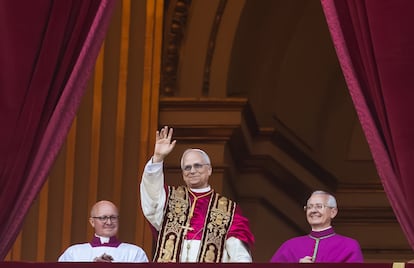
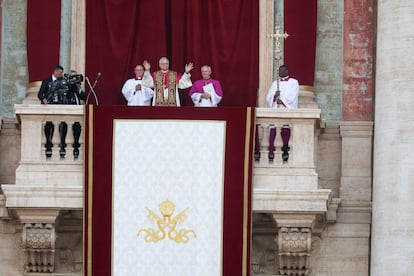
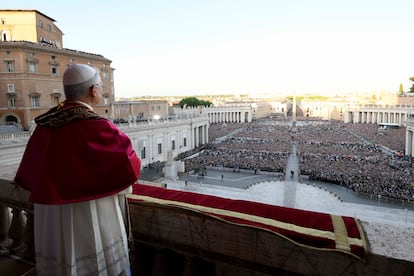
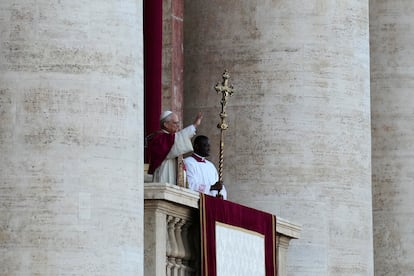
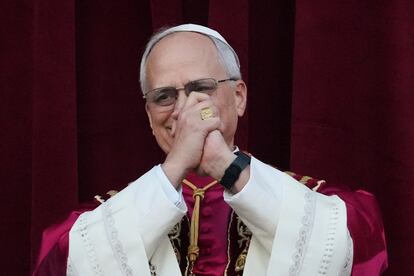
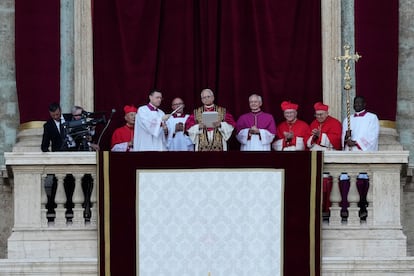
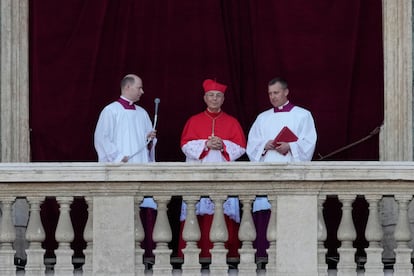
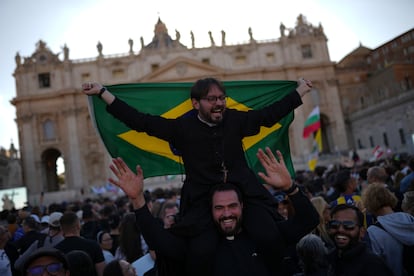
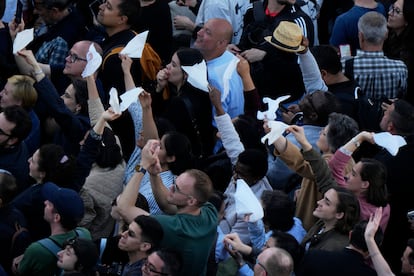
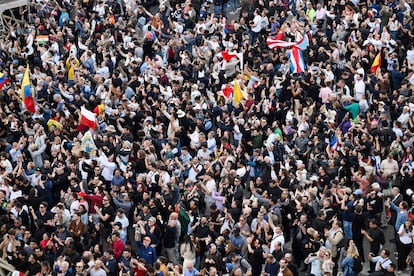
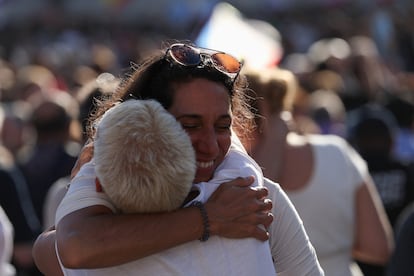
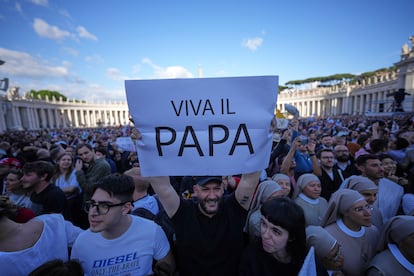
Pope Leo XIV on the central balcony of St. Peter’s Basilica on Thursday.Credit…Gianni Cipriano for The New York Times
The passing of Pope Francis was a stunning experience after his eventful papacy since 2013, even though it clearly seemed imminent. Even more stunning was the choice of the next pope.
One thing we, and it seemed everyone, was sure of, was that the conclave of Roman Catholic Cardinals would not choose an American as the next Pope. We were all wrong. And we should have known better. It could only be an American.
The pivotal, critical, decisive moment in history we are in demanded a gravitas and power balance to the chaos, risks to human rights, human needs, inequality and threats to democracy in global policy determined by America more than any other nation, that only an American pope, with substantial global experience focused on the have-nots and threats to the planet, could bring.
We said we would return to the impact of Francis in the post on his passing, and we will, just as we will return to comment more extensively on the election of Leo the 14th–subjects that are interlinked. For now, however, we restrict ourselves to the extensive coverage of the subject.
The New York Times noted: “The election of Cardinal Robert Francis Prevost, a native of Chicago, as pope represents a singular moment in the history of the Roman Catholic Church in the United States. But some of the cardinals who selected him said his life of service to the poor in Peru and his senior roles at the Vatican mattered far more in the conclave than his nationality.”
Anyone who has spent time at the Vatican, much less in unique behind the scenes historic moments, knows that what is publicly seen and heard is generally not the whole story, to say the least. The inevitable singular impact of an American pope by itself invites understatement, and this particular choice was much influenced by the global experience and nature of the man chosen. His background and history made an enormous difference. But he is an American. An American pope. And that provides both the opportunities and challenges that nothing else could.
How will he handle all the issues before him and what the story of his papacy will be in the end, no one knows. The story must tell itself.
Here are a number of articles from The New York Times, USA Today, El Pais (Updated May 18):
Pope Leo XIV Echoes Francis in His First Mass, Aligning Himself With ‘Ordinary People’
In his advocacy of the poor, migrants and a more open church, many people see the new pope as a continuation of his predecessor.
Jason Horowitz, Elizabeth Dias and Emma Bubola reported from Rome and the Vatican City.
May 9, 2025
Leo XIV, the first pope from the United States, presided over his first Mass as leader of 1.4 billion Roman Catholics on Friday, pledging to align himself with “ordinary people” and not with the rich and powerful. He also called for missionary outreach to help heal the “wounds that afflict our society.”
The election of Cardinal Robert Francis Prevost, a native of Chicago, as pope represents a singular moment in the history of the Roman Catholic Church in the United States. But some of the cardinals who selected him said his life of service to the poor in Peru and his senior roles at the Vatican mattered far more in the conclave than his nationality.
At a news conference in Rome on Friday, some cardinals said discussion of Cardinal Prevost’s American background was, in the words of Cardinal Robert McElroy, the new archbishop of Washington, D.C., “almost negligible.”
The conclave was not a “continuation of the American election,” said Cardinal Wilton Gregory, archbishop emeritus of Washington, D.C. He added, “It was a desire to strengthen the Christian faith among God’s people.”
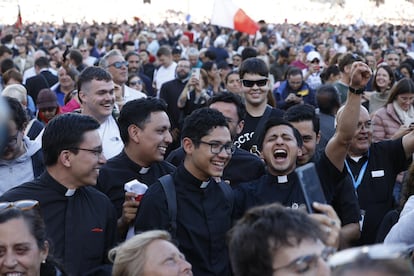
Peruvians in the city of Chiclayo on Thursday celebrated the cardinal’s election as pope.Credit…Marco Garro for The New York Times
In Leo’s persistent advocacy for the poor, migrants and a “synodal” church that seeks input from parishioners rather than simply directing them, many people saw a continuation of his predecessor, Pope Francis, though Leo is seen as quieter and less charismatic.
“It matters a lot that we have a pope and a spiritual leader whose heart is for migrants,” Cardinal Pablo Virgilio Siongco David of the Philippines said at the news conference. “And I think he will sustain the direction of Pope Francis.”
Risky but inevitable predictions of what kind of papacy his will be were plentiful, inside and outside the church.
Pope Leo will soon confront questions that deeply divide Roman Catholics, like greater involvement of lay people and women in decision-making, and a more welcoming view of divorced people and gay people. Francis took steps in each of those directions, even weighing the ordination of married priests under limited circumstances. Those positions earned the animosity of conservative traditionalists who wanted a more top-down, doctrinaire Catholicism.
American church leaders rebutted any suggestion that Leo’s election should be seen in a U.S. political context, but he could find himself at odds with the rightward turn of the United States under President Trump, particularly on migrants.
Asked if the cardinals who supported the new pope saw him as a counterweight to Mr. Trump, Cardinal Timothy M. Dolan, archbishop of New York, shrugged.
“Would he want to build bridges to Donald Trump? I suppose,” he said at the news conference in Rome. “But he would want to build bridges with the leaders of any nation.”
Pope Leo XIV on the central balcony of St. Peter’s Basilica on Thursday.Credit…Gianni Cipriano for The New York Times
Like many in the church’s hierarchy, as a cardinal, Leo was criticized over his handling of priests accused of sexual abuse, both in Chicago and in Peru. The ongoing fallout from such cases around the world, and the church’s history of covering them up, is likely to be another major challenge of his papacy, as they were for each of the three previous popes. (In 2012, the cardinal spoke out against popular culture that accepted “homosexual lifestyle.”)
Leo XIV is a member of the Order of St. Augustine, a group known for missionary outreach to communities and wide consultation in decision-making, both within the order and with parishioners.
“That’s very interesting for a pope, because it means that he is geared toward collaborative decision making,” said Sister Gemma Simmonds, an author and senior research fellow at the Margaret Beaufort Institute of Theology at Cambridge University.
The last pope named Leo is remembered for his 1891 encyclical Rerum Novarum, criticizing capitalist excesses and the wretched state of the working class. Some analysts and prelates read a connection to that history in Leo XIV’s choice of a name.
“We might have a Rerum Novarum 2.0,” said Cardinal Blase J. Cupich, the archbishop of Chicago.
At the Sistine Chapel on Friday, where his fellow cardinals had elected him a day earlier, the new pope evoked the teachings of Francis in his Mass, saying that a loss of religious faith had contributed to “appalling violations of human dignity” around the world.
Echoing Francis’ frequent criticism of prelates who revel in their trappings and put themselves above their flock, Leo said it was cardinals’ duty to “move aside” and “to make oneself small.”
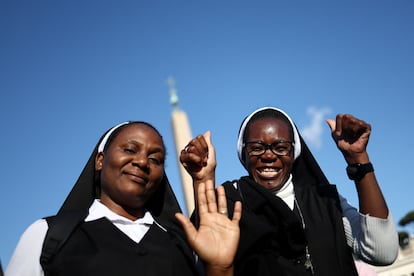
Worshipers in Chiclayo, Peru, after the pope’s selection.Credit…Marco Garro for The New York Times
In his homily, he also lamented that in many spheres, Christianity is seen as “absurd, meant for the weak and unintelligent.” He spoke of settings where, rather than faith and service, “other securities are preferred, like technology, money, success, power or pleasure.”
The new pope worked for more than 20 years in Peru, where he was hailed this week as an almost-native son. As a young friar at the Augustinian mission in the northwestern town of Chulucanas, “one of the things he did is to insist that the leadership of the mission becomes Indigenous,” said John Allen, a veteran Vatican analyst. That fact may have made an impression on an increasingly diverse College of Cardinals that ultimately selected Leo.
Leo later returned to Peru as bishop of Chiclayo, a post for which he became a Peruvian citizen. Priests there recalled that he often traveled deep into the hinterlands to meet people, listening to them at length, and that when there was a backlash against migrants who had fled Venezuela, Bishop Prevost organized clergy and lay people to care for them.
Many analysts had said the election of a pope from the United States was unlikely, with much of the world already seeing the country as wielding excessive power, but Leo’s long history outside the country might have made that less of an issue.
The contrast to President Trump, however, is obvious. A social media account under Cardinal Prevost’s name had reposted messages critical of the president’s positions on issues like immigration, mass deportation, gun control and climate change.
And in February, the social media account had a riposte to comments by Vice President JD Vance, who asserted on Fox News that Christian theology could justify turning away migrants and strangers in need because caring for family comes first.
“You love your family and then you love your neighbor, and then you love your community, and then you love your fellow citizens in your own country, and then after that, you can focus and prioritize the rest of the world,” Mr. Vance said.
The cardinals electing a new pope to lead the Roman Catholic Church left the Sistine Chapel exhausted and hungry.
A meditation to start the conclave had dragged on and pushed their first vote deep into Wednesday evening. It had resulted in an inconclusive tally, with three main contenders. Keeping their vow of secrecy, they returned to Casa Santa Marta, the guesthouse where they were sequestered without their phones, and started talking.
Over dinner, as one gluten-free cardinal picked over vegetables and others shrugged at the simple fare, they weighed their choices. Cardinal Pietro Parolin, 70, the Italian who ran the Vatican under Pope Francis, had entered the conclave as a front-runner but hadn’t received overwhelming support during the vote. The Italians were divided, and some of the cardinals in the room had become bothered by his failure to emphasize the collaborative meetings that Francis prioritized for governing the church.
Cardinal Peter Erdo of Hungary, 72, backed by a coalition of conservatives that included some African supporters, had no way to build momentum in an electorate widely appointed by Francis.
That left Cardinal Robert Francis Prevost, 69 — a quiet American dark horse who had, surprisingly, emerged in the evening’s vote — as a source of particular interest.
Cardinal Pietro Parolin of Italy, Cardinal Peter Erdo of Hungary and Cardinal Robert Francis Prevost of the United States became the front-runners during the conclave.Credit…Michal Cizek/Agence France-Presse — Getty Images; Peter Lakatos/EPA, via Shutterstock; Riccardo De Luca/Associated Press
A missionary turned religious order leader, turned Peruvian bishop, turned Vatican power player, he checked many of the boxes that a broad range of cardinals hoped to fill. His seeming ability to be from two places at once — North and South America — pleased cardinals on two continents. As the prelates sounded out the Latin American cardinals who knew him well, they liked what they heard.
During the dinner, Cardinal Prevost avoided any obvious politicking or machinations, cardinals said. By the next morning, he had transformed into an unsuspecting juggernaut who ultimately left little room for rival candidacies and ideological camps.
“You begin to see the direction and say, ‘Oh my goodness, I’m not going to use my five days’ worth of clothes,’” joked Cardinal Pablo Virgilio Siongco David of the Philippines. “It’s going to be resolved very fast.”
Interviews with more than a dozen cardinals, who could divulge only so much because of secrecy rules that carry the penalty of excommunication, and accounts from Vatican insiders told the story of how Cardinal Prevost became Pope Leo XIV. The swift, stunning and taboo-smashing consensus around an American unfamiliar to many outside the church came on Thursday among an unwieldy College of Cardinals with many new members who didn’t know one another. They had different interests, languages and priorities, but a single choice.
Building Support
After the death of Francis on April 21, cardinals from around the world began arriving in Rome. They joined powerful players in the Vatican who ran the church’s bureaucracy, including Cardinal Prevost, whose career Francis had boosted.
Despite his intimate understanding of the Vatican, Cardinal Prevost was still among the newbies, having been a cardinal not even for two years. And he had questions about the conclave.
He turned to one of the reported front-runners, Cardinal Luis Antonio Gokim Tagle of the Philippines, for help.
“‘How does this work?’” the American said, according to Cardinal Tagle, who recounted the conversation. “I had experience in a conclave,” Cardinal Tagle said, “and he didn’t.”
Cardinal Parolin, Cardinal Luis Antonio Tagle and Cardinal Prevost attending a Mass held for Francis last month. Credit…Antonio Masiello/Getty Images
Unlike Cardinal Tagle, he also didn’t have the name recognition considered necessary in an election among so many new cardinals who barely knew one another. Without a high profile or obvious base of support, the Chicago-born Villanova graduate moved below the radar.
“I didn’t even know his name,” Cardinal David of the Philippines said.
But Cardinal Prevost was not a complete unknown. As the former leader of the Order of St. Augustine, which operates around the globe, and as the head of the Vatican office overseeing the world’s bishops, he had developed powerful connections and backers. First among them had been Francis, who put his career on the fast track. And his decades in Peru, fluent Spanish and leadership of the Pontifical Commission for Latin America gave him deep, and decisive, relationships on the continent.
“We almost all know him. He’s one of us,” said Cardinal Baltazar Enrique Porras Cardozo of Venezuela, who has known him for decades.
In the weeks before the conclave, the cardinals participated in a series of private meetings to discuss their concerns about the future of the church. Unlike Francis, who made his mark with a short speech sharing his vision for the church, several cardinals said that Cardinal Prevost’s remarks did not stand out. “Like everyone else,” said Cardinal Juan José Omella Omella of Spain.
Cardinal Jean-Paul Vesco of France, the archbishop of Algiers,also could not recall what the American had said, but he got to talk to him on the sidelines of the meetings — which was important, he said, because he was increasingly being talked about as a candidate based on his “incredible” résumé, fluent Italian, reputation as a moderate and connection to Francis. The cardinal started asking around to people who had worked with the American to vet him, and learned that he listened and worked well in groups. “I did my job,” Cardinal Vesco said. “I have to vote. I have to know the person.”
Cardinal Wilton Gregory of the United States also said that Cardinal Prevost had engaged “quite effectively” in the smaller group discussions with cardinals.
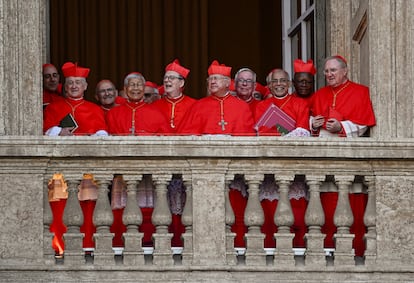
Cardinals leaving a meeting ahead of the conclave, in Rome last Monday. Many of the important conversations to determine the new pope happened on the sidelines. Credit…Murad Sezer/Reuters
Those more intimate settings played to Cardinal Prevost’s strengths, as he had gained a reputation around Rome as a studiously prepared, collegial and organized collaborator, especially as a top Vatican department head.
“I just admire the way he runs a meeting,” Cardinal Blase J. Cupich of Chicago, his hometown, said. “I mean, that’s hard to do, when you’ve got people of different language groups and cultures, and you’re trying to advise a pope on who should be a bishop, and you’re listening to all those people.”
On Saturday, May 3, five days before the conclave, the cardinals drew lots and assigned key roles. With 127 of the 133 who ultimately voted in attendance, Cardinal Prevost was chosen to assist in running the daily meetings before they were sequestered and voting began.
As the different factions argued in those daily meetings about the future direction of the church, the cardinals from the Americas seemed to coalesce around him.
Cardinal Timothy M. Dolan of New York, an outspoken and gregarious figure, said he tried to get to know his fellow American better at a breakfast.
Cardinal Gerhard Ludwig Müller of Germany noted an electoral base that seemed to be forming, saying, “it’s a good number of cardinals from South America, North America.”
Cardinal Porras of Venezuela said that cardinals from Latin America and the United States seemed on the same page about Cardinal Prevost. “When you have friendship first,” he said, “everything is easier.”
The more the cardinals learned about Cardinal Prevost, the more they liked, cardinals said. “Bob, this could be proposed to you,” Cardinal Joseph W. Tobin of Newark, N.J., said he told Cardinal Prevost soon before the conclave began.
Cardinal Prevost had a lot of the experience they were looking for, said Cardinal Vincent Nichols of England. He had the heart of a missionary, scholarly depth and knowledge of the world. He had run a diocese as a bishop, which put him in close contact with parishioners, but had also worked in the Curia, the Roman bureaucracy that helps govern the church.
It did not escape the cardinals, Cardinal Nichols said, that Cardinal Parolin, the Vatican’s top diplomat, who was being pushed by his supporters in and out of the conclave, had deep experience only in the church bureaucracy.
“We’re not stupid,” he said.
Quickly Shifting Fortunes
On Wednesday, after a long and solemn procession into the Sistine Chapel, the cardinals gathered at their assigned seats and took their vows. Just before 6 p.m. the doors closed for the beginning of the conclave.
The meditation at the start, remarks on the gravity of the task at hand, ran about an hour, so long that Cardinal Parolin, who was running the conclave, asked them if they wanted to call it a night and delay the first vote until the next morning.
“We didn’t have dinner, and there were no breaks — toilet breaks — either,” said Cardinal David of the Philippines, but the group decided that it wanted a vote.
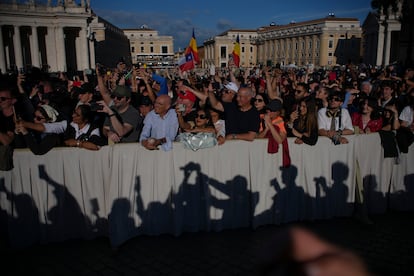
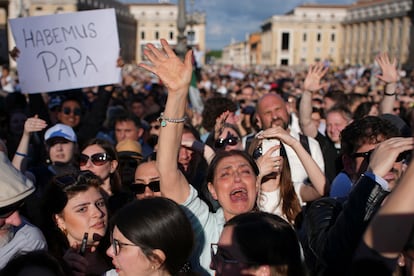
As voting got underway around 7:30 p.m., the delay, with no explanation to the outside world, caused a stir among the waiting crowds. It seemed perhaps that the cardinals had already picked a pope who was getting dressed to come out onto the balcony.
Instead, the first vote that night amounted to what Cardinal Omella of Spain called “a bit of a preliminary poll.”
“In the first vote, there were several candidates who won significant votes,” Cardinal Lazarus You Heung-sik of South Korea said, according to the South Korean news agency Yonhap. Vatican insiders said that those candidates included Cardinals Parolin, Erdo and Prevost.
That’s when the cardinals returned to the guesthouse and started discussing the strengths and weaknesses of the men.
“Once we’re in Santa Marta, there was talk about individual candidates,” Cardinal Nichols of England said. “That’s what we’re supposed to do.”
Cardinal Müller of Germany, a prominent conservative critic of Francis whom the late pope had fired from his position as the church’s top doctrinal official, said he talked to the Latin Americans about Cardinal Prevost and was told that he was “not divisive.”
The climate for Cardinal Prevost seemed to be growing increasingly positive. The election was coming to him.
The next morning’s votes — the second and third of the conclave — made the picture clear.
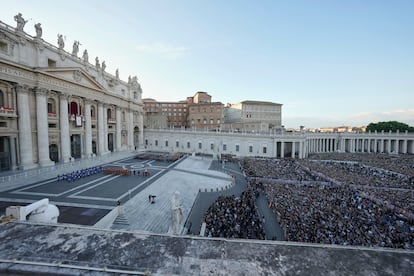
St. Peter’s Basilica on Thursday. For many of those outside, the end of the conclave was unexpectedly swift. Credit…Hannah McKay/Reuters
“In the fourth vote, the ballots overwhelmingly shifted” to Cardinal Prevost, Cardinal You of South Korea said.
Cardinal Müller sat behind the American front-runner in the Sistine Chapel and noticed that he seemed calm. Cardinal Tagle, who sat next to Cardinal Prevost, noticed him taking deep breaths as votes amassed in his favor.
“I asked him, ‘Do you want a candy?’ and he said ‘Yes,’” Cardinal Tagle said.
During one of the votes, Cardinal Tobin, as he held his ballot high and put it in the urn, turned and saw Cardinal Prevost, whom he had known for about 30 years.
“I took a look at Bob,” Cardinal Tobin of New Jersey said, “and he had his head in his hands.”
Later in the afternoon, they voted again, then counted the ballots one by one. When Cardinal Prevost reached 89 votes, the two-thirds majority threshold needed to become pope, the room erupted in a standing ovation. “And he remained seated!” Cardinal David said. “Somebody had to pull him up. We were all teary-eyed.”
As the counting continued and the votes for Cardinal Prevost neared triple digits, Cardinal Parolin had to ask them to sit down so they could finish.
“He obtained a very, very large majority of votes,” Cardinal Désiré Tsarahazana of Madagascar said.
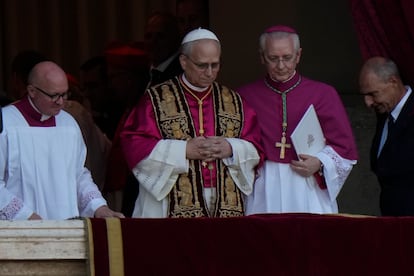
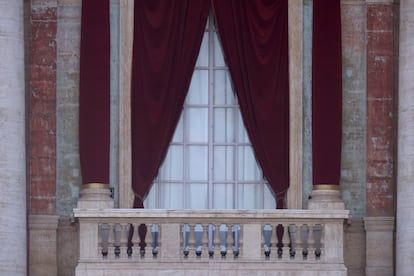
After his election, cardinals enthusiastically congratulated the new pope. A short and uncontentious conclave was over and Leo XIV stepped through the crimson curtains onto the balcony of St. Peter’s Basilica and the world stage.
Cardinal Tagle, the onetime favorite who days earlier had been asked by the American about the rules, told him: “‘If there’s anything you want to change about the conclave rules — it’s all in your hands now.’”
The white smoke that signaled Pope Leo XIV’s election.Credit…Christopher Furlong/Getty Images
Aie Balagtas See contributed reporting from Manila; Josephine de La Bruyère from Vatican City; and Choe Sang-Hun from Seoul.
Jason Horowitz is the Rome bureau chief for The Times, covering Italy, the Vatican, Greece and other parts of Southern Europe.
As many celebrate Cardinal Robert Francis Prevost‘s historic selection as pope, the world’s largest organization for clergy sexual abuse victims is worried about the pontiff’s past handling of sexual abuse cases and called on him to take a tougher stance on the issue that has long plagued the Roman Catholic Church.
The Survivors Network of those Abused by Priests (SNAP), a network that says it represents more than 25,000 victims and supporters worldwide, released a statement on the day of Pope Leo XIV’s selection expressing “grave concern” and urging him to “enact a truly universal zero tolerance law for sexual abuse and cover-up.”
The Chicago-born pontiff was chosen to lead the Vatican on May 8, just one day after the conclave to pick a successor to the late Pope Francis began. Prevost, 69, was born and raised in Chicago but went on to spend most of his career in Peru, first as a missionary and then as a bishop. He is a dual U.S.-Peruvian citizen.
Prevost’s ascension resurfaced concerns about his record on clergy sexual abuse during his tenure in Chicago and in Peru, including that he failed to do enough to address victims’ allegations.
The Vatican has denied Prevost engaged in any wrongdoing, and the former cardinal has drawn plaudits in other cases for helping address abuse threats. He has also advocated for more transparency on the topic from the church.
In an interview with the Peruvian newspaper La Republica, he denounced clergy sexual abuse and urged victims to come forward. In Peru, he helped dissolve an ultra-conservative Catholic movement Sodality of Christian Life after investigations uncovered years of sexual abuses, corruption and mismanagement, according to the Vatican News.
Still, survivors are worried he will not take a tough enough stance to eradicate abuse within the church.
Cases in Chicago, Peru spur questions of accountability and transparency
While Prevost led the Augustinians in Chicago in 2000, a priest whose former ministry years earlier had been restricted over allegations of child abuse, moved into an Augustinian monastery near a Catholic elementary school. Church officials at the time failed to notify the school and, according to the Chicago Sun-Times, church records even claimed there was no school nearby.
In 2006, the Illinois attorney general added the priest, James Ray, to its public list of “abusive clerics and religious brothers,” claiming there were 13 reported survivors between 1974 and 1991. The Vatican has denied that Prevost permitted Ray to live at the monastery.
Prevost also faces allegations of inaction in connection with his time in northwestern Peru. While he served as a bishop in Chiclayo in 2022, three woman came forward with allegations that they were sexually abused by two priests beginning in 2007 when they were minors.
The victims said in a public statement that Prevost failed to thoroughly look into the allegations. They said, “no investigation was carried out, nor were the precautionary measures for the protection of the faithful, boys and girls … the case was filed and archived,” according to the National Catholic Reporter.
Two months before Prevost was elected pope, SNAP filed a complaint against him with the Vatican, claiming he failed to open an investigation and “sent inadequate information to Rome.”
Civil authorities in Peru closed the case after the statute of limitations had passed. The Dicastery for the Doctrine of the Faith, which investigates cases of clergy sexual abuse, closed the case in 2023.
In a public letter, the Diocese of Chiclayo said accusations that the former cardinal “remained silent in face of the complaints … is not true.” The Vatican has also denied any wrongdoing by Prevost.
Prevost helped bring down abusive Catholic group in South America
Pedro Salinas, a Peruvian journalist who wrote a bombshell expose on the Sodalitium of Christian Life in 2015, said Prevost played “an extremely important role” in the Catholic movement’s dissolution.
Leaders of the ultra-conservative group founded in Peru had faced widespread allegations of corruption as well as physical, psychological and sexual violence, including against minors.
In January, Prevost and Pope Francis, who had long paid close attention to the case, met with Jose Enrique Escardo, one of the group’s victims who spoke out against the movement and its abuses. Pope Francis dissolved the movement weeks before he died, according to the Vatican News.
“It was a stunning and extremely rare outcome,” said Bishop Accountability, a victims advocacy group in a statement after Prevost was elected pope. “Yet punishing abusers isn’t heroic — it’s moral and decent. We pray we see more of this decisive action by Prevost when he is pope.”
Speaking to the media on May 8, Bishop Carlos García Camader, the head of Peru’s bishops’ conference, praised Prevost’s work with abuse survivors, saying he “opened the way here in Peru to listen to the victims, to organize the truth commission” against the Sodalitium of Christian Life.
In public statements, Prevost has stated firmly that he stands against sex abuse in the church. In the 2019 interview with La Republica, he encouraged victims of abuse to come forward and said he supported more transparency from the church.
“We reject the cover-up and secrecy, that does a lot of damage, because we have to help the people who have suffered from the bad act,” he said, later adding, “On behalf of the Church, we want to tell people that if there was any offence, if they suffered or are victims of the bad actions of a priest to come and denounce it, to act for the good of the Church, of the person and the community.”
. . .
Leo XIV: The first pope from the United States, a figure in the spirit of Francis
Robert Francis Prevost, 69, an Augustinian and former bishop in Peru, represents the triumph of continuity — but with the added assurance of strong governance and doctrinal solidity.
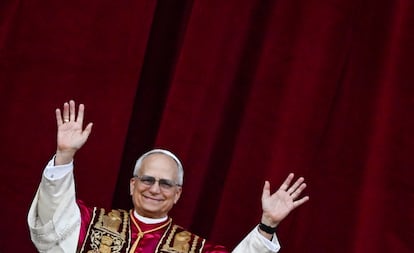
Leo XIV, during his first appearance as Pope on the central balcony of St. Peter’s Basilica. MASSIMILIANO MINOCRI
Leo XIV, Robert Francis Prevost, 69, became the first pope from the United States on Thursday. The Church has placed Prevost — a conciliatory, soft-spoken Augustinian with a humble demeanor — at the forefront in the face of growing polarization fueled by Donald Trump and the rise of populist politics in the United States and around the world.
His first words were a call for peace, delivered to a crowd unsure of who stood before them, as he remains largely unknown: “Peace be with you all.” His election marks a continuation of Pope Francis’s legacy.
Prevost, who also holds Peruvian citizenship, was the quiet favorite of the Church’s more progressive wing, yet garnered widespread support thanks to his pragmatic, centrist profile. He offers conservatives the reassurance of solid governance and doctrinal stability. A calm and steady figure, Pope Leo XIV faces the task of easing the tensions that deeply divided the Church leading up to the conclave.
Having spent decades in Peru as a bishop, Prevost bridges the global North and South — a middle path following Francis, who was Argentine — while remaining within the American continent. His father was of Italian descent, his mother of Spanish heritage, and Iberian cuisine was a staple in their home. In his first address, he spoke a few words in Spanish and paid tribute to his former diocese in Chiclayo, Peru.
Prevost’s mixed heritage made him the safest yet most original choice among Western candidates, given many cardinals’ reluctance to take bold risks by selecting names from Asia or Africa. This was despite the fact that the conclave was the most international in history, with representation from 71 countries — and with the global South now forming a majority.
His choice of papal name, meanwhile, evokes Leo XIII, who served from 1878 to 1903 and opened the Church to dialogue with modernity, as well as to social and labor issues. Doctrinally, Prevost has been a loyal collaborator and supporter of Francis’s reforms and efforts toward openness, although he has expressed opposition to the ordination of women — much like Pope Francis himself.
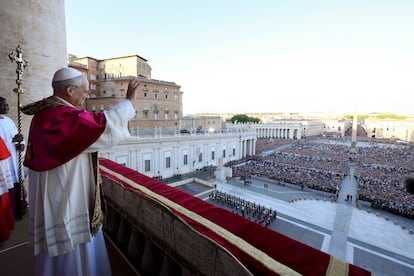
Leo XIV waves from the balcony of St. Peter’s Basilica in the Vatican during his first public appearance as the Supreme Pontiff.DYLAN MARTINEZ (REUTERS)
During the synod, Prevost demonstrated strong mediation skills in the Vatican’s delicate standoff with the German Church — the most progressive in the Catholic world — which was pushing for more ambitious reforms. Within the deeply polarized U.S. Church, especially during the Trump era, he is seen as someone capable of bridging both sides.
In his first remarks as pope, Leo XIV presented a markedly different style from his predecessor. He avoided improvisation, read from a prepared text, and adopted a tone less conversational and more catechetical, with a more classical rhetorical style. To start with, he wore traditional papal vestments, more in the style of Benedict XVI than Francis — a gesture likely to please conservative factions. One of his first major decisions will be whether to return to residing in the Apostolic Palace, a symbolic move that may hint at the direction his papacy will take. So far, his image is that of a more conventional pope, one who avoids theatrics and embraces a steady, traditional presence.
The new Pope appeared deeply moved, almost overwhelmed by the moment, his emotions tightly held back as he faced the crowd. His opening words clearly echoed those of John XXIII in his famous “moonlight speech”: “I would like this greeting of peace to enter your hearts, to reach your families and all people, wherever they are, and all the peoples, and all the earth.” Above all, he sought to deliver a message of hope to everyone, without distinction: “God loves us, all of us, evil will not prevail.”
His speech resonated with the spirit of the Second Vatican Council, even though he was only three years old when it was convened in 1958. In the tradition of Pope Francis, it reflected a vision of a more missionary Church, one closer to the poor: “We want to be a synodal church, walking and always seeking peace, charity, closeness, especially to those who are suffering” — a phrase that could easily have come from the Argentine pope himself.
“Humanity needs Him like a bridge to reach God and His love. You help us to build bridges with dialogue and encounter so we can all be one people always in peace,” he concluded.
Though the Augustinian order is not typically known for progressive leanings, Prevost appears to be something of an outlier — a figure capable of striking a balance between conservatives and reformers. He was ordained by Belgian bishop Jean Jadot, a leading voice of the progressive wing of the Roman Curia, and during his time in Peru, he maintained a good relationship with Gustavo Gutiérrez, the father of Liberation Theology.
A swift conclave for a young pontiff
Keeping a very low profile in recent days, Prevost has politely declined all interview requests — including from this newspaper. Yet the speed of his election suggests significant behind-the-scenes efforts to consolidate support. He was chosen after just four ballots, the same number it took to elect Benedict XVI in 2005. A full account of the events will emerge in time, but it’s likely that by the second vote it had become clear that the leading candidate, Pietro Parolin, was unable to gain further traction.
With degrees in mathematics and philosophy, Prevost brings both intellectual rigor and cultural sensitivity to the papacy. A passionate tennis player — though he has gradually stepped back from the sport due to his responsibilities — he was once known for having a formidable backhand. At 69, he is considered a relatively young pope, suggesting the possibility of a long pontificate. His election breaks a long-standing unwritten rule: that the papacy should not be held by someone from a global superpower. This tradition, long upheld through centuries of Italian popes, has now been set aside. Still, Leo XIV is arguably the least “American” among American cardinals — a fact that worked in his favor.
Born in Chicago to parents of Spanish and Italian descent, Prevost was sent to Peru in 1985 at the age of 30. He spent most of his pastoral life there and even served as second vice president of the Peruvian Episcopal Conference. In 2015, Pope Francis appointed him Bishop of Chiclayo, a poor diocese marked by serious social challenges — and a firsthand vantage point on the roots of migration toward the United States. In many ways, Leo XIV embodies a bridge between the wealthy North and the impoverished South.
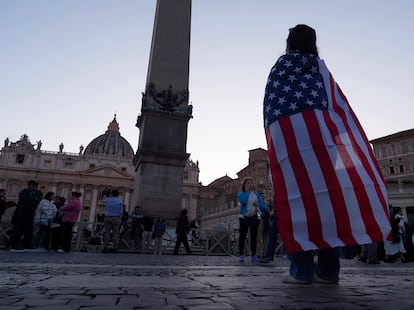
Andrea Gallardo, 20, from Texas, wears the U.S. flag after Pope Leo XIV appeared on the balcony of St Peter’s Basilica following his election, at the Vatican, Thursday, May 8, 2025. PAOLO SANTALUCIA (AP)
In the Diocese of Chiclayo, Prevost faced accusations of alleged inaction in cases of abuse. However, the Dicastery for the Doctrine of the Faith conducted a thorough investigation and ultimately dismissed the complaints. In recent days, as his candidacy gained visibility, these accusations resurfaced in some media outlets — even in the form of a dossier — but they did not present a significant obstacle to his election. The matter was already known in Vatican circles, where it is largely seen as a smear campaign. Still, it is likely that the issue will re-emerge in the coming hours.
What’s more, Prevost actively supported victims of the Sodalitium Christianae Vitae scandal — a powerful ultraconservative Peruvian group that was finally dissolved by Pope Francis this year. Prevost helped the journalists who uncovered the case meet with Francis to provide him with their findings in person.
Leo XIV was made a cardinal in 2023. Francis had already signaled him out by appointing him to a high-profile position in Rome: Prefect of the powerful Dicastery for Bishops. This key role oversees the appointment of diocesan leaders across the world, and under Prevost’s leadership, hundreds of new bishops aligned with Francis’s pastoral vision — “shepherds who smell of their sheep” — were appointed. Having had a hand in many episcopal nominations over the past two and a half years, he became a well-known figure in numerous countries, giving him a strategic edge in the conclave.
Francis first came to know Prevost through Peruvian Jesuit Cardinal Ricardo Barreto, and later met him again during his 2018 visit to Peru.
Prevost was also elected Prior General of the Augustinian order in 2001, a position he held until 2013. These various roles gave him valuable governance experience and familiarity with the inner workings of the Roman Curia — qualities many electors considered essential. There was little appetite for another pope unfamiliar with the Vatican and its complex dynamics. After years of internal tensions, no one wanted to see another rift between the Curia and the pontiff. Now, both supporters and critics of Francis are hopeful that they have chosen someone capable of turning the page and moving beyond confrontation.
. . .
UPDATE: May 18, 2025.
Pope Leo XIV was officially installed as pope today at the innauguaral mass at St. Peter’s in Rome, giving a homily outlined in the following New York Times article:
Pope Leo, Taking Helm of a Divided Church, Urges Unity
Presiding over a Mass in St. Peter’s Square on Sunday, Leo was inaugurated as the first American pope, in a ceremony filled with ancient and symbolic rituals.
Leo XIV on Sunday celebrated an outdoor Mass formally inaugurating him as the 267th pope of the Roman Catholic Church, telling world leaders, the assembled hierarchy of his church and more than 100,000 faithful gathered in St. Peter’s Square that the church needed a new unity that recognized its diversity.
In his homily, the new pontiff sought to bridge the divisions in the church between those who want to engage with the modern world by pushing ahead with the inclusive approach of Pope Francis, and those more conservative members who favor a return to an emphasis on the church’s traditions.
The cardinals tasked with electing a pope, he said, had sought a “shepherd capable of preserving the rich heritage of the Christian faith and at the same time, looking to the future, in order to confront the questions, concerns and challenges of today’s world.”
Leo, an American who has Peruvian citizenship, also said in his homily, that “I was chosen, without any merit of my own, and now, with fear and trembling, I come to you as a brother.” He added that he wanted “us all to be united in one family.”
The morning also marked Pope Leo’s first steps into a global role. He met on Sunday with President Volodymyr Zelensky of Ukraine, which he said, “awaits negotiations for a fair and lasting peace,” called for peace in Myanmar and urged the world not to forget those “reduced to hunger.”
Vice President JD Vance, who had a contentious meeting in the White House earlier this year with Mr. Zelensky, was also in attendance and shook hands briefly with the Ukrainian leader before the Mass began. After the Mass, Mr. Vance, who the White House called “the first Catholic convert,” to serve in the position, briefly shook the pope’s hand on a long receiving line of dignitaries and royals.
It was unclear whether he would receive a private audience before returning to the United States on Monday.
But the focus of the day was the official beginning of Pope Leo XIV’s ministry in a day filled with ancient and symbolic rituals, some of which visibly affected him.
Leo, the former Cardinal Robert Prevost, who after his election on May 8 has still been signing his emails as Bob, took a spin around a packed St. Peter’s Square as crowds of people chanted his name, and captured the moment on upraised camera phones.
He then went into St. Peter’s Basilica and descended to what tradition holds is the tomb of St. Peter to pray. He late emerged on the basilica’s steps to celebrate the Mass.
A cardinal fitted his finger with the fisherman’s ring used as his seal. Leo, seemingly choked up, paused to look at on his hand. He also took on symbolic vestments that underlined his role as the church’s good shepherd and stood before symbolic rites of obedience from lay Catholics and clerics.
Framing his mission by echoing Jesus’ role as a “fisher of humanity in order to draw it up from the waters of evil and death,” he returned to the priority of Francis, his predecessor, that the church keep to its evangelizing mission. Still, he said, it “is never a question of capturing others by force, by religious propaganda or by means of power,” but through love.
Cardinal Luis Antonio Gokim Tagle presented the pope with the fisherman’s ring during the Mass.Credit…Pool photo by Jacquelyn Martin
The new pope added that a pastor, like Peter, the first pope, needed to be close to “the flock without ever yielding to the temptation to be an autocrat, lording it over those entrusted to him.” He said the church needed to be animated by a “missionary spirit” and “not closing ourselves off in our small groups” or “feeling superior to the world.”
But Leo emphasized the idea of a “coexistence of diversity” within what he called a “united Church” — an idea central to Saint Augustine. The new pontiff joined the Order of St. Augustine as a young man and eventually led its global operations from its headquarters just outside St. Peter’s Square.
This was a message many of the cardinals wanted to hear, after periods of division in the church. But many wanted to make sure Leo’s view of unity did not mean going backward, and that the new pope’s vision included Francis’ inclusive spirit.
In his days since becoming pope, supporters of Francis say they feel assured that his welcoming legacy is now safe. On Sunday, Leo reiterated that he sought a “unity which does not cancel out differences but values the personal history of each person and the social and religious culture of every people.”
Beyond the church, Leo said, “we still see too much discord, too many wounds caused by hatred, violence, prejudice, the fear of difference, and an economic paradigm that exploits the Earth’s resources and marginalizes the poorest.”
Marilyn Heller, a lawyer from Long Island, had tears in her eyes after the Mass.
“A pope from the United States,” she said, adding that she felt a new era had begun. “I feel like there is some new energy in the church.”
Elizabeth Dias, Emma Bubola and Elisabetta Povoledo contributed reporting.
Jason Horowitz is the Rome bureau chief for The Times, covering Italy, the Vatican, Greece and other parts of Southern Europe.