Issue of the Week: War
Published June 21, 2025

U.S. Enters War Against Iran, The New York Times, June 21, 2025
Following up on last week’s post on the Israeli strikes aginst Iran’s nuclear and other targets which has led to continued strikes by Israel and counterstirkes by Iran, in a momentous move, the U.S. has now entered the war by bombing three nuclear sites in Iran that it had the capacity to do that Israel did not.
The implications of this action are impossible to overstate, are not uncomplex, and are impossible to fully predict. As we said last week, more comment would come. That is more true than ever now. First, however, events are unfolding quickly in real time so now is not the moment for further reflection by us.
Following is reporting and analysis under the front page headline in The New York Times, “U.S. Enters War Against Iran.” and from The Atlantic “The United States Bombed Iran. What Comes Next?”:
NEWS ANALYSIS
U.S. Military Is Pulled Back Into Middle East Wars
The strikes on Iran ushered in a period of high alert as the Pentagon braced for almost-certain retaliation against American forces in the region.
Listen to this article · 5:49 min Learn more
By Helene CooperEric Schmitt and Julian E. Barnes
Helene Cooper and Eric Schmitt cover the Pentagon. Julian E. Barnes covers U.S. intelligence agencies.
The New York Times, June 21, 2025
The U.S. strikes on nuclear sites in Iran are an extraordinary turn for a military that was supposed to be moving on from two decades of forever wars in the Middle East, and they put the United States back on war footing.
Across the region, where more than 40,000 American troops are on bases and warships, the strikes ushered in a period of high alert as the Pentagon braced for almost-certain retaliation from Iran.
President Trump announced on social media that three Iranian sites were hit, including the mountain facility at Fordo. The bombs used in the strikes are believed to include “bunker busters,” which are designed to destroy deep underground bunkers or well-buried weapons in highly protected facilities.
A U.S. official who spoke on condition of anonymity to discuss confidential intelligence said that multiple 30,000-pound bunker-buster bombs were dropped on Fordo, and that initial damage assessments indicated that the facility had been “taken off the table.” The attack was the first time the U.S. military had used the weapon in combat.
The strikes, whether successful or not, are likely to trigger a fierce response. Tehran has vowed to strike at American bases in the Middle East, and American intelligence agencies confirmed before the strikes took place that Iran would take steps to widen the war and hit U.S. forces in the region.
Want to stay updated on what’s happening in Iran and Israel? Sign up for Your Places: Global Update
, and we’ll send our latest coverage to your inbox.
U.S. officials, speaking on condition of anonymity to discuss intelligence, said the strikes against the three nuclear sites were complete. The official said no follow-up attacks were expected, although commanders were ready to respond to any Iranian retaliation.
A U.S. official said that six B-2 bombers dropped 12 bunker-buster bombs on Fordo, and Navy submarines fired 30 cruise missiles at Natanz and Isfahan. One B-2 also dropped two bunker-buster bombs on Natanz, the official said. The strikes are the culmination of years of planning by U.S. Central Command, which is responsible for operations in the region. But few thought those plans would be carried out so suddenly. They came more than a week after Israel launched attacks on Iran.
Iran responded with missile barrages of its own, as well as offers to resume negotiations over its nuclear development program.
Iran built the centrifuge facility at Fordo to prevent it from being attacked. In 1981, using F-15 and F-16 fighter jets, Israel bombed a nuclear facility near Baghdad as part of its effort to stop Iraq from acquiring nuclear weapons — a strike that basically stopped Iraq’s weapons program. That facility was above ground.
In its strikes on Iran, Israel has hit aboveground nuclear sites, but not Fordo. Only the United States has the GBU-57 Massive Ordnance Penetrator — the formal name for the bomb needed to reach the site. Previous American administrations have refused to give the bomb to Israel. Israel’s Air Force also does not have the warplanes needed to carry it.
Middle East Tensions: Live Updates
Updated
The New York Times, June 22, 2025, 12:07 a.m. ET35 minutes ago
- Iran had vowed to retaliate. Now, it faces hard choices.
- Republican lawmakers cheer the U.S. strike on Iran as top Democrats condemn it.
- Trump’s decision to bomb Iran injects the U.S. into a Middle East conflict.
The bombs have thick steel cases and contain a smaller amount of explosives than similarly sized general-purpose bombs. The heavy casings allow the munition to stay intact as it punches through soil, rock or concrete before detonating.
Iran has many ways to retaliate, including naval assets and other capabilities it would need to shut down the Strait of Hormuz, a move that could pin any U.S. Navy ships in the Persian Gulf, American military officials say. Iranian officials have threatened to mine the strait if the United States joined Israel’s attack on the country.
The narrow 90-mile waterway connecting the Persian Gulf to the open ocean is a key shipping route. A quarter of the world’s oil and 20 percent of the world’s liquefied natural gas passes through it. Mining the choke point would cause gas prices to soar.
Earlier this week, American minesweepers and other Navy vessels began dispersing to avoid attack.
In his first term, Mr. Trump authorized a drone strike that killed a powerful Iranian general in Baghdad. Iran retaliated with a barrage of missiles fired at American troops in Iraq, leaving some 110 troops with traumatic brain injuries and unintentionally hitting a Ukrainian passenger jet, killing all 176 people aboard.
Iran would not need much preparation to attack U.S. air and naval bases in the region. The Iranian military has missile bases within easy striking range of Bahrain, Qatar and the United Arab Emirates.
Indeed, American officials said earlier this week that Iran had prepared missiles and other military equipment for strikes on U.S. bases in the region.
Anticipating such an attack, American forces in recent days have been fortifying air defenses. On Saturday, American officials said that additional U.S. Air Force F-22, F-16, and F-35 fighter jets from the United States had transited bases in Europe and were positioned in the Middle East, with more coming.
The United States has already sent about three dozen refueling aircraft to Europe that could be used to assist those fighters in protecting American bases.
In addition, the aircraft carrier Carl Vinson, with 60 aircraft aboard, including F-35 fighter jets, is currently steaming in the Arabian Sea. A second carrier, the Nimitz, canceled a port call in Vietnam earlier this week to rush to the region, and is expected to arrive in the next few days, U.S. officials said.
Helene Cooper is a Pentagon correspondent for The Times. She was previously an editor, diplomatic correspondent and White House correspondent.
Eric Schmitt is a national security correspondent for The Times. He has reported on U.S. military affairs and counterterrorism for more than three decades.
Julian E. Barnes covers the U.S. intelligence agencies and international security matters for The Times. He has written about security issues for more than two decades.
Live Updates: Trump Claims Success After Bombing Key Iran Nuclear Sites
The New York Times, June 22, 2025, 12:17 a.m. ET11 minutes ago
After hitting Iran’s most heavily fortified nuclear installation, President Trump warned of more strikes “if peace does not come quickly.” Israel’s prime minister called the bombings a “bold decision.”
Maggie Haberman, Farnaz Fassihi, Eric Schmitt, Tyler Pager and Eric Nagourney
Here are the latest developments.
American warplanes and submarines attacked three key nuclear sites in Iran early Sunday, bringing the U.S. military directly into Israel’s war and prompting fears that the strikes could lead to more dangerous escalations across the Middle East.
President Trump said the objective of the strikes “was the destruction of Iran’s nuclear enrichment capacity and a stop to the nuclear threat posed by the world’s No. 1 state sponsor of terror.” He claimed success, saying in a televised address from the White House that the nuclear facilities had been “completely and totally obliterated.”
The strikes hit Iran’s two major uranium enrichment centers: the heavily fortified mountain facility at Fordo and a larger enrichment plant at Natanz, which Israel had struck several days ago with smaller weapons. A third site near the ancient city of Isfahan where Iran is believed to keep near-bomb-grade uranium was also bombed. Iranian officials acknowledged the sites had been attacked but did not immediately describe the damage.
Mr. Trump warned that more strikes were possible. “Iran, the bully of the Middle East, must now make peace,” he said. “If they do not, future attacks will be far greater and a lot easier.”
There was no immediate response from Iran’s foreign minister, Abbas Araghchi, who is in Europe for diplomatic talks. António Guterres, the head of the United Nations, called the attacks a “dangerous escalation in a region already on the edge — and a direct threat to international peace and security.”
As people in the Middle East woke up to news of the strikes, Mr. Trump’s decision was reverberating through Congress.
Top Republicans were rallying behind him, calling the strikes a necessary check on Iran’s ambitions of developing a nuclear weapon. But senior Democrats and some G.O.P. lawmakers condemned the move as an unconstitutional one that could drag the United States into war.
Iran has also warned that America’s entry into war would bring retaliation, including the targeting of U.S. forces in the region or the acceleration of its nuclear program — assuming the program survives U.S. bombing.
Here’s what you need to know:
- Israel’s role: Israel and Iran have been exchanging attacks since June 13, when the Israeli military launched a surprise assault that targeted Iranian infrastructure, including nuclear installations, and military leaders. Prime Minister Benjamin Netanyahu said early Sunday that the U.S. strikes had been carried out “in full coordination” between the American and Israeli militaries.
- Strike details: A U.S. official said that six B-2 bombers dropped a dozen 30,000-pound bunker buster bombs on the Fordo nuclear site, which lies deep underground, and Navy submarines fired 30 TLAM cruise missiles at the Natanz and Isfahan sites. One B-2 also dropped two bunker busters on Natanz, according to the official, who spoke on condition of anonymity to discuss military operations.
- The lead-up: For a week, Mr. Trump sent mixed signals about whether the U.S. would enter the war. He was weighing whether to use the powerful munitions needed to destroy Iran’s deeply buried nuclear enrichment facilities. Only American bombs known as bunker busters are believed up to the job, and only American aircraft can deliver them.
- What’s next? Now that Mr. Trump has helped Israel, it will most likely initiate a more dangerous phase in the war. Here are some ways that could play out, and a look at how the U.S. military’s powerful bunker-busting bombs work.
Robert Jimison, Michael Gold, Megan Mineiro, Jonathan Swan and Talya Minsbergcontributed reporting.
Republican lawmakers cheer the U.S. strike on Iran as top Democrats condemn it.

The New York Times, June 21, 2025
Robert Jimison and Michael Gold
Top Republicans in Congress swiftly rallied behind President Trump on Saturday after he ordered strikes on three Iranian nuclear sites, even as senior Democrats and some G.O.P. lawmakers condemned it as an unconstitutional move that could drag the United States into a broader war in the Middle East.
In separate statements, the leading Republicans in Congress, Speaker Mike Johnson and Senator John Thune of South Dakota, the majority leader, commended the military operation, calling it a necessary check on Iran’s ambitions of developing a nuclear weapon. Both men had been briefed on the military action before the strike was carried out, according to three people familiar with the matter who were not authorized to discuss it publicly.
Mr. Johnson and Mr. Thune both argued that the airstrikes were necessary after Iran had rejected diplomatic overtures to curb its nuclear program.
“The regime in Iran, which has committed itself to bringing ‘death to America’ and wiping Israel off the map, has rejected all diplomatic pathways to peace,” Mr. Thune said.

Mr. Johnson argued that the military action was consistent with Mr. Trump’s muscular foreign policy.
“President Trump has been consistent and clear that a nuclear-armed Iran will not be tolerated,” he said. “That posture has now been enforced with strength, precision and clarity.”
But top Democrats harshly criticized the move.
“President Trump misled the country about his intentions, failed to seek congressional authorization for the use of military force and risks American entanglement in a potentially disastrous war in the Middle East,” Representative Hakeem Jeffries, Democrat of New York and the minority leader, said in a statement. He said the president “shoulders complete and total responsibility for any adverse consequences that flow from his unilateral military action.”
Representative Jim Himes, the ranking Democrat on the Intelligence Committee, condemned the operation as unconstitutional and warned that it could drag the United States into a larger conflict.
“Donald Trump’s decision to launch direct military action against Iran without congressional approval is a clear violation of the Constitution, which grants the power to declare war explicitly to Congress,” he said in a statement. “It is impossible to know at this stage whether this operation accomplished its objectives. We also don’t know if this will lead to further escalation in the region and attacks against our forces, events that could easily pull us even deeper into a war in the Middle East.”
Leading national security Democrats on Capitol Hill were not informed of the strikes until after Mr. Trump had posted about them on social media, according to three people familiar with the matter who would discuss it only on the condition of anonymity.
Most of the praise immediately following the operation came from Republicans. Some emphasized their views that the bombings would not lead to a ground deployment of American forces in the region.
“To those concerned about U.S. involvement — this isn’t a ‘forever war’ in fact, it’s ending one,” Senator Markwayne Mullin, Republican of Oklahoma, said on social media.
Senator Roger Wicker, the Republican chairman of the Armed Services Committee, called Mr. Trump’s decision to strike in Iran “deliberate” and “correct.”
“We now have very serious choices ahead to provide security for our citizens and our allies and stability for the Middle East,” Mr. Wicker said in a statement.
Senator John Fetterman of Pennsylvania, whose unqualified support for Israel has put him at odds with other members of his party, was one of the few Democrats to offer an immediate statement of support. He wrote on social media that the military action “was the correct move.”
“Iran is the world’s leading sponsor of terrorism and cannot have nuclear capabilities,” Mr. Fetterman added. “I’m grateful for and salute the finest military in the world.”
Other lawmakers, many of them Democrats who had already expressed concerns that the Trump administration was considering sidestepping Congress’s constitutional power to declare war, immediately criticized the strikes on the nuclear sites.

Mr. Trump, “did not come to Congress to explain his reasons for bombing a sovereign nation and to seek authorization for these strikes,” Representative Diana DeGette, Democrat of Colorado, said in a statement. “These reckless actions are going to put the lives of American service members and American citizens at risk.”
Representative Thomas Massie, Republican of Kentucky, who earlier this week introduced a bipartisan resolution that would require congressional approval before U.S. troops could engage in offensive attacks against Iran, wrote on social media that the attack was “not Constitutional.”
The United States Bombed Iran. What Comes Next?
President Trump is taking an enormous risk. By Tom Nichols
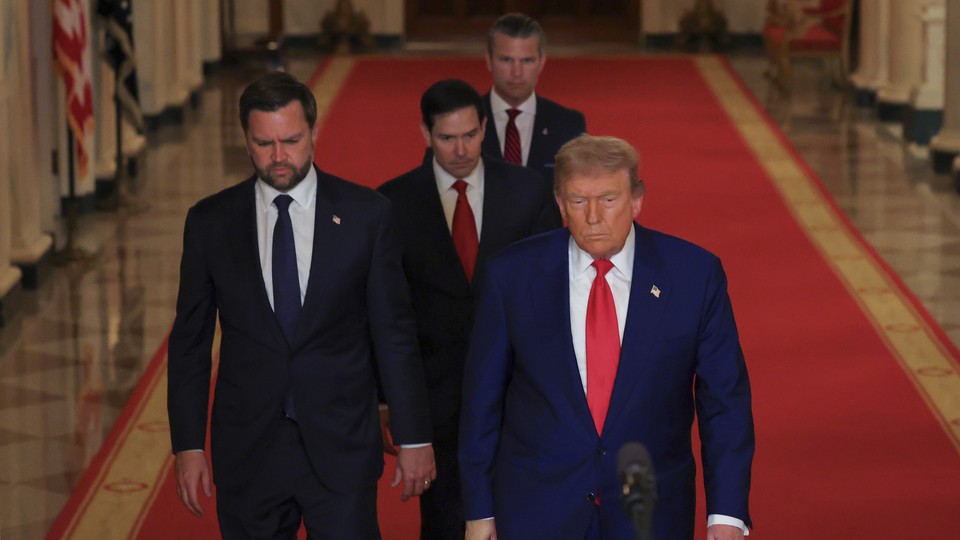
The Atlantic, JUNE 21, 2025, 11:38 PM ET
President Donald Trump has done what he swore he would not do: involve the United States in a war in the Middle East. His supporters will tie themselves in knots (as Vice President J. D. Vance did last week) trying to jam the square peg of Trump’s promises into the round hole of his actions. And many of them may avoid calling this “war” at all, even though that’s what Trump himself called it tonight. They will want to see it as a quick win against an obstinate regime that will eventually declare bygones and come to the table. But whether bombing Iran was a good idea or a bad idea—and it could turn out to be either, or both—it is war by any definition of the term, and something Trump had vowed he would avoid.
So what’s next? Before considering the range of possibilities, it’s important to recognize how much we cannot know at this moment. The president’s statement tonight was a farrago of contradictions: He said, for example, that the main Iranian nuclear sites were “completely and totally obliterated”—but it will take time to assess the damage, and he has no way of knowing this. He claimed that the Iranian program has been destroyed—but added that there are still “many targets” left. He said that Iran could suffer even more in the coming days—but the White House has reportedly assured Iran through back channels that these strikes were, basically, a one-and-done, and that no further U.S. action is forthcoming.
(In a strange moment, Trump added: “I want to just say, we love you, God, and we love our great military.” Presidents regularly ask God to bless the American nation and its military forces—as Trump did in his next utterance—but it was a bit unnerving to see a commander in chief order a major military action and then declare how much “we” love the Creator.)
Only one outcome is certain: Hypocrisy in the region and around the world will reach galactic levels as nations wring their hands and silently pray that the B-2s carrying the bunker-buster bombs did their job.
Beyond that, the most optimistic view is that the introduction of American muscle into this war will produce a humiliating end to Iran’s long-standing nuclear ambitions, enable more political disorder in Iran, and finally create the conditions for the fall of the mullahs. This may have been the Israeli plan from the start: Despite Israeli Prime Minister Benjamin Netanyahu’s warnings about the imminence of an Iranian nuclear-weapons capability and the need to engage in preemption, this was a preventive war. The Israelis could not destroy sites such as Fordow without the Americans. Israeli military actions suggest that Netanyahu was trying to increase the chances of regime change in Tehran while making a side bet on dragging Trump into the fray and outsourcing the tougher nuclear targets to the United States.
The very worst outcome is the polar opposite of the optimistic case. In this bleak alternative, the Air Force either didn’t find, or couldn’t destroy, all of the key parts of the Iranian program; the Iranians then try to sprint across the finish line to a bomb. In the meantime, Tehran lashes out against U.S. targets in the region and closes the Strait of Hormuz. The Iranian opposition fades in importance as angry Iranian citizens take their government’s part.
One dangerous possibility in this pessimistic scenario is that the Iranians do real damage to American assets or kill a number of U.S. servicepeople, and Trump, confused and enraged, tries to widen his war against a country more than twice the size of Iraq.
Perhaps the most likely outcome, however, is more mixed. The Iranian program may not be completely destroyed, but if the intelligence was accurate and the bombers hit their targets, Tehran’s nuclear clock has likely been set back years. (This in itself is a good thing; whether it is worth the risks Trump has taken is another question.) The Iranian people will likely rally around the flag and the regime, but the real question is whether that effect will last.
The Iranian regime will be wounded but will likely survive; the nuclear program will be delayed but will likely continue; the region will become more unstable but is unlikely to erupt into a full-blown war involving the United States.
But plenty of wild cards are in the deck.
First, as strategists and military planners always warn, the “enemy gets a vote.” The Iranians may respond in ways the U.S. does not expect. The classic war-gaming mistake is to assume that your opponent will respond in ways that fit nicely with your own plans and capabilities. But the Iranians have had a long time to think about this eventuality; they may have schemes ready that the U.S. has not foreseen. (Why not spread around radiological debris, for example, and then blame the Americans for a near-disaster?) Trump has issued a warning to Iran not to react, but what might count as “reacting”?
Second, we cannot know the subsequent effects of an American attack. For now, other Middle Eastern regimes may be relieved to see Iran’s nuclear clock turned back. But if the Iranian regime survives and continues even a limited nuclear program, those same nations may sour on what they will see as an unsuccessful plan hatched in Jerusalem and carried out by Washington.
Diplomacy elsewhere will likely suffer. The Russians have been pounding Ukraine with even greater viciousness than usual all week and now may wave away the last of Trump’s feckless attempts to end the war. Other nations might see American planes flying over Iran and think that the North Koreans had the right idea all along: assemble a few crude nuclear weapons as fast as you can to deter further attempts to end your regime.
Finally, the chances for misperception and accidents are now higher than they were yesterday. In 1965, the United States widened the war in Southeast Asia after two purported attacks from North Vietnam; the Americans were not sure at the time whether both of these attacks had actually happened, and as it turns out, one of them probably had not. The Middle East, moreover, is full of opportunities for screwups and mistakes: If Trump continues action against Iran, he will need excellent intelligence and tight organization at the Pentagon.
And this is where the American strikes were really a gamble: They were undertaken by a White House national-security team staffed by unqualified appointees, some of whom—including the director of national intelligence and the secretary of defense himself—Trump has reportedly frozen out of his inner circle. (Given that those positions are held by Tulsi Gabbard and Pete Hegseth, respectively, it is both terrifying and a relief to know that their influence may be limited.) The American defense and intelligence communities are excellent, but they can function for only so long without competent leadership.
Trump has had preternatural luck as president: He has survived scandals, major policy failures, and even impeachment, events that would have ended other administrations.The American planes dropped their payloads and returned home safely. So he might skate past this war, even if it will be hard to explain to the MAGA faithful who believed him, as they always do, when he told them that he was the peace candidate. But perhaps the biggest and most unpredictable gamble Trump took in bombing Iran was sending American forces into harm’s way in the Middle East with a team that was never supposed to be in charge of an actual war.
ABOUT THE AUTHOR
Tom Nichols is a staff writer at The Atlantic and a contributor to the Atlantic Daily newsletter.
Recent Posts
- “The War in Ukraine Has Now Gone On Longer Than World War I”, The New York Times
- “A Crime Doesn’t Make a Child an Adult”, The Atlantic
- Issue of the Week: Human Rights
- Armenia’s pro-Europe party wins election and cements shift away from Russia
- “The Interview: Scott Pelley on the Bari Weiss Era and His Last Days at ‘60 Minutes’”, The New York Times
Archives
- June 2026
- May 2026
- April 2026
- March 2026
- February 2026
- January 2026
- December 2025
- November 2025
- October 2025
- September 2025
- August 2025
- July 2025
- June 2025
- May 2025
- April 2025
- March 2025
- February 2025
- January 2025
- December 2024
- November 2024
- October 2024
- September 2024
- August 2024
- July 2024
- June 2024
- May 2024
- April 2024
- March 2024
- February 2024
- January 2024
- December 2023
- November 2023
- October 2023
- September 2023
- August 2023
- July 2023
- June 2023
- May 2023
- April 2023
- March 2023
- February 2023
- January 2023
- December 2022
- November 2022
- October 2022
- September 2022
- August 2022
- July 2022
- June 2022
- May 2022
- April 2022
- March 2022
- February 2022
- January 2022
- December 2021
- November 2021
- October 2021
- September 2021
- August 2021
- July 2021
- June 2021
- May 2021
- April 2021
- March 2021
- February 2021
- January 2021
- December 2020
- November 2020
- October 2020
- September 2020
- August 2020
- July 2020
- June 2020
- May 2020
- April 2020
- March 2020
- February 2020
- January 2020
- December 2019
- November 2019
- October 2019
- September 2019
- August 2019
- July 2019
- June 2019
- May 2019
- April 2019
- March 2019
- February 2019
- January 2019
- December 2018
- November 2018
- October 2018
- September 2018
- August 2018
- July 2018
- June 2018
- May 2018
- April 2018
- March 2018
- February 2018
- January 2018
- December 2017
- November 2017
- October 2017
- September 2017
- August 2017
- July 2017
- June 2017
- May 2017
- April 2017