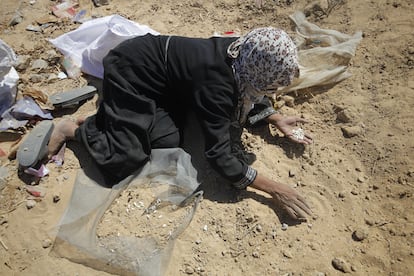
“The Israeli assault on Gaza City: A ‘hell’ foretold without any legal basis”, El Pais
A human rights lawyer, a former officer and activist, and a reserve soldier, all Israelis, describe the Netanyahu government’s actions as ‘criminal’
Beirut – AUG 28, 2025 – 04:42 EDT
The Israeli authorities are ramping up the machinery to carry out the assault on Gaza City. On August 8, the security cabinet led by Benjamin Netanyahu launched its plan to occupy the Strip’s main population center, and the countdown has been on ever since. The operation aims to expel, within a few weeks, the one million people that United Nations agencies estimate “exist” in Gaza City. “And I say ‘exist’ because there’s no way you can call this life,” laments a UN spokesperson from inside the enclave. Once the civilian population has been removed, the Israel Defense Forces (IDF) intend to raze the surface and pull up the subsoil of the Palestinian city.
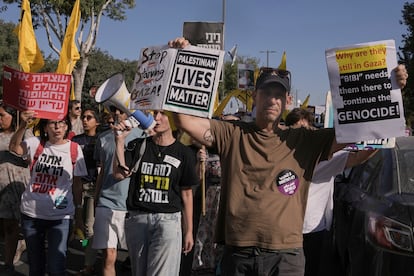
The plan has sparked a still relatively limited opposition within Israel. IDF chief Eyal Zamir has expressed in various meetings that he fears the offensive will result in the deaths of the Israeli hostages still held by Hamas, according to local media reports. The families of the captives and tens of thousands of Israelis who have joined their protests reject the proposed assault for the same reason. But those who openly criticize the recipe for destruction and violent subjugation of Palestinians are still in the minority. In this report, a human rights lawyer, a former soldier who is now an activist, and a retired military officer discuss the risks in this shift by Netanyahu’s government.
“They are war crimes”
Michael Sfard, an Israeli human rights lawyer who defends cases involving Palestinian communities in Israel and the occupied territories, warns that the Netanyahu administration’s plans have no legal basis. If Israel forcibly displaces civilians without committing to returning them to the city when the military campaign ends, it would constitute committing a war crime of forcible transfer, he asserts. “Furthermore, since we are talking about hundreds of thousands of people who would be subject to this evacuation, it could constitute a crime against humanity,” Sfard says in a telephone conversation.
The lawyer also considers Israel’s recent demand that hospital managers and humanitarian organizations working in Gaza City dismantle their facilities and relocate them to the southern part of the Strip to be unacceptable. Sfard points out that these facilities “enjoy special protection [under international humanitarian law] that obliges the parties [to the conflict] to allow them to continue their medical work, facilitating and protecting it.”
Israeli authorities have often done the opposite. Their military actions have already destroyed, in whole or in part, 94% of hospitals, according to the World Health Organization (WHO). They have also resulted in the deaths of at least 1,581 health workers and the detention or disappearance of another 360, according to data from the Hamas-controlled Gaza Health Ministry.
The brutality of the Israeli offensive is preceded by the words of its leaders. Defense Minister Israel Katz announced last Friday the government’s final authorization to take Gaza City, and did so by threatening its complete destruction. “The gates of hell will soon open on the heads of Hamas’ murderers and rapists in Gaza,” he wrote on X. If the Palestinian militia does not accept Israel’s conditions to end the war, Gaza City “will become Rafah and Beit Hanoun,” he added, in a direct admission of the destruction the Israeli army has wrought on those towns.
The minister’s announcement, which openly claims responsibility for razing a city that before the war was home to some 600,000 people — and to which tens of thousands of displaced persons from other areas of Gaza have fled over the past two years — is similar to previous messages from Israeli leaders. In March, at the height of the truce, Netanyahu announced that he would block all supplies and humanitarian aid to the Strip, punishing two million civilians, until Hamas accepted Israel’s demands. Finance Minister Bezalel Smotrich proclaimed in May that the enclave would be “completely destroyed” and that the Palestinians would leave “for third countries.”
“These statements are chilling and constitute mafia-style threats,” Sfard believes. “[These leaders] act more like a criminal gang than like leaders of a country that calls itself democratic,” he emphasizes. But international law, he recalls, does not criminalize “issuing threats to commit war crimes.”
“Wipe you off the map”
Israeli authorities are announcing the destruction of Gaza City because that is their ultimate plan, not to intimidate or instill fear. This is the opinion of Yehuda Shaul, a former officer and co-founder of Breaking the Silence, a group of former Israeli soldiers who denounce the IDF’s crimes in the Palestinian territories. He currently co-directs Ofek, an Israeli think tank that aspires to peace between Israelis and Palestinians through a two-state solution.
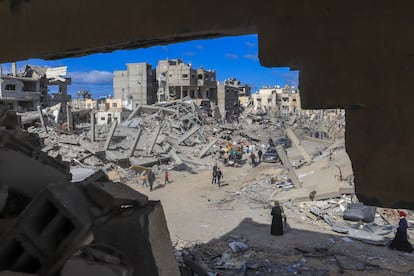
“If Israel is allowed to continue the war and invade Gaza City,” Shaul predicts, “the next step will be to wipe that municipality off the face of the earth.” The activist cites as examples the precedents of Khan Younis and Rafah, where Israeli troops have launched operations that have turned parts of those municipalities into unrecognizable wastelands.
The Israeli army launched the invasion of Rafah, the largest municipality in the southern part of the enclave, in May 2024. The operation took place despite strong international opposition, which anticipated a humanitarian catastrophe that later proved true. During the previous eight months of conflict, Israeli bombs and evacuation orders had driven Gazans from the north and center of the territory to the south, where the majority of the population was then concentrated. At the time, the Israeli government presented the move as definitive in the fight against Hamas, using the same arguments with which it now justifies the capture of the Strip’s capital city.
Shaul points out that Gaza City is the largest Palestinian urban center, suggesting that its destruction will complicate the Palestinian people’s projection into the future. “That’s the idea [of the operation],” Shaul concludes: “to make it remain in the memory of Palestinians and the rest of the region that if you do something against Israel like the attacks of October 7, 2023 [when Hamas killed 1,200 people in Israeli territory], they will wipe you off the map.”
“Exhausted from so much death”
Israeli troops have targeted the Zeitoun and Sheikh Radwan neighborhoods in Gaza City for days, from where UN agencies report thousands of people have been displaced in just one week. The exile of these Gazans to the south, motivated by incessant bombing, is a consequence of the preparatory phase that the Israeli army acknowledges it has begun to later launch the invasion of the city, where several witnesses have observed the presence of tanks and bulldozers.
“This phase is known militarily as the softening of the terrain,” says Ethan (not his real name), an Israeli reservist who fought last year in Sheikh Radwan and other locations in the enclave. In telephone messages, the soldier details how Israeli troops prepare to enter large urban centers. “At the beginning, the army launches aerial bombardments on a ‘bank of targets’ where [the presence of] militants, weapons, or military commanders is suspected.” In many cases, he adds, the navy and artillery units join these operations.
Then the ground forces move in. “Suspicious houses can be bombarded by tanks beforehand. Before entering the building, infantry units fire to reduce risks.” Once inside, they search for combatants, weapons, captives, and tunnels. Excavators, which “move the ground,” are key to underground exploration.
Ethan wants to stay away from the fighting. This young reservist is overseas, dodging new drafts that might take him back to Sheikh Radwan. “We are exhausted from so much war and death,” he says sadly. He asserts that the majority of the Israeli people only want the return of the hostages and the holding of elections. “We no longer trust this corrupt, murderous, messianic government that is dragging us, and the Palestinians, toward final destruction.”