“Takeaways from France’s ‘Block Everything’ protests: ‘A lot of anger is building up around issues of social injustice'”, Le Monde
Our reporters Aline Leclerc, Emeline Cazi, Sofia Fischer, Jonathan Parienté and Benjamin Keltz, who covered the protest movement on the ground, answered questions from Le Monde readers.
10 min read Lire en français
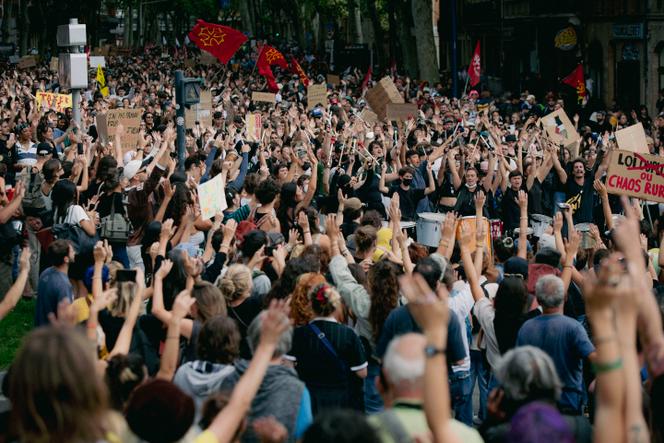
The Bloquons Tout (“Block Everything”) protests around France on Wednesday, September 10, involved some 175,000 participants (according to the government) and 250,000 (according to the CGT, France’s largest trade union). Some 812 actions, including 550 rallies and 262 blockades, took place. In total, there were 540 arrests and 415 people held in police custody. Beyond the numbers, what can we take away from “Block Everything”? Our journalists, who were on the ground, answered questions from Le Monde readers during a live chat on Thursday.
Read more Subscribers only France’s ‘Block Everything’ protests converge around ousting Macron
Guerre des chiffres: You systematically report the number of participants provided by the Interior Ministry (175,000), but not always those put forward by the CGT (250,000) or La France Insoumise [radical left, LFI] (500,000). Yet many protestors pointed out that the prefectures’ counts were lower than the reality, especially since they are not necessarily more impartial than the CGT or LFI when it comes to counting. What was the impression of your reporters on the ground regarding the number of participants?
Aline Leclerc and Emeline Cazi: Counting protestors is already complicated and contested when it comes to traditional marches from point A to point B. It becomes even more difficult when dealing with scattered and spontaneous gatherings, like yesterday or during the first Yellow Vests protests.
At dawn yesterday morning in Paris, there were protestors at Porte de Montreuil (perhaps around 500 people, though that’s hardly a scientific estimate); Porte de la Chapelle; Porte d’Ivry; Porte d’Italie; in front of Lycée Hélène-Boucher (in the 20th arrondissement), as well as in front of other schools; and at several RATP transport depots. It was impossible for us to be everywhere to count.
What we can say is that something definitely happened, with numerous gathering points across the country, both in small towns and in big cities. However, this was not a historic turnout in terms of numbers. But for a movement that was so loosely organized, right at the very start of September, and on a Wednesday, it was by no means insignificant.
Max: Is the movement taking shape like the Yellow Vests protests, and will it continue?
Leclerc: As far as we know at this time, there are no symbolic sites that remain blocked or occupied. However, calls have been made for meetings, general assemblies and so on, in order to “prepare for what comes next.” The main focus is next week, when all the unions have called for a strike across all sectors on September 18.
Sofia Fischer (Nice correspondent): There are a few exceptions. In the Var [southeastern France], for example, we observed the return of Yellow Vest protestors to certain symbolic roundabouts, where they rebuilt infrastructure to enable a longer-lasting presence (pallet tables, eating areas and so on). For now, the intention has been to re-establish a presence on certain main roads. Rebuilding communication channels, especially on Telegram, has also contributed to this organizational effort to keep the movement going.
VousDevezBienPenserQqch: As journalists, does it strike you as odd that so many law enforcement officers were deployed even before the movement had begun? And what about the widespread use of drones (sometimes rejected by the administrative courts)?
Fischer, Arthur Carpentier, Jonathan Parienté, Cazi and Leclerc: For those who followed the protests in Paris, we all agreed that law enforcement intervened very quickly and forcefully to clear bus depots and the entrances to the Périphérique ring road.
At Gare du Nord in Paris, where a general assembly was scheduled to take place at 11 am, law enforcement did everything possible to ensure that as few protestors as possible could access the building or even its immediate surroundings. The transport minister had been very clear: It was imperative to avoid, at all costs, a situation that would “become entrenched” (in his words) and to prevent such a critical transport hub from becoming a rallying and blockade point held by the movement.
Another example was in Nice, where tensions also rose around the train station when protestors tried to push through. The station was barricaded for more than two hours to prevent anyone from occupying it. Travelers remained outside on the forecourt until the protest ended, and trains departed with delays of sometimes more than three hours.
As for the use of drones, it has indeed become widespread, even at peripheral roadblocks in rural areas where only a few dozen people were present. When questioned on the spot, law enforcement said this was now “protocol.” It is not easy to provide a comprehensive count of the number of drones deployed across the country, but their use was extensive. To get a sense of the scale, one could look at the decrees issued by prefects authorizing their use by law enforcement agencies.
Blouhblouh: Since the Yellow Vests movement, protests seem to have broken free from political parties and labor unions. It feels like these groups now join a movement rather than initiate it. How have parties and unions responded internally to these changes?
Leclerc: It’s complicated; I would say both yes and no. As we saw yesterday, and as we saw seven years ago with the Yellow Vests movement, there is a desire among some to break away from traditional frameworks and the usual repertoire of actions.
The main reason given by the protestors was the ineffectiveness of the 14 days of protest spread over six months, organized by the inter-union coalition against the pension reform in 2023. The reform was ultimately pushed through using Article 49.3 of the French Constitution [which allows laws to be passed without a parliamentary vote]. The protestors felt the movement was too “run-of-the-mill” and that it “didn’t scare those in power.”
But they have not yet figured out how to go about it. The same people also admitted that although the Yellow Vests movement managed to leave its mark on public debate and forced politicians to take into account this “invisible” social group – the lower middle class struggling to make ends meet – it did not, despite its sometimes radical and original approach, succeed in changing the lives of those people.
As for the unions, they knew they had somewhat missed the boat with the Yellow Vests movement, whose demands for “social justice” they ultimately shared. So they no longer want to distance themselves too much from these grassroots movements, without necessarily throwing themselves into them either.
Unions know how difficult it is to build a strong, lasting protest movement, and they believe in the power of strikes as a tool to “block the economy.” For them, the first step is to mobilize workers in their workplaces, get them to discuss courses of action and build mobilization together at the local level. But that is difficult, as discontent alone is not enough to convince someone to give up a day’s wages to go out and demonstrate.
RD: Among the Yellow Vests movement, there was a certain amount of hostility (sometimes violent) toward journalists. How were you received at the protest sites?
Leclerc and Cazi: Yes, we often had to spend a lot of time explaining our work to convince the Yellow Vests protestors to answer our questions or to let us listen in on their general assemblies (AG). It was the same situation during some of the AGs held to prepare for yesterday’s movement, as we reported last week in our articles.
Situations can vary depending on the location of the gathering: whether it was a general assembly held indoors or a protest in the street, as well as on the type of media present. Print journalists are less visible than our colleagues from radio or television.
Yesterday, several people – most of them appearing to be left-wing activists – did not want to answer our questions. There was no hostility; that is their right. Even so, it was easy to find people willing to speak. Many photographers were present, some even displaying press stickers or armbands; they were not disturbed while working.
Julien: I didn’t really understand yesterday’s protest. It seems to me like it was just an expression of people’s constant discontent and the usual dislike for those in power, nothing more. Am I wrong?
Cazi: In areas that have traditionally seen high turnout, such as the Paris suburb Montreuil, many of those present were left-wing activists (across the entire spectrum of the left) who oppose capitalism, criticize the lack of resources for education and all public services, demand greater social justice and higher wages, but also mobilize for Gaza and support migrants and undocumented people.
As in other gathering places, the fall of the Bayrou government was not necessarily the main issue. Rather, people were demanding President Emmanuel Macron’s resignation and a change in policy.
Leclerc: Having covered many protests and social movements in recent years, there is definitely a lot of anger building up around issues of social injustice, with a feeling that the same people are always being asked to make sacrifices, while the dividends from the CAC40 [France’s main stock market index] skyrocket, and all the statistics show that the wealth of the richest is growing.
On this point, [ousted prime minister] François Bayrou’s draft budget from this past summer really came across as a provocation, with very specific measures affecting all workers (the elimination of two public holidays in particular left people stunned), while, on the other hand, the measures regarding the contribution expected from the wealthiest remained extremely vague.
But, as I have seen in many companies, employees sometimes put up with a lot before suddenly going on strike in a radical way. It is often a small, anecdotal but highly symbolic measure that pushes them to take action – the final straw. The elimination of two public holidays could have played that role on a national level.
Fischer: Mobilizations rarely stem from anything other than discontent. It’s difficult to gauge what constitutes a “normal” level of discontent, but the political instability of recent weeks suggests a crisis that runs deeper than ordinary frustration.
In rural areas, two notable elements revealed something about this movement. First, there was a diversity of political affiliations among the protestors: At a single roadblock, you could find both right-wing sovereigntists and activists from LFI. Second, the support shown by passersby and drivers for the protestors was striking.
For example, during the first Saturdays of the Yellow Vests protests in 2018, it was rare to see so much support from those who were not actually taking part in the demonstrations. Yesterday, some people even turned off their car engines themselves to help block traffic, while many rolled down their windows to thank those on the roadblocks for their mobilization.
Read more Subscribers only ‘Block Everything’: While September 10 movement echoes the Yellow Vests, it also has key differences
YVAB: The radio says it was a small protest. I live in Rennes, and I have to admit I was impressed by how many people turned out in the city center for a spontaneous movement. Who should we believe?
Benjamin Keltz: Turnout varied depending on the area. Like you, I was in Rennes yesterday. The protest drew between 10,000 and 15,000 people. That is a lot for a city of around 220,000 residents.
I regularly cover strikes and protests in Brittany and in Rennes, a historic stronghold of the left. Such a large turnout was not unprecedented for the Breton capital, but it still remains significant. It is worth noting that the protest took place without any clashes and in a calm atmosphere.
That was not the case at dawn, when protestors, often young and using tactics associated with the “black bloc” movement, blocked the ring road. A bus was set on fire. I also witnessed numerous clashes between law enforcement and hundreds of people who set barricades on fire in the city center after the demonstration.
Rennes is used to tensions on the sidelines of or after protests. This time, they lasted for very long (four hours) and left the city center shrouded in clouds of tear gas.
Benoit: Without a clear rallying cry, what were the main demands of the protesters?
Fischer: The main rallying cry is still the desire for Macron not to serve out his term. As for grievances and demands, the issues that most often came up were the rise in social inequality, the state of public services and a certain disconnect of the political class.
We also heard many people express their fear of an imminent war and of French troops being deployed, whether to Poland or to Gaza. Continuing on this topic, there were many messages about the cost of defense for public finances – spending that would be made at the expense of social rights.
Michel: Your point of view reflects the movement as seen from the inside. Why are you not interested in those who are affected by the blockades, which, let’s not forget, are illegal, or by the violence? Why do you always side only with the protestors?
Cazi, Fischer, Keltz and Parienté: Yesterday, as with every time we have covered a protest movement, our role is to report on and analyze this movement, which had been announced since the end of August and was, to say the least, unprecedented.
Each time, we tried to find the right words and the appropriate photos. For example, we don’t necessarily publish a photo of a burning trash can: Even though it is always dramatic, it sometimes only captures a fleeting moment in the larger event.
There were also constant discussions between the reporters on the field and the editors at the newspaper to determine whether a given piece of information might create too much of a particular impression, one way or the other. At the same time, there is, in France, a clear sense of anger. This movement is one way it is being expressed, and that needs to be reported.
As for blockades and attempted blockades, we reported all the incidents we were aware of, specifying the number of protestors involved and the length of time the sites were blocked.
That is why we reported on the unfortunate travelers who happened to be on the forecourt of the Nice train station and were tear-gassed by law enforcement, as well as the disruption to rail traffic. The same was true at Gare du Nord in Paris, where access was temporarily closed late in the morning, even though most trains were running as usual.
The illegal actions in Rennes – the burned bus, the barricades in the city center – were also reported. There is always a delicate balance to strike when reporting on violence and on the concerns of demonstrators, who often deplore such acts.