Issue of the Week: War
Published October 31, 2025
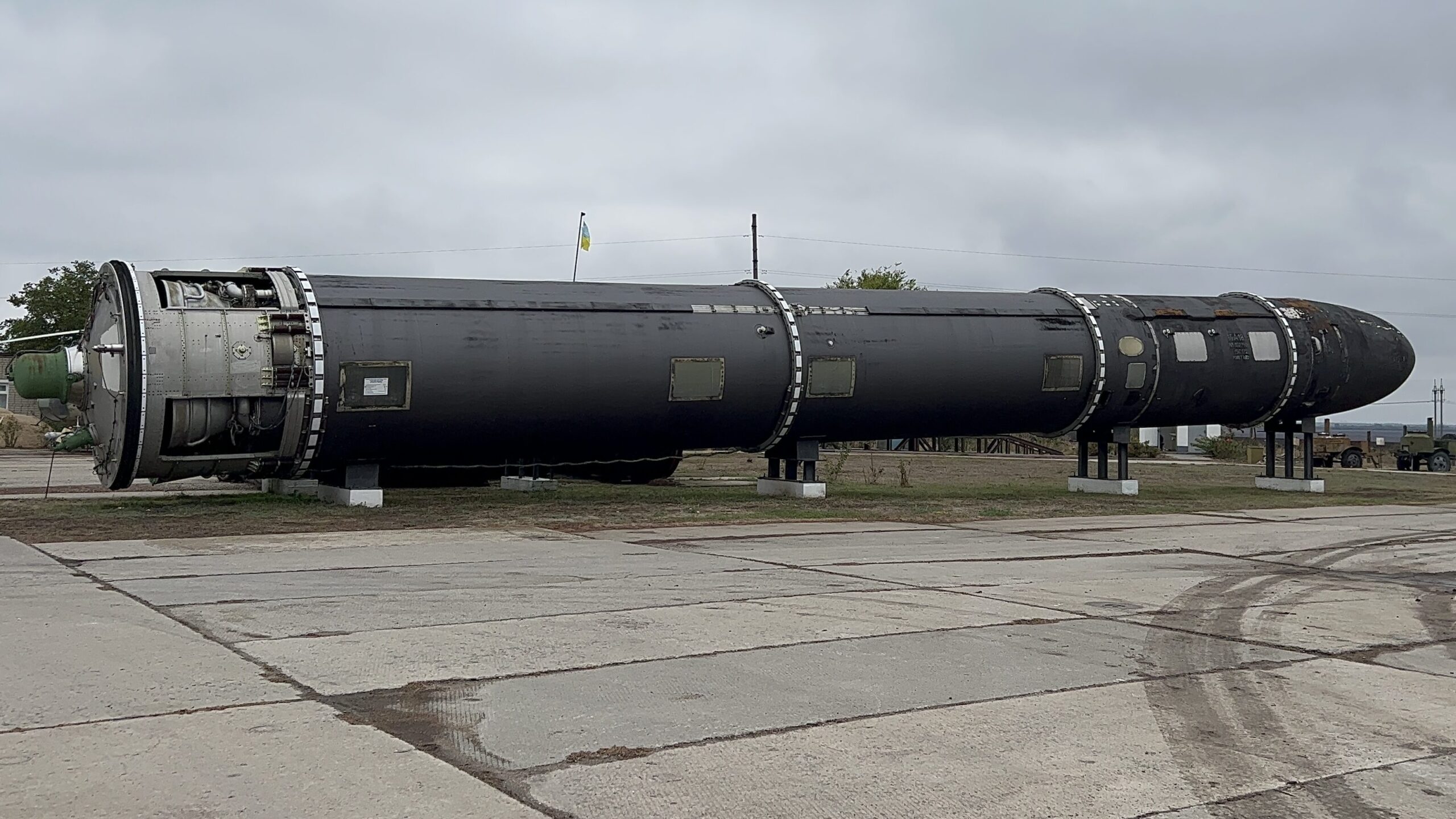
Soviet thermonuclear ICBM, Pobuzke, Ukraine, museum of strategic missile forces, (c) 2025 Planet Earth Foundation, all rights reserved.
Today is All Hallow’s Eve or Halloween in the US, the day before Día de los Muertos, the Day of the Dead, also All Saints Day and All Souls Day.
Usually a celebration of the eternal spirit beyond death of all things.
But today, a potentially more ominous foreshadowing.
“Have you heard the news today?”–A day In The Life, The Beatles.
Actually, yesterday.
Global thermonuclear war is almost certainly coming. Maybe starting in a single incident, maybe the whole shebang.
Not today, probably (but the trick of it on trick-or-treat day is that it absolutely could happen at any moment for numerous predictable and unpredictable reasons). Along with other increasing dangers of more nations seeking a nuclear arsenal, the news below is gasoline on a fire.
Yesterday, President Trump announced that the US would resume testing nuclear weapons for the first time time since 1992, just after the Cold War was won.
Why?
Because others were, he said.
Which is one hundred percent absolutely untrue.
So either he actually lives in a psychotic delusionary world and of course is surrounded by automaton sycophants who do whatever the cult leader says, or is playing a game with the collusion of above said devotees.
Even if this ends up being a political stunt delusionally thought of as strategy and is backed off from in various possible ways, it has an unerasable impact on the rest of the world, and real-world dangerous consequences. Only Trump it seems, in the most powerful trigger-pulling position on the planet (Russia has more nukes barely, but not the overall components of the US arsenal much less the other aspects of military, political and economic power of the US), could blurt the words that trashed decades of international policy, and it was thought, a certainty finally attained about nuclear sanity.
In 1992, the US imposed its own moritorium on testing. In the wake of the end of the Cold War, dissolution of the Soviet Union and the overwhelming US victory in the Gulf War, backed by the UN and all security council members to prevent aggression across borders as the new normal (until Russia invaded Ukraine exactly 30 years later), the global dynamic was democracy, stability and peace. Not completely by any means, but as an anchor and a promise based on rules followed more than not on the largest scale and most crucial ways.
George H. W. Bush stopped all testing much as had JFK (much more below) which had started the arms control process. Then in 1996, the Comprehensive Nuclear-Test-Ban Treaty (CTBT) was passed by the United Nations. It banned all nuclear test explosions anywhere in the atmosphere, in the ocean or underground.
Last week, Russia tested a nuclear-powered missile, but did not detonate an actual bomb. There’s a long list of tests other than nuclear explosions that have occurred over the years and that have been both military and political in intended impact. But the three decades of the world abiding by test ban treaty (with one exception, ended in 2017) has been critical to global stability on nuclear weapons.
Trump was on his way to China when he did this, so the thought occurs he was trying to impress them or the Russians or both or everyone with his bombast.
Starting nuclear testing again by the US will lead to a spiral back down to hell in the arms race–the lack of testing by anyone (the North Koreans last did it in 2017) has been the rule, a treaty not signed by everyone but agreed to, has held virtually since the US stopped after the end of the Cold War.
Asking why is asking why the man who would be king wants to look like the king of the world.
It may be bluster that won’t happen. But just saying it has unparalleled dangers. Everybody games up. The energy behind more nukes and more nations and groups getting them and testing them is fueled by the US indicating it will be lighting such a stunning match based on a transparent lie. And from a source demonstrable in changing positions back and forth, which is itself a cause of instability on an issue in which instability is the definition of danger.
There is no rational strategy here. This is not Ronald Reagan building the nuclear arsenal, mainly short range in Europe, in the early eighties to counter the Soviets doing so and in a larger strategic move to spend them into oblivion. As much as the nuclear freeze movement, one of the largest protest and policy movements in American history (captured in our film aired on PBS stations, Target Seattle, Target Earth), was understandably freaked out, intellectual integrity required recognition in the wake of the intersecting events that ended the Cold War that there was rationality to what Reagan did, agree or not.
One thing is for certain. Trump is no Reagan. He is the opposite of Reagan in nearly every way (except in cutting taxes and deregulation for the rich which began the new age of inequality, but it turns out he was a lightweight in this compared to Trump–and regardless of rhetoric, often not acted on, worked collegially with legendary Democratic Speaker of the House Tip O’Neill despite partisan differences, saving Social Security together in 1983, and operated within constitutional boundaries). Reagan is more than rolling in the grave because of Trump. With a big picture of Reagan in the Oval Office trying to use his legacy as an image adding insult to injury. Reagan’s words on immigration being compared to Trump’s actions by Canada, driving another tarriff rage by Trump, underlining the most recent example of the utter difference between them.
At the end of the Cold War, Reagan and Gorbachev came close to negotiating taking their nuclear arsenals on a trajectory to zero.
Trump is not only no Reagan, but Putin is the antithesis of Gorbachev, who he hated.
Intelectually and morally antithetical. Engaging in various nuclear and other related provocative moves. Not to be confused with what happened just before Gorbachev began reform in the Soviet Union and Reagan saw the opportunity to negotiate presented by Gorbachev, who was democratizing Russia and the USSR by degrees, opening up free speech and so on. He had terrible moments in the midst of this process, such as trying to use force to stop the independence of Lithuania, which the courage of the Lithuanian people thwarted. He ended up overseeing the dissolving of the Soviet Union with all the former nations in the USSR and controlled by it in Eastern Europe voting for independence and democracy.
Ukraine was at the top of the list, the second largest nation after Russia in the USSR, dominated by centuries of Russian imperialsim, voting for independence in 1991.
Russia too was a democracy for a minute, even looking at joining NATO, with Bill Clinton and Boris Yeltsin in a dialogue that would have changed history (and would have ended the nonsense about Russia being cornered by NATO enlargement which treats history as a Stalinist show trial–the nations which joined had every historical reason to fear Russia, which Putin has since proven in spades, and none of them had been or were a threat to Russia, just impediments to Putin’s commitment to a restoration of the USSR/Russian empire).
When Putin took over, after a brief appearance of pro-liberal democracry leaning, he became increasingly the dictator who kills (literally) any threat to replace his reign with democracy, calling the end of the Soviet Union the worst catastrophe of the 20th century and creating butchery in numerous places. The Ukrainian revolution that overthrew a Putin puppet (twice, in 2004 and 2013) with the Ukrainians demanding democracy independent of Russian influence and alignment with the liberal democracies of the EU, led to Putin invading, first Crimea in 2014, then ongoing denied fueling and backing of the separatist conflict in western Ukraine, then full invasion in 2022.
More on that to come.
But the nuclear scenario, and the real international struggle between freedom and dictatorship (unless liberal democracy in the US actually crumbled with no way back in the short term, in which case the world is done) is more centered between Washington and Beijing than Moscow per se, although as allies of dictatorship, at the moment it becomes indistinguishable. North Korea and Iran are also loose cannons, although the former still is under formidable Chinese influence and the latter for now has lost the war with Israel and the US and the Arab gulf states, with its imminent nuclear threat vastly diminished (although a nuke could still be in the dark there.)
Trump did the right thing in hitting Iran’s nuclear facilities. But the context of seeming manipulated into it by Israel and the larger policy of not recognizing the moral and strategic horror of Gaza until a cease-fire thousands of innocent lives too late and unnecessary in Israels’ necessary destruction of Hamas (and really the blunting of their masters in Iran) was odious and ominous for the future in the Middle East and the spread of nuclear weapons there.
A more detailed commentary on this is for another post.
As we pointed out on the 80th anniversary of the first and only use of an atomic bomb in Hiroshima and Nagasaki to end Word War Two in 1945, the pace of new nuclear powers is moving at breakneck speed. Even Japan, and Japanese public opinion, is heading for it, along with South Korea because of China, North Korea, the lack of a sense of continued US protection and the concern that if the Russian invasion of Uraine is successful, all sense of US protection and respect for national sovereignty will be gone and the Chinese will take the long-awaited leap to invade Taiwan, along with other aggressive moves already having occured.
. . .
The number one movie globally on Netfix today is a new film, A House Full of Dynamite, a dramatic depiction by the gifted Academy Award-winning director, Kathryn Bigelow, of a completely mysterious, unknown, unpredictable launch of a thermonuclear missile on the US. Regardless of any technicality inaccuracy (debatable and irrelevant to the point), the irrefutable reality of the shock and chaos and unpredictability of the event is palpable.
The New York Times is the apex of reviewers. Here’s some excerpts:
Kathryn Bigelow wastes no time getting “A House of Dynamite” moving — it’s just go, go, go. A propulsive thriller, her latest movie hinges on a potential nuclear catastrophe of such annihilating magnitude that it seems almost inconceivable, despite being altogether credible. Ordinary life, after all, is tough enough without contemplating the truth that at any second someone, somewhere — in North Korea, say, or in France, Russia or the United States — could set off a nuclear strike. It’s no wonder that the specter of the world’s end has inspired so few memorable films. The reality is unspeakably grim and unbearably absurd. …
One minute, everyone is slurping coffee and exchanging pleasantries while revving up for another day of maintaining national security. The tempo and texture of their chatter seems routine, whether someone is joking about a colleague’s marriage proposal or name-checking Iran and North Korea. The next minute, though, someone announces that the missile is about to go suborbital and will hit the United States, and the world shifts on its axis. Everything — the chatter, gestures, movements and the movie’s pacing — accelerates as the ordinary gives way to the extraordinary. It’s tense and eerie, and then the story stops, only to restart from another vantage point.
The best documentary series ever made on the entire history of the threat of nuclear war and all the political, historical issues surrounding this, centered around the Russian aggression in Ukraine and exploring every aspect of what has occurred from 1945 to today, is Turning Point: The Bomb and The Cold War, also on Netflix. It shows how in reality the Cold War has not ended, has become hotter, with the threat of dictatorship against democracy and the threat of nuclear war both reaching an apex. It is remarkable in a sweep of history showing all sides of the issues.
. . .
The most useful place to start with the the bookends of nuclear arms testing is President John F. Kennedy at the starting end. The bookends are not surprisingly the same as with the US being the humanitarian glue on the planet, the man who started USAID and the man who ended it.
When the author was a child, the world came closer to ending by thermonuclear obliteration than it ever has in the Cuban Missile Crisis in 1962.
And it was very close.
If you weren’t there you really don’t have a clue.
All odds were that it would happen, and could only be prevented by a wing and a prayer.
When President Kennedy addressed the nation on all channels on National TV about the nuclear missiles snuck into Cuba by the Soviets and aimed at the US, everyone was certian that nuclear war was guaranteed.
Getting under the desks at school as we had through endless drills for years was very different when the real thing was pending. About to be “kindling” in the nuclear fire as Lewis Black put it, reminding with ferocious seriousness during an unforgettable comedy sketch, that no one before or since (in the wake of 9/11) had any reason to be constantly toxically traumatized compared to this generation of children.
Every day during the 13 days in October, all the children in America went to school. Kennedy told us all that the best thing to do was go on as normal–as necessary for our national fortitude and sanity (and as nothing else would matter anyway–the nukes could not be escaped) and as a message of both commitment to resolve the crisis and fearlessness if need be in defense of the nation and freedom.
JFK and his brother (and virtually co-president as advisor), Attorney General Robert F. Kenedy, (whose son “Jr” has comitted sacrilege against the name as one who may have killed or debilitated hundreds of millions had he been in his current position just a few decades back, by questioning vaccines, for polio and small pox, and now covid and measles and on and on)–resisted the irresistable impulse and seeming strategic logic of taking out the missiles and Cuba. All deserved–the world’s superpower dictatorship and it’s puppet dictatorship threatening nuclear war (hello unthinking “but the US…fill in the blank” equalled global nuclear annihilation risk ready to rock) while denying the missiles were there (only to be busted in front of the world by US photos shown to the UN by ambassador Adlai Stevenson, twice democratic presidential nominee who lost to Eisenhower before JFK).
But Jack and Bobby, while knowing they may have been forced to risk potential armageddon, who knew more and more knawingly that the chain of events after the first shot was almost certainly going to be the last shot ever fired on earth, kept finding the next brilliant chess move to get to resolution. We’ve told that story before but it merits revisiting, in detail, which we will do in future.
The short story is that JFK and RFK decided to respond to a more diplomatic message from Khrushchev and not a subsequent fiery one (he was under pressure, as was JFK, to take military action), to start with a blockade solely, to ignore serious Soviet errors that normally would have triggered a military response, and to trade US missiles in Turkey (no longer judged useful in any event, so a face-saving mechanism for the Soviets–and they agreed to keep this part of the bargain secret for a short time because JFK was not allowing any ambiguity about who had committed the world-threatening action) and a pledge not to invade Cuba (which with the Soviet missiles gone was an easy call).
In the end, the Soviets removed the missiles, World War Three was averted and JFK was a global hero.
The next most important move was JFK’s next most brilliant, and planet saving move.
He gave an historic speech at American University in DC about the unthinkability of nuclear war while announcing that the US would, unilaterally, stop testing nuclear weapons in the atmosphere, while calling for an international treaty to ban testing in the atmosphere. The Soviets immediately accepted. All nuclear arms treaties from that point forward started with this treaty.
Here is the link to President Kennedy’s speech on nuclear war and nuclear weapons. It is one of the greatest speeches in American, and world history. It’s importance is impossible to overemphasize.
(The momentous impact of JFK’s presidency is underlined by the implausible fact that the next day he gave a stirring speech on national TV calling out historical racism in the US and calling for civil rights legislation–which passed soon after his assassination five months later. Look at the unimaginable bookends of either of these speeches compared with any speech ever given by the current occupant of the oval office.)
We now know what may have happened if the first treaty had not been implemented. The entire atmosphere could have been so badly polluted by radioactivity and its other impacts as to have environmentally destroyed the planet and at best the damage, famine and disease would have been unprecedented by now, over 60 years later.
The announcement by President Trump of resumed nuclear testing, damage done whether it proceeds or not, was made by the man who renamed the Department of Defense (still the correct statutory name), the Department of War, for no rational reason. It was changed from this to “defense” after World War Two precisely to signal that war, in the nuclear age especially, could only be for defense of vital interets and values.
The signals to the world, whatever the motives, are perilous.
. . .
29 days ago, the author of this post and colleague had the incomparable experience of going to the former Soviet nuclear missile complex near Pobuzke, the Ukaine museum of strategic missile forces.
Sometimes words are so woefully inadequate it seems sacreligious to use them at all. But use them we must.
No one had been there for many months because of the war.
We climbed down the claustrophobic cylinder on metal steps for many stories to arrive at the command bunker deep underground. You could see from the top how far down it was–you could barely see to the bottom of an endless pit, as the pit in your stomach shattered.
The launch center was designed to withstand a direct thermonuclear strike from the US.
Outside were the silo openings from which the missiles exited.
And the missiles themselves, including the most powerful in the Soviet arsenal, along with many others, now without warheads.
The writer of this post was transported back to being a little child under a school desk, from the present to the past and back, immersed in a far more terrifying and darkly empty place than ever before.
The missile complex had been taken over by Ukraine at independence in 1991 and one of the most momentous processes in history ensued with Ukraine eventually giving up all nuclear arms.
The Ukrainians were the last of the former Soviet republics that possesed nuclear weapons to give them up.
They knew that the chance that Russian imperialism would come for them again was high, if not certian.
They had suffered through centuries of Russian control and barbarity. In 1932-33 alone Stalin had killed between 5 and 10 million Ukrainians through the Holodomor, the famine created by forced collectivization of agriculture. The explosion of the nuclear power plant in Ukraine at Chernobyl in 1983 came within an inch of destroying all of Ukraine, most if not all of Europe, killing millions, and making these lands, other Soviet republics, and part of Russia itself uninhabitable for 500,000 years. This was a real-life symbol of the ongoing brutality and suffocation of the communist big lie that the Soviets imposed, enabled and were in a worldwide conflict with the US to control the globe with. The US committed its share of atrocities, but to compare systems and responsibility for destroying human life in any relative way (ask the thousands of young progessive women and men Ukrainian refugees and activists in Berlin, a number of whom we interviewed for a documentary in 2022) who were pacifists before the invasion) is demonstrably empty of intellectual and moral integrity. Do you want democracry and freedom with all its flaws or dictatorship without human rights if sometimes with short term benefit. Stalin eventually killed more than Hitler and Mao more than both. As the saying goes, people vote with their feet. The Berlin Wall was built because millions were fleeing the oppressive communist regimes controlled by the Soviets, not the other way around.
Many Ukrainians, none of whom wanted nuclear weapons, were afraid to give them up. Hundreds of years of Russian oppression until 1991 were fresh and they foresaw the Rusian invasions of 2014 and 2022, the largest since World War Two, not as prophecy, but as certainty.
Nonetheless, in solidarity with a global movement toward ridding the world of these weapons, and under pressure from the US who in effect had liberated them, they did.
The Budapest Memorandum in 1994 agreed that in trade for giving up nuclear weapons, the US, UK and Russia would assure Ukrainian sovereignty.
How did that go?
One US veteran volunteering to fight for Ukraine told us he went because America agreed to defend Ukraine and wasn’t doing nearly enough to make certian of this and live up to its agreement. He had lost an arm. It was blown off by the Russians on the front. He said he would either die in Ukraine or the Russians would “F” off.
Former President Bill Clinton, who made the agreement and who pressured the Ukrainians, understandably, to give up the weapons, in a post Cold War world where the reduction and elimination of these planet killers seemed possible, recently said he now regretted that the Ukrainians had not kept nuclear weapons.
This from one of the more intelligent people around, whatever flaws he may have. From a president of the US, who is the one person with a world view that is singular in exposure to such issues. Someone who was conflict-averse and understands the horror of nuclear weapons and the primacy of the need to control them from ever being used. And who concluded that Putin’s invasion of Ukraine was a fuse far more likely to lead to nuclear war than if Ukraine, in 1991 the third largest nuclear power in the world after the US and Russia, had kept its nuclear arsenal.
Putin never would have considered invading.
And his attempted nuclear blackmail threats are absurd on their face even now because it would lead to his own obliteration. If you can’t do the various equations on that math, we can’t help you.
And the lesson of not having your own nukes is not lost on the rest of the world, which continues to nuke up.
Turning Point ends with the moving scenes from the annual anniversary in Hiroshima of the bombing. It was finished in early 2024. Now, Japan is considering rearming with nuclear weapons. Polls have shown that a majority of Japanese don’t see Hiroshima as it once did, as a reason never to have nuclear weapons. It has receded in importance in the way it had been seen in the national psyche and if anything is a reminder of a reason to have nuclear weapons in the face of an aggressive China and North Korea who do, as they watch missile tests nearly hit Japan, and wonder where the US will be when push comes to shove.
This is happening everywhere.
It’s possible that President Trump understands his rhetoric at the UN that using nuclear weapons could end everything. And that the US and Russia will at least extend the only remaining nuclear arms control treaty between them. That the maxim that even if you’re fighting a war, and even if you see the only sane policy of a democracy versus a dictatorhsip of what world you will be in and the odds of greater war if you don’t fully support the democracy invaded by the dictatorship, nuclear weapons are not allowed and talking about this must continue under any circumstances. But this treaty only involves two countries, which are amping up nuclear rhetoric and weapons creation in other ways.
While the rest of the world follows.
To be continued …
Following are three articles from The New York Times today and yesterday, on Trump’s nuclear tests announcement, the impact with China, and the modernizing of the US nuclear arsenal with a history of what has happened since the creation of the atomic bomb including the status with Russia, China and others.
NEWS ANALYSIS
Trump’s Call to Resume Nuclear Testing After Decades Revives a Cold War Debate
President Trump explained the order by saying other, unnamed nations were testing their own nuclear weapons, even though no country has tested since 2017.
Listen to this article · 8:52 min Learn more

By David E. Sanger and William J. Broad
David E. Sanger and William J. Broad have covered nuclear issues at The New York Times for nearly four decades, in articles and books that have detailed nuclear programs in North Korea, Iran, Russia, China and Pakistan.
Oct. 30, 2025
President Trump’s unexpected declaration on Thursday that he was ordering the U.S. military to resume nuclear testing prompted visions of a return to the worst days of the Cold War, when the United States, Russia and China were regularly detonating new weapons, first in the atmosphere and outer space, then underground.
It was an era of terrifying threats and counter-threats, of dark visions of Armageddon and theories of deterrence by mutually assured destruction. That age supposedly ended with the arrival of the Comprehensive Nuclear-Test-Ban Treaty that nations agreed to in the mid-1990s. But not enough of the signatories ratified it for the treaty to formally come into force. Its objective was to starve the arms race by cutting off new tests and the cycle of retaliation they engendered.
Mr. Trump has now revived the debate inside the national security community over whether to break the tradition of observing that treaty, which some of his former aides have argued impedes the country’s ability to demonstrate “peace through strength.” On Air Force One, returning from Korea, the president told reporters he had made the call because of all the other countries conducting nuclear tests.
“We’ve halted it years — many years — ago,” Mr. Trump said, referring to the fact that the last U.S. explosive test of a nuclear weapon was in 1992, during the George H.W. Bush administration. “But with others doing testing, I think it is appropriate that we do also.”
Except, of course, they aren’t. The only nation that has been regularly testing in the past quarter century is North Korea, and its last explosive test was in September 2017.
Moscow has not conducted a test in 35 years, in the last days of the Soviet Union. Mr. Trump, however, may have been confusing nuclear weapons tests with Russia’s recent declaration that it had tested two exotic delivery vehicles for nuclear weapons: a nuclear-powered cruise missile and an undersea torpedo, called Poseidon, that could cross the Pacific and strike the West Coast of the United States. Both are designed to evade American missile defenses, which look for the warheads of intercontinental ballistic missiles as they speed through space.
Mr. Trump told reporters that he was not including China on that list of testing nations; its last explosive test was 29 years ago, though there is some evidence the country has made preparations at Lop Nur, where Mao first demonstrated China’s nuclear capabilities in the 1960s, in case it decides to resume.
Want to stay updated on what’s happening in China, North Korea and Russia? Sign up for Your Places: Global Update
, and we’ll send our latest coverage to your inbox.
Mr. Trump’s own senior official in charge of nuclear testing — Brandon Williams, a former one-term member of Congress from upstate New York — was asked point-blank during his confirmation hearing in April whether the United States needed to go back to explosive testing.
“I would not advise testing, and I think we should rely on the scientific information,” Mr. Williams said, referring to such things as data gathered from supercomputer modeling. But he quickly noted the decision would be made “above my pay grade.”
Apparently, that is exactly what happened. In the hour before Mr. Trump met Xi Jinping, China’s leader, in South Korea on Thursday, he sent out a social media post saying he had ordered the “Department of War,” as he calls the Defense Department, to resume tests “immediately.” His qualifier that the tests would occur “on an equal basis” with U.S. rivals left many national security officials scratching their heads. (It was also puzzling because the Energy Department, not the Pentagon, is responsible for testing.)
Mr. Trump provided no rationale for resuming the testing, other than his incorrect statement that others were doing the same. He boasted that “the United States has more Nuclear Weapons than any other country,” which is incorrect — Russia has more. (Many of the weapons in Russia’s arsenal are small battlefield weapons of the kind American officials worried in October 2022 would be used against Ukraine.)
He said China was a “distant third” in its capabilities. That is true, but they are also growing fast. The Pentagon estimated during the Biden administration that China would have 1,000 deployed weapons by 2030 and would hit rough parity with the United States and Russia in 2035.
Speaking to reporters on Thursday, Vice President JD Vance said that testing the nuclear arsenal was important to make sure it “actually functions properly.”
“To be clear,” he said, “we know that it does work properly, but you got to keep on top of it over time, and the president just wants to make sure that we do that.” He made no reference to testing “on an equal basis” with other nations.
Many experts believe that if the United States resumes testing, it would essentially give permission to other nations to do the same — roughly 100 days before the last arms control treaty between the United States and Russia, limiting the size of their arsenals, is set to expire.
Nuclear experts say that both Russia and China are prepared to conduct nuclear detonations at their underground test sites fairly rapidly. That is in contrast to the United States, which is seen as having made few serious preparations. Its test site is a desolate expanse of the Nevada desert bigger than the state of Rhode Island.
During Mr. Trump’s first term, he revived the possibility of new American testing. In addition to discussing a restart of underground detonations, officials called for major reductions in the preparation time for a U.S. nuclear test resumption. The federal agency in charge of the nation’s nuclear test site ordered the required time for preparations to drop from years to as few as six months.
Nuclear experts saw the goal as unrealistic because testing equipment at the sprawling Nevada site had fallen into disrepair, or vanished.
Even so, Project 2025, the 2023 right-wing blueprint for Mr. Trump’s presidency, echoed the push for a quickening. It called on Washington to forego the lengthy period of preparation altogether and “move to immediate test readiness” in order to give the president “maximum flexibility in responding to adversary actions.”
The drumbeat continued in 2024 when Robert C. O’Brien, a former national security adviser to Mr. Trump, said in Foreign Affairs that Washington “must test new nuclear weapons for reliability and safety in the real world.” But his core argument seemed less about a scientific need for explosive testing than about a political one — to demonstrate to rising and aggressive powers that the United States, which opened the nuclear age when it dropped two atomic weapons on Japan, remained prepared to use the ultimate weapon.
Critics say a testing restart would incite a global arms race. They note that directors of the national labs in charge of the nation’s atomic arsenal have repeatedly testified to Congress that the United States did not need to return to nuclear detonations.
In lieu of testing, the United States now relies on top experts and machines at the nation’s weapons labs to verify the lethality of the country’s arsenal. Today the machines include room-size supercomputers, the world’s most powerful X-ray machine and a system of lasers the size of a sports stadium. No other country has such an extensive array of nonnuclear testing tools.
In contrast to laboratory studies, nuclear testing underground in explosive detonations lets scientists uncover major flaws in prototype arms and fine-tune new weapon designs. During the Cold War, China conducted 45 test explosions at Lop Nur, its underground test site in the Western desert. In comparison, France set off 210, Russia 715 and the United States 1,030.
Such tests slowly concluded at the end of the Cold War. In 1996, the stoppage was formalized in the global test ban. The world’s atomic powers signed it as a way to curb a costly nuclear arms race that was spinning out of control. But it has been an essentially voluntary agreement, since the U.S. Senate never ratified it, and other countries held back formal approval as well.
Siegfried S. Hecker, a former director of the Los Alamos weapons lab in New Mexico, where the first atomic bomb was created, has long argued that the test ban favors Washington because it bars pact-abiding rivals from catching up on the huge edge the United States possesses in advanced nuclear arms.
“Yes, we can learn things by nuclear testing,” Dr. Hecker said in an interview. “But when you look at the big picture, we have much more to lose by going back to testing than we have to gain.”
The test disparities give Washington a military edge because they keep other powers from making their arsenals more diverse and deadly.

Testing America’s Nuclear Bombs: What to Know
David E. Sanger covers the Trump administration and a range of national security issues. He has been a Times journalist for more than four decades and has written four books on foreign policy and national security challenges.
William J. Broad has reported on science at The Times since 1983. He is based in New York.
. . .
Trump’s Test Threat Could Fuel Nuclear Tensions With China
Beijing has been expanding its arsenal, and distrust between China and the United States over nuclear weapons has deepened, with little hope of an agreement.
Listen to this article · 5:35 min Learn more

Oct. 30, 2025
When President Trump called for nuclear testing, shortly before talks with the Chinese leader Xi Jinping, he may have inadvertently added a new complication to one of the most difficult issues between their countries: their nuclear weapons rivalry.
Mr. Trump declared on Thursday that “because of other countries testing programs, I have instructed the Department of War to start testing our Nuclear Weapons on an equal basis.” His order may have been prompted by a claim by President Vladimir V. Putin, a few days earlier, that Russia had successfully test-flown a nuclear-powered and nuclear-capable cruise missile, even though the test did not involve a detonation.
Moves toward renewed explosive tests of nuclear warheads would further endanger the treaty that for decades has constrained all but a handful of countries from carrying them out. If the United States follows through with resuming nuclear testing, “it would effectively give, I think, China and Russia a carte blanche to resume full-yield nuclear testing, which is something that neither country has done in a number of years,” said Ankit Panda, the author of “The New Nuclear Age.”
“The nuclear nonproliferation regime is under tremendous stress at the moment. Russia, China, the United States can’t even agree on the basic principles of what really makes the nonproliferation regime tick,” said Mr. Panda, a senior fellow at the Carnegie Endowment for International Peace.
Mr. Trump and his administration may clarify his comments in the coming hours or days. Mr. Panda and other experts said Mr. Trump may have meant that he wants to test-launch nuclear-capable missiles, not detonate nuclear devices underground.
When asked later about his remarks on nuclear weapons testing, Mr. Trump suggested that they were not related to China. “It had to do with others,” he said, without naming any countries. “They seem to all be nuclear testing.”
But Mr. Trump’s combative words alone could reinforce wariness in Beijing about U.S. nuclear intentions. Nuclear weapons are one area where distrust between China and the United States has deepened, with little prospect for quick agreement.
Under Mr. Xi, China has been rapidly building up its nuclear arsenal after decades of maintaining a comparatively modest force. China has about 600 nuclear warheads, most of them designed for land-based missiles, according to a survey published earlier this year by experts at the Federation of American Scientists. That is still far fewer than the thousands of nuclear warheads that the United States and Russia have.

But the speed of China’s buildup, as well as Moscow’s growing threat, has prompted calls in Washington for faster modernization of U.S. nuclear forces to deter two big adversaries.
“Russia has nearly completed their modernization of all of their nuclear forces, and China is modernizing, and they are growing their arsenal at a breathtaking speed,” Elbridge A. Colby, the undersecretary of defense in the Trump administration, told senators during his confirmation hearing earlier this year.
China’s next development plan, released in summary this week, calls for “strengthened strategic deterrence capabilities” — a term that includes nuclear forces — a military priority for the next five years. And last month, China displayed its growing collection of nuclear-capable missiles, including ones that can be launched from submarines and bomber planes, at a military parade in Beijing.
Mr. Xi used the parade to emphasize China’s maturing “nuclear triad,” that is, the ability to threaten enemies with nuclear attack from land, sea and air, said Lin Po-chou, a researcher at the Institute for National Defense and Security Research, a government-funded group in Taipei, Taiwan.
The pace of China’s nuclear expansion “will continue and won’t change just because of Trump’s announcement on increasing nuclear weapons testing,” Mr. Lin said.
Satellite evidence suggests that China may be making facilities ready to conduct nuclear tests underground, possibly to signal that it could respond in kind if other countries resume testing.
China conducted its first nuclear test in 1964 and its last in 1996, just before the Comprehensive Nuclear-Test-Ban Treaty, a global moratorium on testing, was adopted by most countries. (China, like the United States, signed but has not ratified the treaty.)
China carried out about 45 tests in total, fewer than the many hundreds conducted by the United States or Russia. As a result, China’s nuclear weapons scientists probably have had to work with less data than other superpowers to design their warheads. Since 1996, China and other atomic powers have checked and tested warheads by using “sub-critical tests” that stop short of atomic blasts.
But satellite imagery has revealed renewed construction at Lop Nur, China’s nuclear test site in Xinjiang, a far western region of the country. The activity includes new tunnels that could be used for underground nuclear tests, which may help in the design of new nuclear weapons, two experts, Renny Babiarz and Jason Wang, wrote in a recent study of the area.
If Mr. Trump actually orders new nuclear tests, it would take the United States about 18 months to prepare the likely test site in Nevada, said Mr. Panda, the expert at the Carnegie Endowment for International Peace. China and Russia, he said, could probably move a bit faster.
Amy Chang Chien and Erica L. Green contributed reporting.
Chris Buckley, the chief China correspondent for The Times, reports on China and Taiwan from Taipei, focused on politics, social change and security and military issues.
. . .

Alicia Inez Guzmán is reporting on nuclear weapons production in New Mexico as part of The Times’s Local Investigations Fellowship.
- Oct. 28, 2025
In a sprawling building atop a mesa in New Mexico, workers labor around the clock to fulfill a vital mission: producing America’s nuclear bomb cores.
The effort is uniquely challenging. Technicians at Los Alamos National Laboratory must handle hazardous plutonium to create the grapefruit-size cores, known as pits. They do so in a nearly 50-year-old building under renovation to address aging infrastructure and equipment breakdowns that have at times disrupted operations or spread radioactive contamination, The New York Times found.
Now, the laboratory is under increasing pressure to meet the federal government’s ambitions to upgrade the nation’s nuclear arsenal. The $1.7 trillion project includes everything from revitalizing missile silos burrowed deep in five states, to producing new warheads that contain the pits, to arming new land-based missiles, bomber jets and submarines.
But the overall modernization effort is years behind schedule, with costs ballooning by the billions, according to the Congressional Budget Office. In 2018, Congress charged Los Alamos with making an annual quota of 30 pits by 2026, but by last year it had producedjust one approved for the nuclear stockpile. (Officials have not disclosed whether more have been made since then.)
That pace has put the lab — and especially the building called Plutonium Facility 4, or PF-4 — under scrutiny by Trump administration officials.
Satellite image of Los Alamos National Laboratory and the Los Alamos town, highlighting the location of the Plutonium Facility (PF-4) building.

LOS ALAMOS NATIONAL LABORATORY, NEW MEXICO, Plutonium Facility 4 (PF-4, Satellite image by Maxar Technologies via Google, Ani Matevosian/The New York Times
In August, James Danly, the deputy secretary of the Energy Department, ordered a study of the leadership and procedures involved in pit production and related projects at Los Alamos and the Savannah River Site in Aiken, S.C. That facility was also designated to produce pits but is unlikely to begin before 2032,according to federal officials.
“I have become increasingly concerned about the National Nuclear Security Administration’s ability to consistently deliver on nuclear weapons production capabilities needed to support the national defense of the United States,” Mr. Danly wrote to the agency’s acting administrator. The N.N.S.A., an agency within the Energy Department, maintains the nuclear stockpile and is overseeing the renewal project.
In response to questions from The Times last month, a spokeswoman for the N.N.S.A., the Energy Department and the national laboratory said: “We are fully committed to strengthening the nation’s nuclear deterrent and ensuring the long-term national security of the United States. This commitment includes accelerating our plutonium pit production” at Los Alamos and completing the South Carolina facility, “which are critical for a safe, secure and effective nuclear stockpile.”
To ramp up, PF-4 is undergoing dozens of infrastructure projects. But some major systems in “poor condition” will require repairs and replacements over the next 25 years, a 2020 Energy Department report said.
Complicating the renovation is not only the presence of radioactive materials, every gram of which must be closely tracked, but also contamination. Beyond the sealed steel workstations, called glove boxes, where workers handle plutonium and other nuclear materials, contamination has been found in pipes, unused laboratory rooms, ceilings, a stairway, ladders and basement floors. Those findings have been documented in federal and state reports and weekly inspection records from the Defense Nuclear Facilities Safety Board, a federal watchdog group. The Times also interviewed 30 nuclear experts and current and former employees.
Replacing glove boxes is going slowly, for example, because decontaminating and removing the old models can take weeks for each one. Fifteen water leaks — including one that flooded part of the basement with 4,700 gallons of water and required extensive cleanup — have been reported since 2018. Three spread radioactive particles into nearby spaces, safety inspectors noted.

Systems for transporting plutonium — an overhead trolley and the only freight elevator — have also had outages, so workers have had to manually move nuclear material, which can increase safety risks. Hand-carrying nuclear waste in a stairwell spread contamination and reduced productivity, an inspector reported. The workaround for the elevator put “an extra burden on personnel,” according to a July email from Timothy Bolen, a top weapons production official at the lab.
Since 2018, the lab’s overall work force has grown by 50 percent to nearly 18,000. About 1,000 people in the plant handle nuclear material or perform construction work. Those in the building at the same time have more than doubled, causing congestion in certain areas. A federal report called the increased activity a “very high risk.”
Choreographing dual renovation and production work is intricate. “The best analogy I can come up with is that we are overhauling and upgrading a plane during flight with a load of passengers on board,” Mark Davis, the lab’s deputy operations director, once described the effort.
Terry Wallace, the laboratory’s former director, put it this way in a recent interview: “How do we keep this part going while we upgrade this part and make no mistake? Well, you still have high-hazard material there, so you have to do it extremely carefully, extremely thoughtfully.”
The United States created its stockpile decades ago as a deterrent to nuclear war. Like the U.S., China, Russia, North Korea and other nations are upgrading or enlarging their arsenals amid rising global tensions over nuclear threats. Of the nine countries known to have such arms, the U.S. ranks second, with about 3,700, just behind Russia’s 4,300, according to estimates by nuclear weapons researchers.

America’s modernization effort began under President Obama, when Republican senators agreed to endorse a hallmark arms-reduction treaty with Russia, but only if the U.S. updated its nuclear weapons complex. The project accelerated during the first Trump administration when Congress pushed to resume pit production, a capability mostly phased out after the Cold War.
Los Alamos became a stopgap solution because the Rocky Flats Plant, in Colorado, which had produced pits for decades, was officially shut down in 1992 for environmental violations. The Savannah River Site was also tapped to make pits, but retrofitting a facility there into a production hub has been repeatedly delayed.
Until then, it all comes down to Los Alamos.
“Is it the best place to do it?” Mr. Wallace, the former director, asked. “Well, it’s the only place.”
The Pit Factory
The laboratory, where J. Robert Oppenheimer oversaw efforts to develop the world’s first atomic bombs, spreads across 40 square miles in northern New Mexico. It is circumscribed by federally protected forests and archaeological sites, the towns of Los Alamos and White Rock and the San Ildefonso Pueblo, home to a Native American tribe.
The lab has to guard against perils inside and outside its buildings. Much of the property is blocked off to the public. Canyons plunge on either side of PF-4, or the plant, as workers call it. Around it are security checkpoints, armed guards and armored vehicles with mounted turrets.

Three wildfires whipped through the area in recent decades. One in 2000 burned 7,600 acres of lab property, damaging or destroying 100 structures. Since 2020, New Mexico has designated Los Alamos County as a high wildfire risk, which the lab says it mitigates through tree thinning and careful monitoring.
Because the region is home to multiple faults, the plant and some equipment have been buttressed against earthquakes. But the safety board, which advises Congress and the Energy Department, has repeatedly questioned whether the building could contain the plutonium and keep it from endangering the public if a quake triggered a fire. The facility does not have the highest-graded ventilation system.
When PF-4 opened in 1978, it was a state-of-the-art building dedicated to research, not production. Its age is now a liability, an Energy Department report said. As the nation’s sole facility for plutonium surveillance, research and manufacturing, the building, the document warned, is “a single point risk of failure for the majority of defense-related and non-defense plutonium missions within the United States.”
PF-4 also performs special tasks done nowhere else. It assesses America’s stockpile of plutonium pits, most made in the 1980s, to ensure they haven’t degraded and will work as designed. It dilutesthe nation’s surplus plutonium for disposal and creates power sources for NASA’s space rovers, using a different form of plutonium from the kind in weapons.

The plant also produced a small run of plutonium pits left unfinished when Rocky Flats shuttered. But in 2011 a worker lined up eight rods of plutonium side by side for a photo, a configuration that could have set off a dangerous radiation pulse.
That incident prompted an exodus of frustrated safety experts at the lab, which led to a production shutdown in 2013 that lasted until 2017. That year, Los Alamos was the only nuclear site given a failing rating in an Energy Department report card. Since resuming plutonium operations, the lab’s safety record now ranks “good.”
The New York Times would like to hear from readers who want to share messages and materials with our journalists. nytimes.com/tips
When Congress designated Los Alamos as a pit production site in 2018, the plant became the linchpin in a sprawling nuclear complex. Lawrence Livermore National Laboratory, in California, designed the pits and the new W87-1 nuclear warhead, the first in decades. A Kansas City, Mo., site is making some components of the warhead, which is intended to arm Sentinel intercontinental ballistic missiles, being produced by Northrop Grumman.
Because the U.S. stopped making new plutonium in 1992, workers now salvage the metal from the pits of retired weapons, held at the Pantex Plant near Amarillo, Texas.
After impurities are removed at PF-4, the material is combined with another metal to create an alloy. Workers heat and cast the alloy into hollow half-spheres, or hemishells, which they weld together and smooth. If the pit were uniformly compressed by explosives in a warhead, a nuclear blast would result.

Refining the pit-making process for a new design has taken years of testing and development, said the lab’s director, Thomas Mason, at a town hall in January. There is “rigorous quality assurance that goes into making sure that the pits we produce meet the needs,” he said.
The N.N.S.A. gave production efforts at the lab an “excellent” rating last year, and Los Alamos says it will meet its annual 30-pit quota by 2028.
A Series of Breakdowns
At the plant, workers wear protective clothing and gear. Monitors detect radiation, and everyone inside the building must wear a badge that tracks cumulative external exposure. When exiting the plant, employees pass through full-body scanners to check for radioactive particles.
While the Energy Department provides reports for all exposed workers at Los Alamos every year, it does not break down how many were at the plant. When plutonium enters the body through inhalation, an open wound or ingestion, it can circulate for decades, potentially causing cancer and other diseases. At least eight plant workers since 2018, seven of whom were handling heat source plutonium for NASA, had confirmed cases of bodily intake, according to safety reports.
Renovation activities have also spread contamination in the building at least a dozen times in recent years, including work on an industrial waste pipe in August last year when radioactive particles were found on a pipefitter’s equipment, nearby flooring and scaffolding. This August, workers spread high levels of contamination in the basement, where bags of radioactive equipment had been improperly disposed and were leaking oil.
While the federal government owns the lab, a private contractor, Triad National Security, led by Battelle, a scientific nonprofit that runs seven other national labs, has managed Los Alamos in affiliation with the University of California and Texas A&M since 2018.
Among its biggest projects is removing approximately 90 old glove boxes and installing new versions fortified against earthquakes. The effort won’t be finished until the 2030s, a Government Accountability Office report said in 2023. The stainless steel chambers can weigh as much as four tons and are connected to other boxes, supply and waste systems. Before removing the boxes, workers wipe them down with decontaminants, enclose them in tents and cut them out for disposal.

Water leaks or spills near nuclear materials can also pose hazards, spreading contamination or in, rare cases, setting off a harmful burst of radiation.
In March last year, water from an overflowing decontamination shower spread radioactive particles in adjacent rooms and the basement. In July 2021, 200 gallons of water poured through the ventilation system into an inactive glove box, then spilled onto floors and eventually into the basement, dispersing contaminants.
The July leak was among four safety incidents that led the N.N.S.A. to withhold $1.5 million from Triad’s contract in 2021 because of “a significant lack of attention or carelessness,” the agency said. Triad routinely “focuses on human errors,” the agency added, “rather than on the conditions that make those errors more likely.”
The plant’s trolley system, which inspectors describe as a “critical piece of infrastructure,” has broken down at least three times since 2018. The system involves buckets that travel overhead on a mechanized clothesline through a metal channel, transporting plutonium and other materials and waste across the plant.
Buckets have sometimes tipped over, spilling contents inside the channel. The cable on which they travel has also snapped. There were monthlong outages in June 2020 and May 2024, and to keep pit production moving, workers had to manually bag nuclear material. This year, the buckets were redesigned and some electrical components upgraded.
The ventilation system has also shut down at times because of outdated parts, according to federal reports. In 2022, the safety board said that shutdowns and repairs caused serious work disruptions. While the safety board has recommended making significant enhancements to the ventilation system, the N.N.S.A. instead opted for more limited upgrades, citing taxpayer costs and other priorities.
In coming months, it is unclear how much outside safety scrutiny Triad and other lab contractors may face. The bipartisan Defense Nuclear Facility Safety Board, which oversees on-site inspectors at Los Alamos and five other facilities, now has only one member instead of the requisite five.
Meanwhile, lab officials have signaled that they intend to increase productivity at the plant. “It can’t be down for any reason,” John Benner, then a weapons production manager, said last year.
In an email to The Times, a spokesman for the safety board wrote that it was factoring the “increased tempo of operations” into its “robust safety oversight.” But if a quorum isn’t restored, the board “cannot elevate its safety concerns” to the Energy Department in “a binding way,” he said. Whether the Trump administration will appoint new members remains uncertain.
The New Brinkmanship
Soon after returning to the White House this year, President Trump said there was no reason to build new nuclear weapons, adding that countries were spending “a lot of money” on them that could be put to better use. While addressing the United Nations In September, he spoke of the need to stop developing them. ”If we ever use them,” he went on, “the world literally might come to an end.”
Later that month, before a gathering of military leaders, he boasted how America had “newer” and “better” nuclear weapons than other nations — a bit premature, since none of the U.S. next-generation arms are yet operational. Russia never lost its ability to produce plutonium pits, and China is estimated to have doubled its arsenal since 2020.
The rising nuclear brinkmanship has raised alarms among weapons control experts, scientists and prominent global figures including the U.N. secretary general, António Guterres.
Uncertainty surrounding the New START treaty, the last remaining arms control accord between the U.S. and Russia, is adding to their concerns. Mr. Trump and Russian President Vladimir V. Putin have recently expressed interest in extending it for one more year, after it expires in February 2026, but that would not bind any other countries.
Meanwhile, the Trump administration is pressing on with the modernization.
“We’ve built one in the last 25 years,” the energy secretary, Chris Wright, said of pit-making efforts in an interview with Fox News in March, “and we’ll build more than 100 during the Trump administration.”

When Mr. Danly, the deputy secretary, announced the inquiry into pit production at Los Alamos and Savannah River, he set a deadline of 120 days for its findings, due in early December. “Delaying the restoration of this capability could result in significant cost increases and risks to national security,” he wrote.
Alicia Inez Guzmán is a reporter covering nuclear weapons production in New Mexico as part of The Times’s Local Investigations Fellowship.
A version of this article appears in print on Oct. 30, 2025, Section A, Page 1 of the New York edition with the headline: A Nuclear Linchpin Battles Wear, Tear and Time
Recent Posts
- Armenia’s pro-Europe party wins election and cements shift away from Russia
- “The Interview: Scott Pelley on the Bari Weiss Era and His Last Days at ‘60 Minutes’”, The New York Times
- “Child’s Play”, Harper’s Magazine
- “How social media platforms keep students hooked: Notifications during school hours and paid ‘teen ambassadors’”, El Pais
- “With Ukraine Stronger on the Battlefield, Zelensky Offers to Meet Putin”, The Wall Street Journal
Archives
- June 2026
- May 2026
- April 2026
- March 2026
- February 2026
- January 2026
- December 2025
- November 2025
- October 2025
- September 2025
- August 2025
- July 2025
- June 2025
- May 2025
- April 2025
- March 2025
- February 2025
- January 2025
- December 2024
- November 2024
- October 2024
- September 2024
- August 2024
- July 2024
- June 2024
- May 2024
- April 2024
- March 2024
- February 2024
- January 2024
- December 2023
- November 2023
- October 2023
- September 2023
- August 2023
- July 2023
- June 2023
- May 2023
- April 2023
- March 2023
- February 2023
- January 2023
- December 2022
- November 2022
- October 2022
- September 2022
- August 2022
- July 2022
- June 2022
- May 2022
- April 2022
- March 2022
- February 2022
- January 2022
- December 2021
- November 2021
- October 2021
- September 2021
- August 2021
- July 2021
- June 2021
- May 2021
- April 2021
- March 2021
- February 2021
- January 2021
- December 2020
- November 2020
- October 2020
- September 2020
- August 2020
- July 2020
- June 2020
- May 2020
- April 2020
- March 2020
- February 2020
- January 2020
- December 2019
- November 2019
- October 2019
- September 2019
- August 2019
- July 2019
- June 2019
- May 2019
- April 2019
- March 2019
- February 2019
- January 2019
- December 2018
- November 2018
- October 2018
- September 2018
- August 2018
- July 2018
- June 2018
- May 2018
- April 2018
- March 2018
- February 2018
- January 2018
- December 2017
- November 2017
- October 2017
- September 2017
- August 2017
- July 2017
- June 2017
- May 2017
- April 2017