“Trump and Putin bring nuclear threat back into spotlight”, El Pais
The US president’s intention to resume tests, along with the Russian leader’s boasts about his atomic arsenal, heighten uncertainty with just four months to go before the last arms-limitation treaty expires
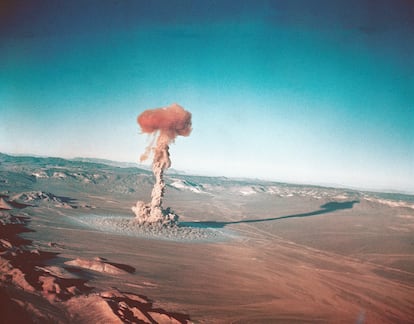
Madrid – NOV 10, 2025
A few minutes before meeting with Xi Jinping in Busan, U.S. President Donald Trump stated that he had ordered the United States Department of Defense to “immediately” resume nuclear weapons tests. The announcement sparked a mixture of alarm and confusion among the negotiating team that had traveled with the Chinese leader to the South Korean city, as well as in Beijing, Moscow, and even Washington.
The U.S. president hinted that the world’s leading power might once again detonate atomic bombs — a practice only North Korea has carried out this century — just hours after Russian President Vladimir Putin boasted of successfully testing a nuclear-powered underwater drone capable of devastating entire cities. All of this comes just months before the last treaty limiting U.S. and Russian nuclear arsenals expires, marking the potential end of the nuclear control era established during the Cold War.
Trump’s post on October 30 on Truth Social — the social network he owns — while en route to his meeting with Xi was ambiguous and contained numerous falsehoods. “We have more nuclear weapons than anybody,” the message began, even though Russia possesses more that the United States. Trump also falsely claimed China “will be even within five years.” The Republican argued that during his first term there had been “a complete update and renovation” of U.S. atomic bombs, although in reality the Pentagon is about to launch the first major modernization of its nuclear arsenal since the Cold War — a project originating under the Obama administration, with a planned investment of $1 trillion over the next decade (roughly Switzerland’s GDP).
Above all, Trump’s post from Busan raised many questions about whether the president was referring to resuming nuclear tests, which have been under a de facto moratorium for more than 30 years, or testing strategic nuclear weapons delivery systems.
Trump was less ambiguous a couple of days later, when asked in a televised interview whether he had ordered nuclear tests in the strict sense — that is, whether the United States would detonate atomic bombs for the first time since 1992. “I’m saying that we’re going to test nuclear weapons like other countries do, yes,” he told CBS from his golf club in Florida, before boasting that the U.S. arsenal could “blow up the world 150 times.” “You have to see how they work,” the president said, adding that Russia, China, Pakistan, and North Korea conduct secret nuclear tests — “they don’t talk about it […] they don’t have reporters that going to be writing about it,” he argued. “We’re the only country that doesn’t test,” Trump concluded.
Beijing, Moscow, and Islamabad quickly responded to Trump’s accusations, asserting that they comply with the informal moratorium prohibiting nuclear tests since the late 1990s. That same day, U.S. Energy Secretary Chris Wright tried to calm concerns, stating: “The tests we’re talking about right now are […] not nuclear explosions.” “You’re testing all the other parts of a nucelar weapon to make sure they deliver the apporopriate geometry and set up a nuclear explosion,” Wright told Fox News.
Daniel Salisbury, a researcher at the International Institute for Strategic Studies, considers it “unlikely” that Washington will resume underground nuclear tests. “In theory, the U.S. retains the capability to perform a nuclear test within 36 months. However, the reopening of the Nevada National Security Site [where nearly a thousand nuclear tests were conducted in the last century] would be a remarkably controversial, expensive and lengthy proces,” he argued in an article.
Trump’s incendiary announcement from Busan, more than a message to China — which it was — seemed to respond to veiled threats against the U.S. made by Putin just hours earlier. During a visit to a military hospital in Moscow, the Russian president said he had just conducted a test of “super weapon”: the Poseidon torpedo, a nuclear-powered underwater drone designed to travel thousands of miles and create a radioactive tsunami capable of destroying coastal cities. The power of its nuclear warhead is “significantly higher than that of our most advanced Sarmat intercontinental ballistic missile,” said Putin, surrounded by soldiers wounded in Ukraine. “There is nothing like this unmanned vehicle anywhere in the world,” he added. “And there is no way to intercept it.”
A few days before boasting about the supposed successful Poseidon test, the Russian leader informed senior military commanders, during a televised meeting, that they had completed “a final successful test” of the Burevestnik: a nuclear-powered cruise missile capable of carrying atomic warheads and, according to Putin, “with unlimited range.” Both Poseidon and Burevestnik are strategic weapons of mass destruction, designed to strengthen Russia’s deterrence capability and intended only for use in the event of a nuclear attack.
It is not unusual for the Russian military to test its most advanced weapons, nor the Kremlin to showcase them. In 2018, during his state-of-the-nation speech, Putin boasted of “six super weapons” in development, including the Poseidon torpedo and Burevestnik — a missile “with a practically unlimited range, unpredictable flight path […] [that] is invulnerable to all existing and future anti‑missile and air‑defence weapons,” he noted at the time.
Even more significant is the timing of the Russian president’s announcement of the successful Poseidon and Burevestnik tests. After months of frantic diplomatic activity, during which Trump seemed confident he could bring Putin and his Ukrainian counterpart Volodymyr Zelenskiy to the same negotiating table, the U.S. president’s efforts to end the war between the two former Soviet republics appear to have cooled. A few days before Putin praised the capabilities of Poseidon and Burevestnik, the White House canceled a planned meeting between Trump and Putin in Budapest and imposed sanctions on Lukoil and Rosneft, two giants of the Russian oil industry.
Nuclear blackmail as a pressure tactic
With the large‑scale invasion of Ukraine launched by Russian troops in February 2022, tanks and trenches returned to the Old Continent — and so did nuclear blackmail to intimidate Kyiv’s allies. Most analysts agree that the Kremlin’s boasts about its atomic arsenal should be interpreted less as direct threats and more as a diplomatic pressure tool; a way to remind the West — especially Washington — that if Russia felt cornered and unable to achieve its objectives in Ukraine, the risk of a nuclear apocalypse would increase.
Following Trump’s announcement in South Korea, the Kremlin reacted swiftly. “”We hope that, regarding the Burevestnik and Poseidon tests, the information was properly communicated to President Trump,” presidential spokesman Dmitry Peskov told the TASS news agency. “These tests cannot be regarded as nuclear ones in any way.” After Trump claimed in his CBS interview that Russia was conducting secret nuclear tests, Putin flatly denied the accusation but warned that Russia would resume testing weapons of mass destruction if Washington made the first move.
The growing use of nuclear rhetoric comes less than four months before the New Strategic Arms Reduction Treaty (New START) — the last bilateral agreement in force limiting the atomic arsenals of Russia and the United States — expires. Other pillars of this arms‑control framework — such as the Intermediate‑Range Nuclear Forces Treaty, signed by Ronald Reagan and Mikhail Gorbachev in 1987, or the Anti‑Ballistic Missile Treaty, agreed between Richard Nixon and Leonid Brezhnev in 1972 — have long since collapsed.
Negotiating with China
With the end of the security framework established by Washington and Moscow more than 50 years ago looming, Trump insists that any future arms-control agreement must include China. Beijing shows no interest in such talks, arguing that its atomic arsenal is very limited compared to that of the United States. In July 2024 — after the sale of several U.S. air-defense systems to Taiwan — the Xi government suspended all arms-control talks with Washington.
Around 90% of the 12,240 nuclear bombs estimated by the Federation of American Scientists to exist in the world are stockpiled in Moscow and Washington. The other seven nuclear powers (China, France, the United Kingdom, Israel, India, Pakistan, and North Korea) have just over a thousand combined. The Pentagon estimates that China currently possesses 600 nuclear warheads and projects it will have over 1,000 by 2030.
When New START — signed by Barack Obama and then-Russian President Dmitry Medvedev in Prague in 2010 — expires in February, it will usher in a period of uncertainty. “The absence of agreed limits will increase distrust and raise the risk of misunderstandings and miscalculations,” argued Georgia Cole, a researcher at the British think tank Chatham House. “Unfortunately, given the current geopolitical tensions, it is very unlikely that a new nuclear control treaty will be signed in the near future.”
It is precisely Medvedev, the current Vice Chairman of Russia’s Security Council, who has most frequently resorted to nuclear blackmail since the start of the invasion of Ukraine. In September, the former Russian president warned European leaders “simply cannot afford a war with Russia.” In a post on Telegram, he srgued that such a conflict could escalate into “a war using weapons of mass destruction.” Medvedev added that the end of the nuclear-control era marks the beginning of “a new reality all our opponents will have to reckon with.”
A few weeks ago, while Washington debated the possibility of sending long-range Tomahawk missiles to Ukraine — which would allow Kyiv to strike targets in Moscow and St. Petersburg — Medvedev directly threatened the U.S. president: “The supply of these missiles could end badly for everyone. First and foremost for Trump.”
The risks of a new nuclear arms race are not limited to the arsenals of Russia, the United States, and China. “The relationship between India and Pakistan remains very tense and volatile, and North Korea continues to advance in developing atomic weapons,” said Cole. She notes that “even though the United States and Israel claimed that the [June] bombings of Iranian nuclear facilities were highly effective,” it appears that the Islamic Republic “still retains some of its capabilities.”
Adding fuel to the controversy in Washington over atomic weapons, Kathryn Bigelow’s drama A House of Dynamitepremiered a few weeks ago, playing with the idea of an imminent nuclear attack on the United States. Reflecting the Pentagon’s concern, an internal Missile Defense Agency document obtained by Bloomberg argued that the catastrophic scenario portrayed in the film is “inaccurate” and that the movie “underestimates the power of the United States.” Noah Oppenheim, the screenwriter of A House of Dynamite, told CNN that his intention was precisely “to invite a conversation about an issue which we think is tremendously important and doesn’t get enough attention, which is the fact that we have all these nuclear weapons that exist in the world and that pose a great threat to all mankind.”
Sign up for our weekly newsletter to get more English-language news coverage from EL PAÍS USA Edition