“How Cesar Chavez is being scrubbed from public spaces after abuse allegations”, PBS NewsHour
By — Joshua Barajas
Joshua Barajas is a senior editor for the PBS NewsHour’s Communities Initiative. He’s also the senior editor and manager of newsletters.
Mar 23, 2026
The bronze statue had looked out over the California State University San Marcos campus for nearly 30 years.
Students and faculty had fought to pay tribute to Cesar Chavez with a memorial after his death in 1993. Back then, a bench or fountain felt too small for the civil rights leader whose farmworker union, co-founded with fellow activist Dolores Huerta, improved the pay and working conditions for many Latinos, especially in central and southern California.
It took years to establish a plaza with a statue at Cal State San Marcos in his honor. It took only a matter of days to cover and remove the statue, once sex abuse allegations against Chavez emerged last week, first reported by The New York Times.
Cynthia Chavez Metoyer, who helped lead the effort for the school’s Chavez Plaza, said the moment was “weird and right.”
As a public institution, Cal State San Marcos values “ensuring that our students feel welcomed and safe,” the political science professor said. “Our symbols should align with our values. And sadly, the symbol of the Chavez statue, and all of the shame that comes with it now, the reality is it no longer aligns with our values.”
A paragon of pride for many Mexican Americans, Chavez inspired heroic iconography across the country over the last few decades. Street signs, parks, schools and other buildings were christened with his name. His birthday, March 31, became a state and federal commemorative holiday.
Now, the swift undoing of those public declarations leaves communities asking what’s next.
Here’s a look at some of the changes already taking place.
Chavez statues covered and removed
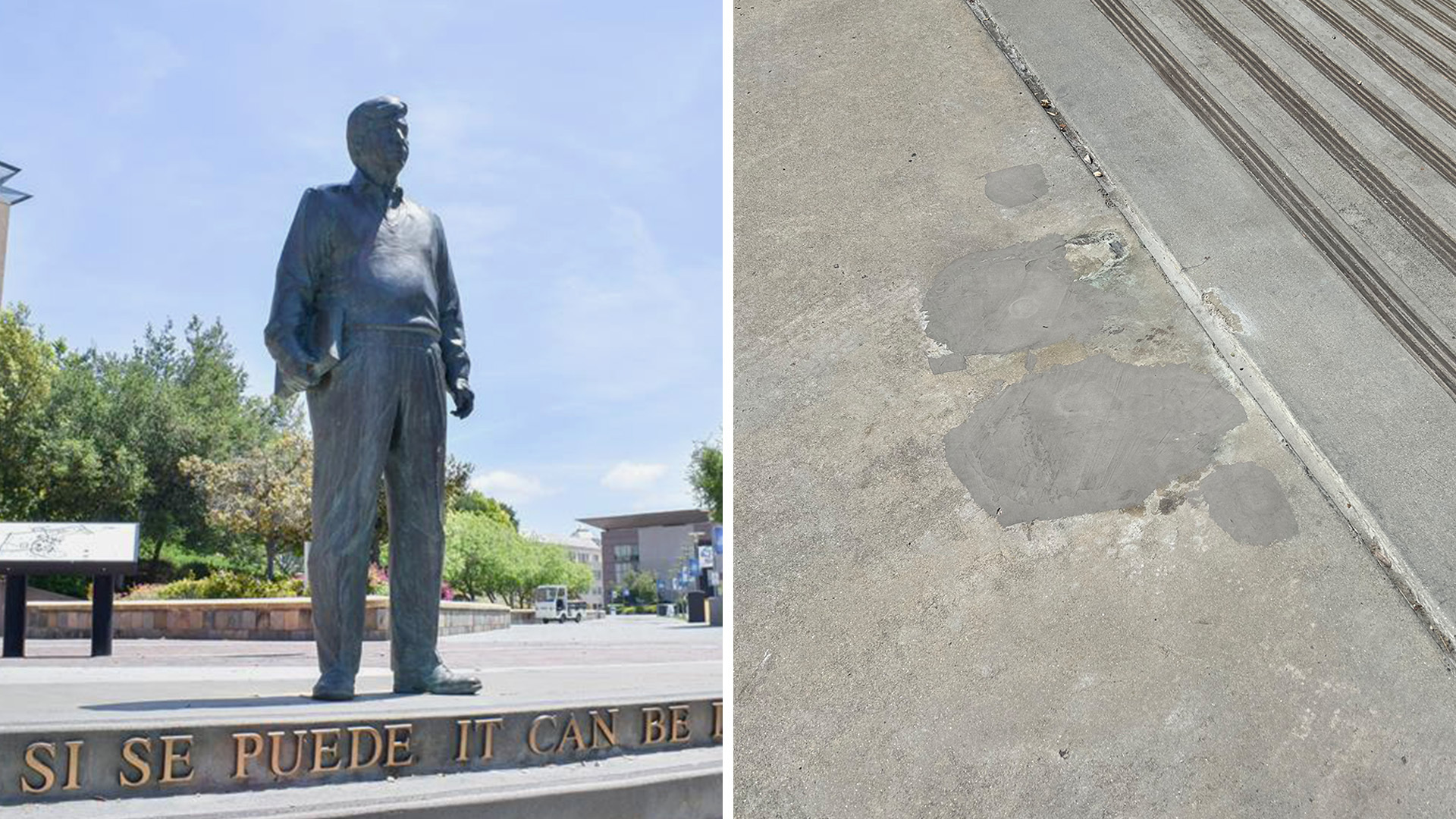
An undated photo of the Chavez statue (left) before it was removed overnight last week (right). Photos courtesy of CSUSM and Chavez Metoyer
At the top of a series of cascading steps, the Chavez statue at Cal State San Marcos greeted students every day. At the artwork’s feet were the words, “SI SE PUEDE.”
That rallying cry was long associated with United Farm Workers, the largest farmworker union in the U.S. It was coined by Huerta, who told the Times she stayed silent for decades after Chavez raped her in the 1960s for fear that any negative attention would hurt the larger movement.
The 95-year-old civil rights leader came forward after learning the stories of the two other women named in the bombshell investigation, a spokesperson for Huerta told Los Angeles Times.The investigation found credible evidence that Chavez sexually abused Ana Murguia and Debra Rojas, two underage girls and daughters of UFW organizers, in the 1970s.
How about we sit in the emptiness for a while?
After the news came out, Cal State San Marcos president Ellen Neufeldt said in a statement the university will hold a campus group to discuss “what could come next for this space.” Until then, there’s an empty spot atop the steps.
Chavez Metoyer said this is a moment to pause.
“There’s this human tendency to rush in with some sort of decision or replacement,” she said. “How about we sit in the emptiness for a while, and really reflect on what does that mean?”
Among the many public references to Chavez, statues and busts were some of the quickest to be dismantled.
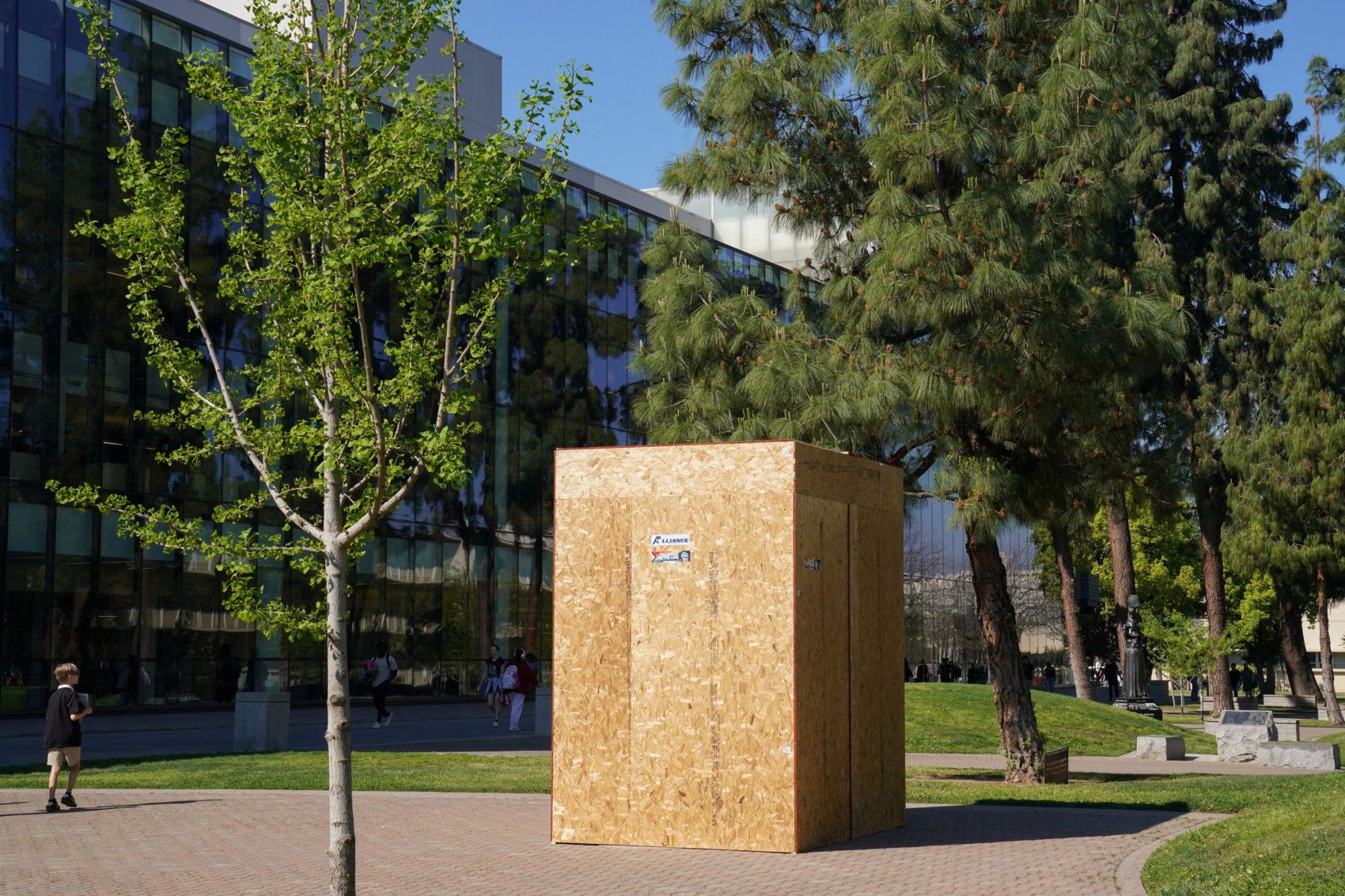
A statue of Chavez on Fresno State University’s campus is covered in a plywood box. Photo by Tracy Barbutes/Reuters
The Chavez statue on Fresno State’s campus was covered in black tarp and plastic before it was hidden inside a plywood box. It was later removed, leaving behind a small crater on campus.
When a bust of the labor leader — located in a Denver park named after him — was boxed up, hand-written signs that read “Dolores Huerta Park” were placed onto the temporary covering.
San Fernando’s city council voted Thursday to unbolt its statuefrom its pedestal in Cesar E. Chavez Memorial Park. Mayor Joel Fajardo said the urgency behind the decision was to “let our children know that we took this seriously, to make sure that we have a society that values the victims, that trusts the survivors.”
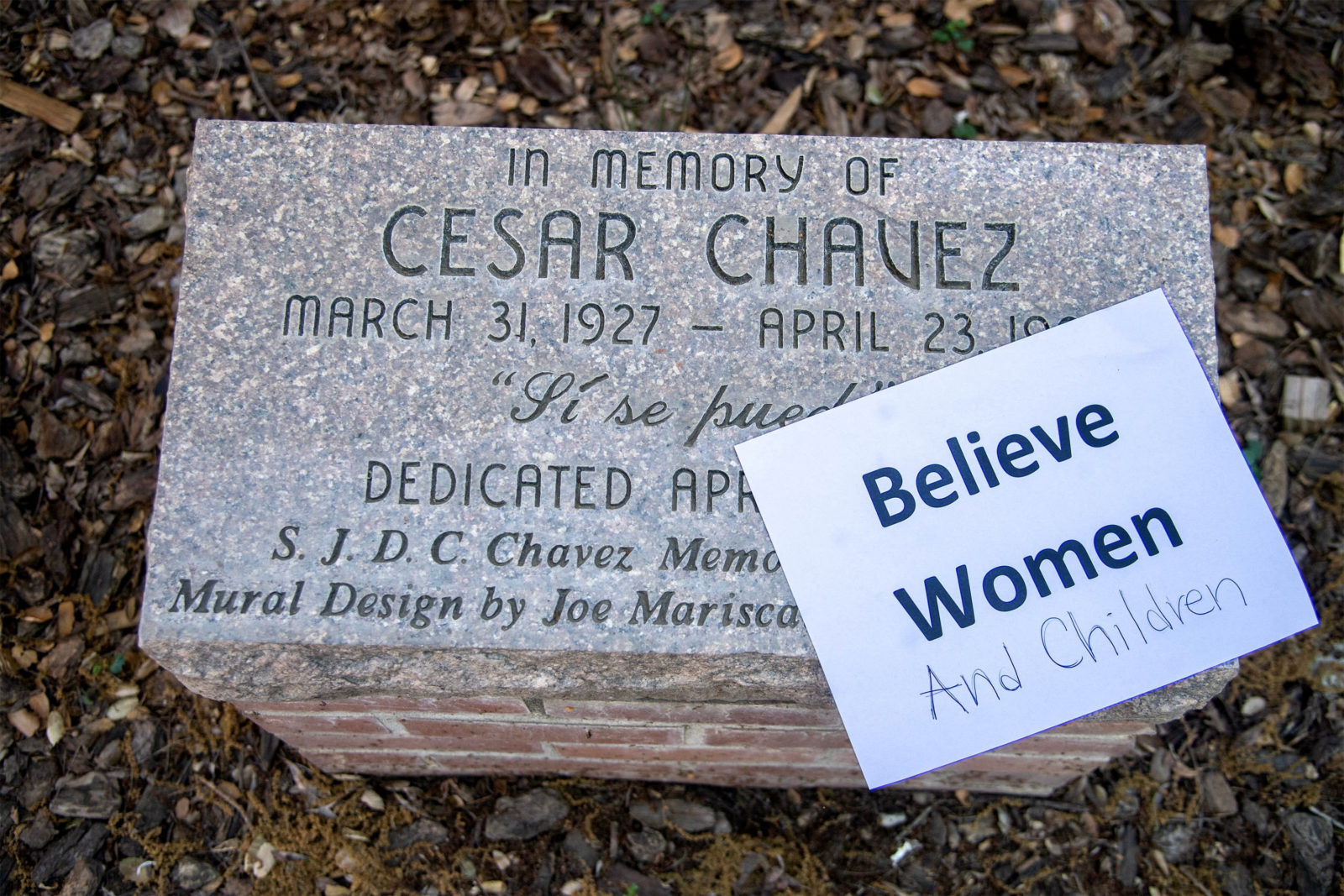
A plaque sits at the base of a relief mural featuring Chavez, on the eastern exterior wall of the Goleman Library on the Delta College Campus in Stockton, California. Photo by Clifford Oto/The Stockton Record/USA Today Network
In Stockton, California, where lawmakers are weighing a host of changes, a sheet of paper was attached to a plaque below a metal relief mural that features Chavez on Delta College Campus. It read, “Believe Women,” with “And Children” written in by hand.
Chavez disappears from murals
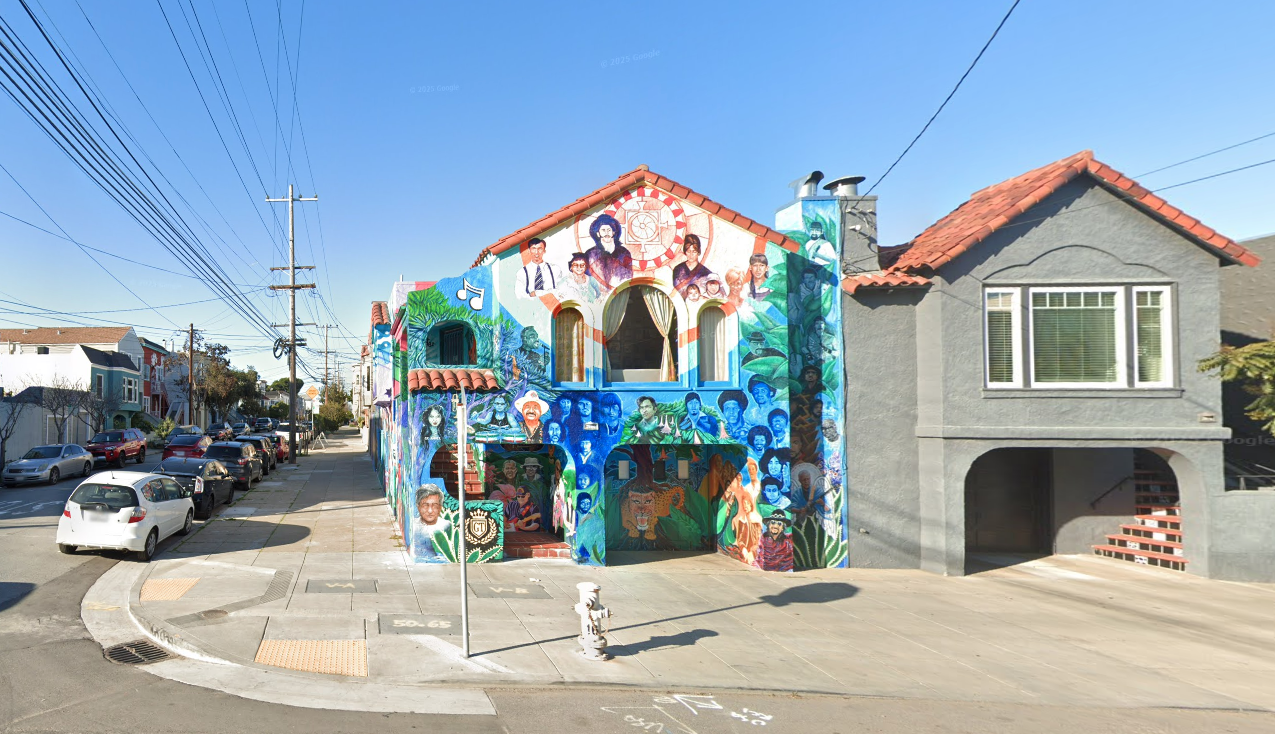
A Google Street View of the famed Latin Rock Music House in San Francisco’s Mission District. The exterior of the building is a tribute to Latin rock pioneers and other icons. Cesar Chavez’s face can be seen in the lower-left corner. Screenshot image via Google
Artists have slathered white paint over Chavez’s face and name in murals in multiple cities.
Misteralek repainted his 2021 mural that featured Chavez alongside Dr. Martin Luther King Jr. in Los Angeles’ Watts neighborhood. The artist replaced Chavez’s face with Huerta holding up a megaphone.
Chavez will no longer be one of the 80-plus faces on the exterior of San Francisco’s Latin Rock Music House — a who’s who of Latin icons. In the tableau of pioneers, no one person is the focal point of the artwork. Richard Segovia, the building’s owner, said on social media that the famed mural was getting a facelift over the weekend.
Changes to street signs will take more time
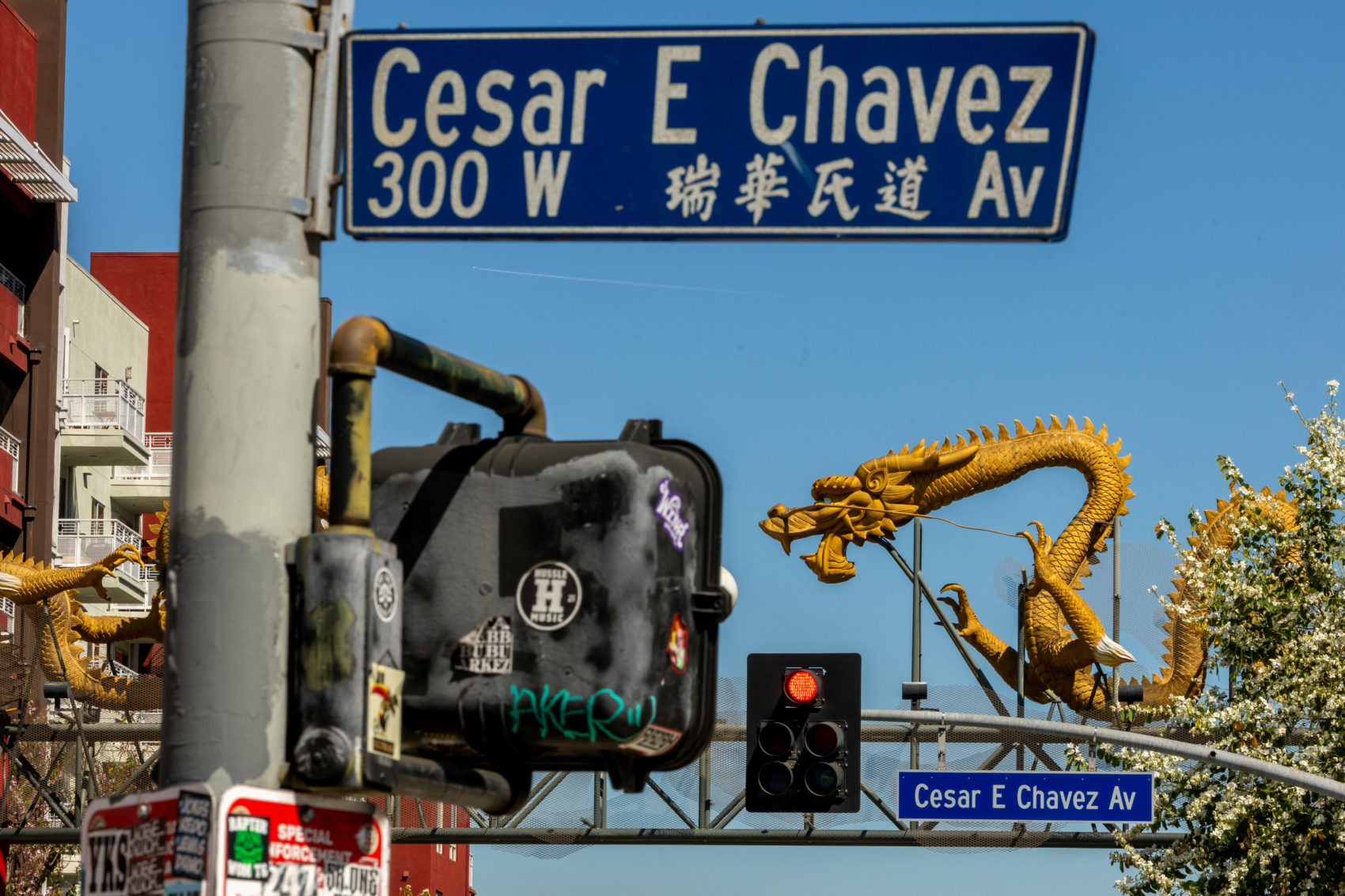
A street sign named after Cesar Chavez is shown along a major roadway in downtown Los Angeles. Photo by Mike Blake/Reuters
Changes to street signs require more time and community input.
Fresno, a central hub for the farmworker movement, voted unanimously to begin the process to take back its move to dub a road after Chavez shortly after last week’s revelations. The city voted to name the street after the labor leader in 2023.
California Rising, a grassroots activist group and nonprofit, called for renaming Cesar Chavez Avenue in Los Angeles to “Dolores Huerta Avenue.” The street name has had its own fraught history, with some Boyle Heights residents opposing renaming Brooklyn Avenue after Chavez, saying the name papered over the neighborhood’s history as a Jewish community.
Raul Claros, the group’s founder, said the proposed change isn’t trying to rewrite history.
“We’re trying to course correct the facts,” he said at a news conference Wednesday. “We are idolizing and championing someone that wasn’t all he was cut out to be.”
A de-emphasis from ‘one man’ to honoring the larger movement
Reacting to the allegations, many elected officials and labor leaders echoed one point: The movement was “bigger than one man.”
California lawmakers said Thursday they will introduce a bill to change Cesar Chavez Day, a state holiday observed since 2000, to “Farmworkers Day.”
The Chicano/a studies department at the University of California, Los Angeles, voted unanimously to remove Chavez from its name at an emergency meeting Wednesday.
Veronica Terriquez, director of UCLA’s Chicano Studies Research Center, was one of those votes. She grew up appreciating UFW and its advocacy for farmworkers as a collective movement — not the toils of one person.
“We tend to simplify history.”
“Similar to the civil rights movement, we often highly regard the spokespeople, the people who are up in front of the microphone, and don’t often recognize the larger collective that makes movement possible,” she said.
And yet, Chavez’s name rose to national prominence as a kind of shorthand for what the farmworker movement accomplished.
Terriquez said it’s often easier to talk about the “one, brave, brilliant person who achieved a lot” than recognizing the complexities of a movement. We don’t hear enough about the people in the background, strategizing and making decisions, making sacrifices, making mistakes, she added.
“We tend to simplify history,” Terriquez said.
One path forward, she added, is for the public to understand why the farmworkers needed to organize a union all those years ago and what progress is still needed since labor conditions for farmworkers “remain unjust in many parts of the country.”
A free press is a cornerstone of a healthy democracy.
Support trusted journalism and civil dialogue.
Left: Workers remove a bust of United Farm Workers union co-founder Cesar Chavez in Denver, Colorado, after several women tied to the farmworker movement, including civil rights leader Dolores Huerta, accused Chavez of sexually assaulting them in the 1960s and ’70s. Photo by Cheney Orr/Reuters
Related
- California moves to rename César Chavez Day over sexual abuse allegationsBy Trân Nguyễn, Haven Daley, John Seewer, Associated Press
- Investigation uncovers sexual abuse allegations against Cesar ChavezBy William Brangham, Karina Cuevas, Azhar Merchant
- Labor rights leader Dolores Huerta says she was sexually abused by César ChavezBy Fernanda Figueroa, Associated Press