“A generation in crisis: Why young people are so unhappy”, EL PAÍS
OCT 12, 2025, Madrid
This stage of life, which should be full of opportunity, has become a period of uncertainty and struggle. Heightened mental health awareness, social media–driven anxiety, and poorer economic prospects than previous generations make it harder to plan a future. How can we turn things around?
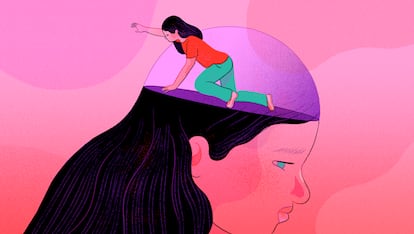
Young people are in a bad way; they feel very sad, completely depressed. The worst thing isn’t the anxiety, or being glued to their phones, or feeling lonely, or being unemployed, or even knowing that it’s impossible for them to buy a house; the worst part is that, until just a few years ago, none of them expected to find themselves in this situation.
In August, an article published in the U.S. scientific journal PLOS One reported that there is currently no age group more dissatisfied than young people. Until recently, the curve of happiness followed a clear pattern: it started high in childhood and youth, dipped in middle age, and rose again in old age. Young people, who used to be the second happiest group, are now the only ones whose happiness has dropped. The most affected are teenagers and young adults, between the ages of 12 and 24. The study is based on surveys of millions of people across more than 40 countries. And while it’s always wise to be cautious with survey-based conclusions, the trend is hard to dispute.
Are young people overly sensitive? The so-called “snowflake generation” goes to therapy more often than their parents or grandparents did and easily uses terms like OCD, ADHD, burnout, and imposter syndrome. Has this greater awareness of mental health affected their overall mood? “Not necessarily, but it’s clear that the idea of happiness isn’t the same for a 20-year-old as it is for their grandmother,” says Alejandro Cencerrado, a physicist, analyst at the Happiness Research Institute in Copenhagen, and author of En defensa de la infelicidad (In Defense of Unhappiness). “If someone born at the beginning of the 20th century had been asked at some point in their life if they had depression, they wouldn’t even have known how to answer. And they were living in very difficult situations.”
The world changes, and qualities once considered essential to being intelligent — like having an encyclopedic memory — are no longer the ones that help people navigate and overcome challenges today. Similarly, the factors that defined happiness 50 years ago, such as having a traditional family or a strong relationship with God, differ from those that shape well-being now. “It’s really hard to compare the responses of a kid who spends his day on TikTok with those of two people who lived through a war. Everyone values things differently.”
Happiness only began to be measured systematically in the 1970s. In 1972, Bhutan introduced the concept of Gross National Happiness, and soon after, surveys like the World Values Surveybegan asking about life satisfaction. The big leap came over the past two decades, with large-scale international surveys — evidence that we’ve never been so intent on quantifying our own well-being. “The paradox is that the more obsessed we become with measuring happiness, the more sensitive we are to mental health problems like depression,” says Cencerrado.
However, there are more objective indicators than self-reported happiness surveys. In the United States, the suicide rate among teenagers aged 12 to 17 rose by 70% between 2008 and 2020. The European Union has seen a similar increase, with Spain going from 1.99 to 2.94 deaths per 100,000 young people aged 15 to 19 between 2011 and 2022. Hospital admissions for mental health disorders among minors and the use of psychiatric medications have also risen. In the United Kingdom, for instance, antidepressant prescriptions for teenagers aged 12 to 17 doubled between 2005 and 2017 — amid growing concern among doctors about overmedication, not only among young people.
According to the PLOS One report, youth unhappiness began to rise sharply around 2012. What happened then that could have had a global impact that is still felt today?
The first hypothesis links this “quarter-life crisis” to the rise of social media and smartphones. Sociologist Jonathan Haidt, author of The Anxious Generation, explains via video call that there are now too many studies — of many different kinds — to deny a causal link between these technologies and the deterioration of young people’s mental health. “Social media is a substantial cause — not just a small correlation — of depression and anxiety, and therefore of the behaviors associated with those disorders, including self-harm and suicide.”
Haidt argues that the problem isn’t just the anxiety or isolation caused by platforms like Instagram or TikTok, but that these networks have completely reshaped how young people socialize. That’s why, he warns, if a teenager were to quit social media to protect their mental health, they might actually feel worse — because they’d be cut off from their peer group’s social life. Haidt calls this the “network and cohort effect”: an entire generation trapped in a system where everyone would be better off if they disconnected, but where anyone who does so by themselves ends up isolated.
Something as essential to well-being as sleep has also been disrupted by smartphones. In Spain, 83% of young adults aged 18 to 34 show symptoms of insomnia, and around 13% meet the criteria for a chronic disorder. Only one in four say they sleep well and enough, according to the 2024 report Habits and Prevalence of Sleep Disorders in Spain. Sleep problems have worsened over the past two decades — 20 years ago, chronic insomnia affected only half as many people. Those under 35 have suffered the greatest decline.
Sleep expert Dr. Javier Albares, author of Generación Zombi (Zombie Generation), warns that the overuse of phones and tablets is shaping a “generation trapped in a spiral of overstimulation, addiction, and chronic sleep deprivation.” Screens, he explains, not only steal hours of rest but also fragment it: “They increase the number of awakenings during the night, and as a result, both the quality and quantity of rest decline.” He notes that half of teenagers reply to messages during the night, and a similar percentage check their phones at least once in the middle of the night. “This lack of sleep translates into fatigue, poorer academic performance, irritability, and greater risk of anxiety or depression.”
Haidt acknowledges that such a global trend stems from multiple factors. Another, he argues, is the “overprotection of children in the real world.” In recent decades, children have lost the freedom to play outside unsupervised, in mixed groups, with a healthy degree of risk —something once common and crucial to developing resilience, autonomy, and the ability to handle uncertainty. He sums it up neatly: today there is overprotection in the real world and underprotection in the virtual one. “Children’s freedom outside the home is increasingly restricted, while they’re left completely exposed online and on social media,” he warns.
The findings on declining happiness don’t surprise philosopher and literature professor Jesús G. Maestro, whose YouTube channel enjoys huge popularity among young viewers. He sees it every time he walks into a classroom. But he rejects the idea that millennials are an overprotected generation: “That’s false — they’re the most unprotected generation in decades,” he says over the phone. “You can’t call a generation ‘protected’ when it’s been deprived of essential knowledge for facing life and left unshielded on the internet and social media, where the psychological pressure is enormous — and many simply can’t withstand it.”
For Maestro, the author of Una filosofía para sobrevivir en el siglo XXI (A Philosophy for Surviving the 21st Century), the malaise among young people has a very specific cause: their parents’ idealism. “It’s a generation that was promised everything and has found nothing.”
According to Maestro,the boomers raised their children to face a world that no longer exists. “Education should be geared toward making human beings compatible with reality. And reality is that of a predatory world governed by market logic.”
Maestro criticizes the harshness with which this generation is often judged: “Millennials are spoken of very badly without knowing what they’re talking about. They are portrayed as lazy, stupid, or useless. The worst has been heaped on them. And you can’t help a person if you’ve misunderstood them.”
As Maestro points out, many young people grew up with the promise that adulthood would bring a better world than that of their parents, full of opportunities for personal fulfillment and happiness. Yet the reality facing today’s high school and university graduates is bleak. Young people’s economic situation is far worse than that of the previous generation.
According to Spain’s National Statistics Institute (INE), in 2004, those of retirement age were the group at highest risk of poverty (30%); last year, that figure had fallen to 16.8%, while poverty is hitting young people (21%) and children (29%) hardest. At the same time, the average wealth of a young family was cut in half between 2002 and 2022. Youth unemployment, while at its lowest level since 2008, still hovers around 25%.
“There’s a sense of discouragement,” says sociologist Patricia Castro, author of Tu precariedad y cada día la de más gente (Your Precarity and That of Increasingly More People). “Our parents’ generation, even if they came from poverty, had the perception of life moving forward — that if you studied, your life could improve and you could land a better job. To a large extent, that hope has been lost.”
Spain is actually one of the countries where the social mobility is the worst: more than 35% of income inequality is determined by background factors — mainly parents’ socioeconomic level — one of the highest figures in the OECD. This situation has sparked a recent debate between boomers and young people, with the latter arguing that they are living worse than their parents did.
Castro argues that new generations suffer from a “light nihilism,” having lost faith in the possibility of fighting for a world with better conditions. “Moreover, society makes them feel that the responsibility for their precarious situation lies with them. It’s a kind of inward self-destruction: you blame yourself for your situation.”
She adds that young people live in an increasingly atomized world, where the sense of community has been lost. “They don’t feel they can achieve anything together,” she says. Castro agrees with Maestro that the previous generation has judged young people too harshly: their addiction to new technologies, their difficulty making a living, even the recent rise of conservatism. “People who haven’t even had the opportunity to screw up have been blamed.”
Experts propose various solutions to reverse youth unhappiness and make adolescence one of life’s most fulfilling stages again. One of the most frequently mentioned is ensuring access to mental health treatment. According to the White Paper on Psychiatry in Spain, published by the Spanish Society of Psychiatry and Mental Health (SEPSM), there are only 10 professionals for every 100,000 children under 14 — a figure significantly below the rates seen in other countries.
Jonathan Haidt suggests delaying access to social media until age 14 and warns that the rise of artificial intelligence could prove even more harmful to young people than social networks themselves. And, though obvious, improving economic conditions — especially in work and housing — would certainly help.
For Patricia Castro, the key is strengthening social bonds: “Not all of us are going to have the job of our dreams or live in the city center, but there is no shortage of people in the world.”
Jesús G. Maestro, true to his vocation as a literature professor, proposes a very concrete remedy: “Read Don Quixote. If anything, it teaches that idealism leads to failure.” And he warns: “If you don’t take care of young people, you ruin the future of society.”
Sign up for our weekly newsletter to get more English-language news coverage from EL PAÍS USA Edition