Issue of the Week: Human Rights, War, Economic Opportunity
Published April 12, 2026

A firework being ignited during celebrations in Budapest on Sunday. Credit…Lisi Niesner/Reuters
Today, Easter Sunday in the Orthodox churches, the resurrection of a dead democracy occured in Hungary.
The defeat in the election for Prime Minister of Victor Orban, in power for 16 years, the international hero of anti-democratic forces, has been more like the democratic revolutions that occurred in Eastern Europe against the Soviet Union than an election.
Because the forces stacked against the opposition leader, Peter Magyar, would have seemed impossible to overcome. His overwhelming victory has launched a powerful pivot from populist authoritarianism to liberal democracy in this global struggle.
Orban’s supporters ranged from Trump to Putin, the latter whom Anne Applebaum reports was even more controlled by him than already known. He was anathema to the principles of liberal democracy in the EU and was wreacking havoc with the EU support for Ukraine.
Now, finally, Ukraine should get the support approved for it that Orban had blocked.
And Hungary will get much needed support from the EU.
Re-integration with the rest of Europe will begin, and the global ripples may become more like a tidal wave.
Trump and JD Vance, who was in Hungary days ago campaigning for Orban, have been rejected by the Hungarian people, especially the new generation, as anti-liberal democracy invaders, interjecting themselves into a foreign election uninvited by the voters of a sovereign nation.
Liberal democracy is on the march again.
There is much to comment on, but for now, one point, to the great credit of Peter Magyar. He was an ally of Orban until a secret pardon by Orban allies came to light of a sexual abuser of children. Magyar rejected association with Orban over this. Then increasingly concerned about corruption, anti EU policy and pro-Putin actions by Orban, he formed his own party.
Good for him.
The results are in.
It’s a new day.
Following are the front page articles today from The New York Times and The Atlantic:
Orban, Beacon to the Right, Concedes Defeat in Hungary’s Election
Prime Minister Viktor Orban, who has inspired populist movements globally, could not overcome the growing dissatisfaction of his own citizens.
By Andrew Higgins and Lili Rutai
Reporting from Budapest
April 12, 2026
Prime Minister Viktor Orban of Hungary, a lodestar for MAGA culture warriors and right-wing populists in Europe, conceded defeat on Sunday in a general election, breaking the momentum of a global nationalist revival promoted by President Trump.
In a surprisingly early and gracious concession speech in Budapest, Mr. Orban congratulated the opposition saying, “The responsibility and opportunity to govern were not given to us.” But, he also made a vow: “We are not giving up. Never, never, never.”
His defeat paves the way for Peter Magyar, a former Orban loyalist and the leader of the main opposition party, to take over as Hungary’s prime minister once the newly elected Parliament meets.
“We have done it,” Mr. Magyar told a cheering crowd gathered with flags on the bank of the River Danube. “We have liberated Hungary and have taken back our country.”
Sunday’s vote was widely seen as showdown between friends and foes of liberal democracy, a cause that Mr. Orban has battled against for years to applause from his fans in the United States, Europe and Latin America. The race was closely watched by the Trump administration and the Kremlin, both of which wanted Mr. Orban to win and both of which offered support in his campaign.
The implications of the outcome extend far beyond Hungary’s borders. The next prime minister may help alter the course of the war in Ukraine, a neighbor that Mr. Orban has cast as an enemy of Hungary, and affect European security. And the results will be looked at by populists around the world who view the Hungarian leader as a model of success and of pugnacious defiance of the mainstream.
After the results, large crowds of mostly young people thronged the banks of the River Danube in front of the Parliament Building, cheering and waving Hungarian flags. Many were stunned by the speed and scale of the defeat of Mr. Orban, whose party won the four previous elections easily.
With 66 percent of votes counted, Mr. Magyar’s opposition party was on course to win 137 seats — more than a two-thirds majority. Mr. Orban’s party, Fidesz, was expected to win just 55.
Shortly before polls closed, the electoral authorities said that more than 77 percent of registered voters had cast ballots, the highest turnout in a Hungarian election since the collapse of Communism in 1989 and the start of democracy.
“Thank You Hungary!” Mr. Magyar said in a brief message on Facebook, reporting that Mr. Orban had called to congratulate him.
Want to stay updated on what’s happening in Hungary? Sign up for Your Places: Global Update
, and we’ll send our latest coverage to your inbox.
During his 16 years in power, Mr. Orban remade Hungary in his own image, eliminating many checks and balances by stacking the judicial system and nominally independent agencies with Fidesz loyalists, and taking control of most news media outlets. He also worked to export his model of “illiberal democracy,” promoting himself as an invincible guru for followers across Europe and elsewhere.
Sunday’s election results are likely to disappoint Mr. Trump, who sent Vice President JD Vance to Budapest, the Hungarian capital, last week to rally support for Mr. Orban in the final stretch of the campaign.

“I love Viktor,” said Mr. Trump, speaking by telephone from Washington to a gathering of Fidesz supporters in Budapest on Tuesday.
But Mr. Orban’s defeat will delight liberals and the European Union, which had increasingly come to view him as a disruptive menace. Before the results were known, Mr. Magyar noted that Election Day was the anniversary of a 2003 vote in favor of joining the European Union, a signal that he may move to end the Orban government’s antagonism toward the bloc.
Long a thorn in the side of E.U. officials in Brussels, Mr. Orban has consistently blocked European assistance to Ukraine, worked to water down sanctions on Russia and presented Ukraine, not Russia, as the principal threat to Europe’s security.
Those positions made him an invaluable ally for the Russian president, Vladimir V. Putin. Mr. Putin, hoping to help Mr. Orban’s chances in the election, assured him last month that Hungary could rely on steady deliveries of Russian oil and gas despite disruptions to global energy supplies caused by the war in Iran.
Despite his country’s small size and population of fewer than 10 million people, Mr. Orban, 62, has played an outsize role on the world stage, inspiring and, in some cases, funding like-minded political forces abroad. He became the standard-bearer for right-wing politicians committed to “family values” and “Western civilization” against what he has denounced as degenerate, multicultural liberals.
While sharing some of Mr. Orban’s views on the importance of national sovereignty and the dangers of “woke ideology,” the opposition leader, Mr. Magyar, a lawmaker in the European Parliament and divorced father of three, won votes for Tisza by promising drastic change, though he was often vague on the specifics.
On one issue he has been unequivocal. Mr. Magyar, 45, promised voters a clean break with the endemic corruption that has enriched the prime minister’s family and friends and helped saddle Hungary with the slowest-growing economy in the region. Hungary, according to an annual ranking by Transparency International, is the most corrupt country in the European Union.

Eager to reach beyond Budapest liberals, who have loathed Mr. Orban for years, Mr. Magyar stayed far away from issues dear to progressives like L.G.B.T. rights. He campaigned mainly on his biggest asset: he is not Viktor Orban. The prospect of change, no matter in what direction, underpinned much of his support.
“I want a change, I think we deserve a change,” said Eva Kepesne Fekete, 51, who works at a McDonald’s restaurant in Budapest. On her way to a polling station, she said she was tilting toward Tisza but was worried by reports in the media about a coming war if Mr. Orban lost.
Fears of war, stoked relentlessly by television and other new media outlets controlled by Fidesz, loomed large for those who said they had voted for Mr. Orban’s party.
“Magyar would drag Hungary into war,” said a Roma woman who would give only her first name, Eniko, 67. “I have two sons, and I don’t want them to become soldiers.”
Mr. Orban grew increasingly strident during the campaign in his attacks on Ukraine’s president, Volodymyr Zelensky. Mr. Magyar tried to tap into nationalist sentiment by recalling Hungary’s bitter history of bullying by Russia, which helped crush a liberal revolution in 1848 and an anti-Communist uprising in 1956.
Kremlin propaganda amplified and in some cases inspired Fidesz campaign talking points, particularly the message that Mr. Zelensky posed a serious threat to Hungary, and that a loss for Mr. Orban in the election would bring conflict and sharply higher energy prices for Hungarian households.
The outcome this weekend vindicated the credibility of pollsters, most of which had given Tisza a wide lead over Fidesz and predicted a crushing defeat for the governing party.

The election also delivered a major blow to Europe’s longest-serving government leader, and to those who look to him for inspiration and funding.
Despite pressure from the European Union, whose rules he has persistently defied, Mr. Orban has been dogged in pursuing the goal he set in 2014 of “constructing in Hungary an illiberal state, a non-liberal state.”
Since then, Hungary has slid steadily down global rankings for personal and economic liberty, corruption and press freedom, becoming the first member of the European Union to drop from “free” to “partly free” in a 2019 ranking compiled by Freedom House.
Hungary, under Fidesz, established a host of research centers and other bodies offering well-paid work to American and other foreign conservatives who say they have been discriminated against in their home countries because of their views. It also hosted an annual conference in Budapest of the U.S. Conservative Political Action Committee, a fiesta of “anti-woke” speeches by right-wing politicians and pundits from around the world.
Mr. Magyar, speaking in Budapest soon after polls closed, declared himself “cautiously optimistic,” despite what he said had been “thousands of reports” of election tampering.
“Even in the smallest township,” he said, “people have seen that this cruel, inhumane power is finished and Hungary will once again become a free country.”
Andrew Higgins is the East and Central Europe bureau chief for The Times based in Warsaw.
A version of this article appears in print on April 13, 2026, Section A, Page 1 of the New York edition with the headline: Orban Concedes in Hungary, Slowing Global Tilt to the Right.
. . .
Who Is Peter Magyar, the Man Who Toppled Viktor Orban?
Mr. Magyar’s success in the Hungarian election is fueled in large part by widespread public anger at corruption and concern about sluggish economic growth.

April 12, 2026
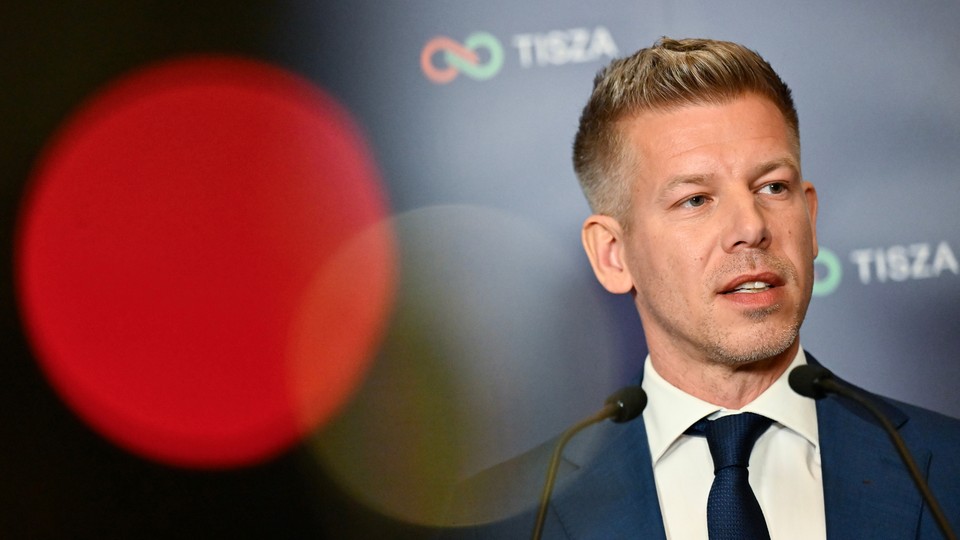
The party of Peter Magyar, 45, a conservative politician and a lawmaker in the European Parliament, delivered a stunning blow in Sunday’s election in Hungary, dethroning the longtime prime minister, Viktor Orban.
Mr. Magyar, who studied law, was a little-known member of Mr. Orban’s Fidesz party for more than two decades, serving as a diplomat in Brussels and holding senior positions in state agencies. He was married to Judit Varga, a leading Fidesz figure, until 2023.
Mr. Magyar rose to prominence in 2024 after he broke with Mr. Orban over a political scandal set off by revelations that a man convicted of covering up sexual abuse at a children’s home had been pardoned. That year, Mr. Magyar created Tisza, an upstart political movement that went on to win 30 percent of the vote in Hungary during the European Parliament elections.
In the parliamentary election in Hungary on Sunday, with 66 percent of votes counted, the party was on course to win 137 seats, more than a two-thirds majority.
His campaign was fueled in large part by widespread public anger about corruption, particularly the misuse of billions of euros in E.U. funding, and concern about Hungary’s sluggish economic growth. He promised to improve relations with the European Union, which has held up development funds for Hungary amid assertions that Mr. Orban has undermined democratic institutions.
Mr. Magyar also focused on living standards and issues like Hungary’s dilapidated health care system. But he steered clear of issues like L.G.B.T.Q. rights and stayed silent on a ban on the Budapest Pride parade last year. And while he criticized Mr. Orban’s tilt toward Russia by emphasizing Moscow’s long history of bullying Hungary, he avoided talking about the war in Ukraine.
Mr. Magyar was not Mr. Orban’s first right-wing challenger.
In the 2022 general election, Mr. Orban’s fractious opponents rallied behind Peter Marki-Zay, a conservative, churchgoing, small-town mayor with seven children. The effort flopped, ending in a landslide victory for Fidesz after the governing party deployed its media machine to portray Mr. Marki-Zay as a warmonger intent on sending Hungarians to fight against Russia in Ukraine.
. . .
Illiberalism Is Not Inevitable
If Viktor Orbán can lose, then his Russian and American admirers can lose too. By Anne Applebaum
APRIL 12, 2026
In the end, the defeat of Viktor Orbán, Hungary’s autocratic prime minister, required not just an ordinary election campaign or new messaging but rather the construction of a broad, diverse, and patriotic grassroots social movement. And by building exactly that, Hungary’s opposition changed politics around the world.
Orbán’s loss brings to an end the assumption of inevitability that has pervaded the MAGA movement, as well as the belief—also present in Russian President Vladimir Putin’s rhetoric—that illiberal parties are somehow destined not just to win but to hold power forever, because they have the support of the “real” people. As it turns out, history doesn’t work like that. “Real” people grow tired of their rulers. Old ideas become stale. Younger people question orthodoxy. Illiberalism leads to corruption. And if Orbán can lose, then his Russian and American admirers can lose too.
Péter Magyar, the opposition leader and likely next Hungarian prime minister, has now won by a substantial margin, giving him and his party, Tisza, a constitutional majority. To do so, they had to overcome obstacles not usually present in European democracies. After 16 years of what Orbán himself described as an illiberal regime, the Hungarian leader’s political party, Fidesz, had come to control much of the judiciary, bureaucracy, and universities, as well as a group of oligarchic companies that in turn controlled a good chunk of the economy.
Orbán used his control of the state to build an extraordinary web of international illiberal and far-right supporters, and funding mechanisms to support some of them. In the last weeks of the campaign, these friends and beneficiaries rallied round. Orbán received visits or verbal support from Donald Trump, J. D. Vance, Benjamin Netanyahu, Marine Le Pen (the leader of the French far right), Alice Weidel (the leader of the German far right), and other illiberal leaders from Argentina, Poland, Slovakia, Brazil, and more. Both Hungarian and American news organizations reported that a Russian intelligence team had set up in Budapest to amplify Orbán’s social-media campaign, and perhaps to stage provocations.
By contrast, Magyar had very little access to Hungarian media, the overwhelming majority of which is owned either by the state or by Fidesz oligarchs. He and his party had limited access even to billboard space, both because they had less money than the ruling party and because many advertising spaces are controlled by the government. Tisza leaders and supporters faced personal obstacles as well. A year ago, I met a Tisza politician who told me that his wife had lost her job and his friends began to stay away after he announced his support for Magyar. Tisza’s database was at one point hacked and posted online, apparently to encourage harassment of party members. Even three weeks ago, many Tisza leaders in Budapest would speak only off the record.
Magyar and his team fought back on the ground. Knowing he could not win if he stuck to Budapest and other large cities, Magyar has been traveling the country since 2024, visiting small towns and villages, many more than once. In the last few days of the campaign, he was holding five or six election meetings every day. He avoided the themes that Orbán chose to promote—global politics, the war in Ukraine, the conspiracy that Ukraine was somehow colluding against or might even invade Hungary—and focused his campaign speeches and social media on the economy, health care, and schools. As a former member of Fidesz himself, he was able to speak with extra conviction about Fidesz’s corruption. He portrayed himself as a part of the European, democratic, law-abiding center-right. He waved a lot of Hungarian flags, as did his supporters.
Despite enormous restrictions and both financial and political pressure, the tiny number of journalists who were still able to report in Hungary also made a difference. In the past few weeks, the investigative journalist Szabolcs Panyi, along with his colleagues at the website Direkt26, one of the few independent outlets in the country, patiently debunked Orbán’s anti-Ukrainian propaganda, producing leaked transcripts and audio that revealed Orbán and his foreign minister colluding with Putin and the Russian foreign minister, Sergey Lavrov. These tapes exposed what Panyi described to me as the “big lie that Orbán was a sovereigntist prime minister.” Indeed: Orbán boasted and talked a big game about Hungarian traditions and Hungarian nationalism, but when he spoke on the phone with the Russian leader, he described himself as a mouse and Putin as a lion. For years Orbán has claimed to be fighting shadowy foreign forces—George Soros, the European Union, migrants—but in fact he was himself dependent on foreigners all along.
Those stories resonated, especially with younger Hungarians. At a rock concert in Heroes’ Square in central Budapest on Friday, tens of thousands of them started chanting “Russians, go home”—the same chant that their grandparents used when Soviet soldiers invaded their country in 1956.
Although results are not final, Tisza appears to have won more than two-thirds of the seats in Parliament. That would give Magyar a constitutional majority that should allow him to pick apart some of the damage that Orbán has done to the Hungarian constitution and to public life. In his victory speech, he called for the resignation of the president, the prosecutor general, the president of the constitutional court, and other institutions. He said he would rejoin the European legal system. In response, according to one witness, Hungarians at his rally chanted, “Europe, Europe, Europe.”
Nobody is pretending this will be easy. Fidesz still dominates many Hungarian institutions and businesses, and the party’s friends and supporters will do their best to undermine a Tisza government. Orbán also leaves behind a fiscal mess, which the analyst Dalibor Rohac suggests Orbán might be happy to abandon while plotting his comeback. “Letting the opposition deal with the economic fallout of the last 16 years might well facilitate Orbán’s return to power in the future,” Rohac wrote earlier this week. Some in the opposition are still expecting dirty tricks in the next days and weeks, before Orbán formally hands over power.
But whatever happens next, this election represents a real turning point. For most European governments, this result is a relief: We can’t know yet what kind of government Tisza will create, but it won’t be one that functions as Russia’s puppet in Europe, blocking EU funding for Ukraine or European sanctions on Russia. Nor will it be a regime that serves as a model for Americans or Europeans who want to capture their own states, or take apart their own checks and balances, or impose their own illiberal ideologies on people who don’t accept them.
Recent Posts
- Armenia’s pro-Europe party wins election and cements shift away from Russia
- “The Interview: Scott Pelley on the Bari Weiss Era and His Last Days at ‘60 Minutes’”, The New York Times
- “Child’s Play”, Harper’s Magazine
- “How social media platforms keep students hooked: Notifications during school hours and paid ‘teen ambassadors’”, El Pais
- “With Ukraine Stronger on the Battlefield, Zelensky Offers to Meet Putin”, The Wall Street Journal
Archives
- June 2026
- May 2026
- April 2026
- March 2026
- February 2026
- January 2026
- December 2025
- November 2025
- October 2025
- September 2025
- August 2025
- July 2025
- June 2025
- May 2025
- April 2025
- March 2025
- February 2025
- January 2025
- December 2024
- November 2024
- October 2024
- September 2024
- August 2024
- July 2024
- June 2024
- May 2024
- April 2024
- March 2024
- February 2024
- January 2024
- December 2023
- November 2023
- October 2023
- September 2023
- August 2023
- July 2023
- June 2023
- May 2023
- April 2023
- March 2023
- February 2023
- January 2023
- December 2022
- November 2022
- October 2022
- September 2022
- August 2022
- July 2022
- June 2022
- May 2022
- April 2022
- March 2022
- February 2022
- January 2022
- December 2021
- November 2021
- October 2021
- September 2021
- August 2021
- July 2021
- June 2021
- May 2021
- April 2021
- March 2021
- February 2021
- January 2021
- December 2020
- November 2020
- October 2020
- September 2020
- August 2020
- July 2020
- June 2020
- May 2020
- April 2020
- March 2020
- February 2020
- January 2020
- December 2019
- November 2019
- October 2019
- September 2019
- August 2019
- July 2019
- June 2019
- May 2019
- April 2019
- March 2019
- February 2019
- January 2019
- December 2018
- November 2018
- October 2018
- September 2018
- August 2018
- July 2018
- June 2018
- May 2018
- April 2018
- March 2018
- February 2018
- January 2018
- December 2017
- November 2017
- October 2017
- September 2017
- August 2017
- July 2017
- June 2017
- May 2017
- April 2017